Results by title
82 books match the query 'Arts and society' and 5 start with c
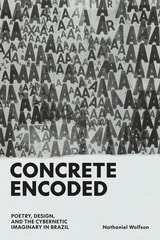
Concrete Encoded
Poetry, Design, and the Cybernetic Imaginary in BrazilNathaniel Wolfson
University of Texas Press, 2025
A study of concrete art and poetry, its implications, and influence in Brazil.
Concrete art and poetry burst onto Brazil’s cultural stage in the 1950s, while the country was embarking on a dizzying period of modernization. Bringing together key poets and visual artists alongside less recognized figures, Nathaniel Wolfson shows that concretism was hardly socially inert, as pundits have suggested. Rather, it presciently grappled with an emerging information age that would soon reorganize human relations globally.
Concrete Encoded describes a nascent cybernetic imaginary. Concretism has long been considered Brazil’s most global aesthetic movement. Wolfson traces new circles of international theorists and practitioners involved in critical technological thought. Wolfson argues that concrete poetry is the quintessential literary genre of the early information age. He shows that Brazilian poets, artists, and designers contested the military dictatorship’s technological authoritarianism and information-gathering operations. Vigorous experimentalists, their attention to form and semantics unveiled both the creative and nefarious possibilities of algorithmic writing. A highly original work, Concrete Encoded reckons with aesthetic responses from Brazil to an advancing capitalist and digital era.

Creating a World on Paper
Harry Fenn's Career in ArtSue Rainey
University of Massachusetts Press, 2013
Arriving in New York from London in 1857 as a young wood engraver, Fenn soon forged a career in illustration. His tiny black-and-white wood engravings for Whittier's Snow-Bound (1868) surprised critics with their power, and his bold, innovative compositions for Picturesque America (1872–74) were enormously popular and expanded the field for illustrators and publishers. In the 1880s and '90s, his illustrations appeared in many of the finest magazines and newspapers, depicting the places and events that interested the public—from post–Civil War national reconciliation to the World's Columbian Exposition in 1893 to the beginnings of imperialism in the Spanish-American War.
This handsomely designed volume documents Fenn's prolific career from the 1860s until his death in 1911. Sue Rainey also recounts his adventurous sketching trips in the western United States, Europe, and the Middle East, which enhanced his reputation for depicting far-flung places at a time when the nation was taking a more prominent role on the world stage.
Cultural Agency in the Americas
Doris Sommer, ed.
Duke University Press, 2006
Based in North and South America, scholars from fields including anthropology, performance studies, history, literature, and communications studies explore specific variations of cultural agency across Latin America. Contributors reflect, for example, on the paradoxical programming and reception of a state-controlled Cuban radio station that connects listeners at home and abroad; on the intricacies of indigenous protests in Brazil; and the formulation of cultural policies in cosmopolitan Mexico City. One contributor notes that trauma theory targets individual victims when it should address collective memory as it is worked through in performance and ritual; another examines how Mapuche leaders in Argentina perceived the pitfalls of ethnic essentialism and developed new ways to intervene in local government. Whether suggesting modes of cultural agency, tracking exemplary instances of it, or cautioning against potential missteps, the essays in this book encourage attentiveness to, and the multiplication of, the many extraordinary instantiations of cultural resourcefulness and creativity throughout Latin America and beyond.
Contributors. Arturo Arias, Claudia Briones, Néstor García Canclini, Denise Corte, Juan Carlos Godenzzi, Charles R. Hale, Ariana Hernández-Reguant, Claudio Lomnitz, Jesús Martín Barbero, J. Lorand Matory, Rosamel Millamán, Diane M. Nelson, Mary Louise Pratt, Alcida Rita Ramos, Doris Sommer, Diana Taylor, Santiago Villaveces
Cultural Democracy
The Arts, Community, and the Public PurposeJames Bau Graves
University of Illinois Press, 2004
Drawing upon a range of scholarship and illustrative anecdotes from his own experiences with cultural programs in ethnically diverse communities, Graves explains in convincing detail the dynamics of how traditional and grassroots cultures may survive and thrive--or not--and what we can do to provide them opportunities equal to those of mainstream, Eurocentric culture.
Culture Game
Olu Oguibe
University of Minnesota Press, 2004
An acclaimed artist and cultural provocateur reveals the hidden biases of the contemporary art world
In self-congratulatory tones of tolerance and open-mindedness, the Western gatekeepers of the contemporary art world—gallery owners and museum curators, patrons and promoters—take great pains to demonstrate their inclusive vision of world culture. They highlight the Latin American show mounted “a few years ago” or the African works featured in a recent exhibition of non-Western artists. Non-Western artists soon discover that this veneer of liberalism masks an array of unwritten, unspoken, and unseemly codes and quotas dictating the acquisition and exhibition of their works and the success of their careers. In past decades, cultural institutions and the critical establishment in the West resisted difference; today, they are obsessed with exoticism. Both attitudes reflect firmly entrenched prejudices that prescribe the rules of what Nigerian-born artist, curator, and scholar Olu Oguibe terms the “culture game.”
In the celebrated, controversial essays gathered here, Oguibe exposes the disparities and inconsistencies of the reception and treatment afforded Western and non-Western artists; the obstacles that these contradictions create for non-Western and minority artists, especially those who live and practice in the Western metropolis; and the nature and peculiar concerns of contemporary non-Western art as it deals with the ramifications and residues of the colonial encounter as well as its own historical and cultural past. Ranging from the impact of the West’s appetite for difference on global cultural relations and the existence of a digital Third World to the African redefinition of modernity, Oguibe’s uncompromising and unapologetic criticism provides a uniquely global vision of contemporary art and culture.