Results by title
109 books match the query 'Astronomy' and 9 start with c
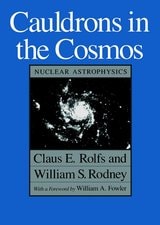
Cauldrons in the Cosmos
Nuclear AstrophysicsClaus E. Rolfs and William S. Rodney
University of Chicago Press, 1988
"One could not wish for a better account of the current state of knowledge (and uncertainty) about nuclear reactions in stars."—B. E. J. Pagel, Nature
"Written in an informal style that those uninitiated into the jargon of nuclear astrophysics and astronomy will find readable and illuminating. . . . A useful and long-awaited introduction to nuclear astrophysics."—G. J. Mathews, Science
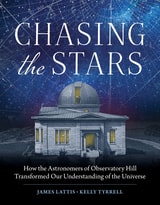
Chasing the Stars
How the Astronomers of Observatory Hill Transformed Our Understanding of the UniverseJames Lattis
Wisconsin Historical Society Press, 2024
Explore the remarkable story of Wisconsin astronomers whose curiosity, persistence, and innovation helped us better understand our universe.
Chasing the Stars traces the history of the University of Wisconsin’s Washburn Observatory, where some of the world’s most cutting-edge astronomical inventions were born. Learn about the earliest Indigenous stargazers, the women who worked as the first human computers, the astronomers who sold time by the stars, the scientists who shrank the Milky Way, and the crucial role Wisconsin astronomers played in the development of modern astrophysics and space astronomy.
This extraordinary book features more than 100 modern and historic photographs that illustrate the people and science behind Wisconsin’s astronomical innovations. Designed for lay readers and astronomers alike, Chasing the Stars inspires all of us to look up at the sky in wonder.
“Filled with fascinating astronomy-related facts, Chasing the Stars covers the first century-plus of the University of Wisconsin’s Washburn Observatory and the science it inspired. . . . [It is] a thorough, enlightening history of an important scientific site and the personalities who brought it to life.”
—Foreword Reviews
“Lattis and Tyrrell give us a masterful tour of Washburn Observatory, its legacy of astronomical discovery, and the key figures who forever changed our understanding of the cosmos. Readers will find delightful insights on these pages that bring this rich history to life and instill a desire to gaze at the stars.”
—Kenneth Sembach, former director of the Space Telescope Science Institute
“Through enchanting photos and compelling tales of astronomers, Lattis and Tyrrell shed light on the impressive innovations Wisconsin has contributed to the field of astrophysics. From the novel ways of collecting light from space to the new technologies sent to space on early satellites, readers will be fascinated to learn how Wisconsin astronomers have influenced our understanding of the universe.”
—Dr. Amanda Bauer, deputy director and head of science and education, Yerkes Observatory
“This fascinating and detailed account of the history of astronomy in Wisconsin highlights a diverse set of connections, from the construction of the University of Wisconsin’s first observatory in the late 1880s, to General Mills, Oscar Meyer, railroads, and the creation of the American Astronomical Society. Chasing the Stars recounts for us how Wisconsin’s astronomers came to be leaders in this field for more than a century and reminds us of why astronomy is a deeply human endeavor that appeals to professionals and nonprofessionals alike.”
—Dr. Andrea Ghez, UCLA astrophysicist and Nobel laureate
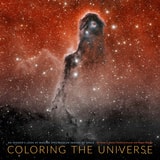
Coloring the Universe
An Insider's Look at Making Spectacular Images of SpaceTravis Rector, Kimberly Arcand, and Megan Watzke
University of Alaska Press, 2015
Coloring the Universe uses accessible language to describe how these giant telescopes work, what scientists learn with them, and how they are used to make color images. It talks about how otherwise un-seeable rays, such as radio waves, infrared light, X-rays, and gamma rays, are turned into recognizable colors. And it is filled with fantastic images taken in far-away pockets of the universe. Informative and beautiful, Coloring the Universe will give space fans of all levels an insider’s look at how scientists bring deep space into brilliant focus.
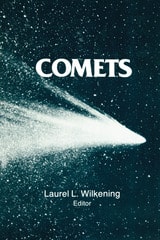
Comets
Laurel L. Wilkening
University of Arizona Press, 1982
"The volume is highly recommended to all interested in comets and the Solar System."—Journal of the British Astronomical Association
"A good representation of the studies that are currently being done on comets, and it is an extremely good source of information on a wide variety of topics."—International Comet Quarterly
"Extremely well-written and informative. . . . A must for library collections."—The Observatory

Comets
Laurel L. Wilkening
University of Arizona Press, 1982
"The volume is highly recommended to all interested in comets and the Solar System."—Journal of the British Astronomical Association
"A good representation of the studies that are currently being done on comets, and it is an extremely good source of information on a wide variety of topics."—International Comet Quarterly
"Extremely well-written and informative. . . . A must for library collections."—The Observatory
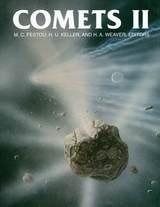
Comets II
Edited by M. C. Festou, H. U. Keller, and H. A. Weaver
University of Arizona Press, 2004
Comets II situates comet science in the global context of astrophysics for the first time by beginning with a series of chapters that describe the connection between stars and planets. It continues with a presentation of the formation and evolution of planetary systems, enabling the reader to clearly see the key role played in our own solar system by the icy planetesimals that were the seeds of the giant planets and transneptunian objects.
The book presents the key results obtained during the 1990s, in particular those collected during the apparition of the exceptional comets C/Hyakutake and C/Hale-Bopp in 1996-1997. The latest results obtained from the in situ exploration of comets P/Borrelly and P/Wild 2 are also discussed in detail.
Each topic of is designed to be accessible to students or young researchers looking for basic, yet detailed, complete and accurate, information on comet science. With its emphasis on the origin of theories and the future of research, Comets II will enable scientists to make connections across disciplinary boundaries and will set the stage for discovery and new understanding in the coming years.
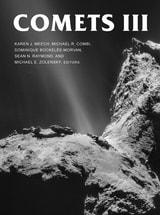
Comets III
Karen J. Meech, Michael R. Combi, Dominique Bockelée-Morvan, Sean N. Raymond, and Michael E. Zolensky
University of Arizona Press, 2024
With the contributions of more than eighty authors spanning twenty-five chapters, Comets III investigates the early solar system origins of comets and the clues provided by the composition and distribution of their present population for their long-term dynamical evolution and interrelations with other members of the solar system. Organized thematically, each section is designed to enable connections across disciplinary boundaries in both planetary science and planetary formation astrophysics.
This comprehensive volume explores recent advancements in space missions, telescopic observations, and robotic surveys, providing new understandings of the origins and dynamics of comets. Intended for both researchers and students, Comets III offers insights into unresolved questions and sets the stage for future advancements.
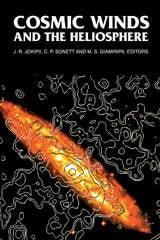
Cosmic Winds and the Heliosphere
Edited by J. R. Jokipii, C. P. Sonett, and M. S. Giampapa
University of Arizona Press, 1997
Cosmic Winds and the Heliosphere is a comprehensive sourcebook on conceptually correlated topics in astrophysical winds and heliospheric physics. The contributors review the various kinds of winds, such as solar wind, winds of cataclysmic variables, and winds from pulsating stars. They then examine the physics of wind origin and physical phenomena in winds. including heliospheric shocks, magnetohydrodynamic turbulence, and kinetic phenomena. A final section considers interactions with surrounding media, with contributions ranging from studies of the interstellar cloud surrounding the solar system to considerations of solar wind interaction with comets.
Prepared to the scrupulous standards of the University of Arizona Space Science Series, Cosmic Winds and the Heliosphere is an essential volume for astronomers and space physicists.
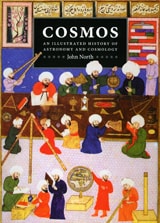
Cosmos
An Illustrated History of Astronomy and CosmologyJohn North
University of Chicago Press, 2008
Organizing his history chronologically, North begins by examining Paleolithic cave drawings that clearly chart the phases of the moon. He then investigates scientific practices in the early civilizations of Egypt, Greece, China, and the Americas (among others), whose inhabitants developed sophisticated methods to record the movements of the planets and stars. Trade routes and religious movements, North notes, brought these ancient styles of scientific thinking to the attention of later astronomers, whose own theories—such as Copernicus’ planetary theory—led to the Scientific Revolution.
The work of master astronomers, including Ptolemy, Galileo, Kepler, and Newton, is described in detail, as are modern-day developments in astrophysics, such as the advent of radio astronomy, the brilliant innovations of Einstein, and the many recent discoveries brought about with the help of the Hubble telescope. This new edition brings North’s seminal book right up to the present day, as North takes a closer look at last year’s reclassification of Pluto as a “dwarf” planet and gives a thorough overview of current research.
With more than two hundred illustrations and a comprehensive bibliography, Cosmos is the definitive history of astronomy and cosmology. It is sure to find an eager audience among historians of science and astronomers alike.