Results by title
70 books match the query 'Authority' and 7 start with c
Character, Community, and Politics
Clarke E. Cochran
University of Alabama Press, 1982
The revival of political philosophy has frequently assumed that a theory of human well-being and fulfillment is necessary, preoccupied with questions of epistemology and technical conceptual analysis. In instances where the nature of the human good is considered, the paradigm of autonomous individualism customarily dominates. In Character, Community, and Politics, Cochran moves away from these prevailing ideas to develop a communal theory of political order, helping to redefine a number of fundamental, but often neglected, ideas. Chief among them are commitment, community, responsibility, and character—concepts Cochran develops through discussions of authority, freedom, pluralism, and the common good.
Drawing on a wide variety of fields, such as philosophy, ethics, literature, moral theology, and sociology, the author renews these concepts to outline a theory of human life and political order distinct from sclerotic categories such as conservatism, socialism, radicalism, or Marxism.
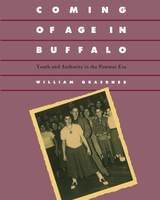
Coming Of Age In Buffalo
Youth and Authority in the Postwar EraWilliam Graebner
Temple University Press, 1993
Pegged pants poodle skirts, record hops, rock ‘n’ roll, soda shops: in the interval between the bombing of Hiroshima and the assassination of John F. Kennedy, these were distinguishing marks of the "typical" postwar teenager-if there was a "typical" teenager. In this richly illustrated account of Youth in postwar Buffalo, William Graebner argues that the so-called Youth culture was really a variety of "disparate subcultures, united by age but in conflict over class, race, ethnicity, and gender." Using scrap books, oral histories, school Yearbooks, and material culture, he shows how Buffalo teenagers were products of diverse and often antagonistic subcultures. The innocuous strains of "Rock Around the Clock" muffled the seething gang loyalties and countercultural influence of James Dean, Marlon Brando, and Buffalo’s own "Hound Dog" Lorenz. Racial antipathies once held in check spilled out on Memorial Day, 1956, when white and black Youth clashed on board a take Erie pleasure boat in a "riot" that recast the city’s race relations for decades to come.
While exploring the diversity within Youth subcultures, Graebner examines the ways in which adults—educators, clergy, representatives of the media, and other authorities—sought to contain this generation. The Hi-Teen Club, Buffalo Plan dress code, record hops, graduation ceremonies, film censorship, and restrictions on secret societies and on corner lounging were all forms of social engineering that reinforced social and economic boundaries that were at the heart of the dominant culture. The prevailing adult influence on activities, attitudes, and style served to redirect the "misguided Youth" of the fifties and to obliterate their image from public memory. Although the media still portrays this decade as the golden age of cultural homogeneity, the diversity in musical preferences, hair and clothing styles, and allegiances to disc jockeys suggest the wide diversity of Youth experiences and challenges to adult authority that were part of coming of age in postwar America.

Constance Pascal (1877–1937)
Authority, Femininity and Feminism in French PsychiatryFelicia Gordon
University of London Press, 2014
Constitutional History of the American Revolution, Volume I
The Authority Of RightsJohn Phillip Reid
University of Wisconsin Press, 1987
Constitutional History of the American Revolution
Volume I: The Authority of Rights
Volume II: The Authority to Tax
Volume III: The Authority to Legislate
Volume IV: The Authority of Law
John Phillip Reid addresses the central constitutional issues that divided the American colonists from their English legislators: the authority to tax, the authority to legislate, the security of rights, the nature of law, the foundation of constitutional government in custom and contractarian theory, and the search for a constitutional settlement.
Constitutional History of the American Revolution, Volume II
The Authority To TaxJohn Phillip Reid
University of Wisconsin Press, 1987
John Phillip Reid addresses the central constitutional issues that divided the American colonists from their English legislators: the authority to tax, the authority to legislate, the security of rights, the nature of law, the foundation of constitutional government in custom and contractarian theory, and the search for a constitutional settlement.
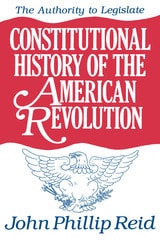
Constitutional History of the American Revolution, Volume III
The Authority to LegislateJohn Phillip Reid
University of Wisconsin Press, 1992
This is the first comprehensive study of the constitutionality of the Parliamentary legislation cited by the American Continental Congress as a justification for its rebellion against Great Britain in 1776. The content and purpose of that legislation is well known to historians, but here Reid places it in the context of eighteenth-century constitutional doctrine and discusses its legality in terms of the intellectual premises of eighteenth-century Anglo-American legal values.
The third installment in a planned four-volume work, The Authority to Legislate follows The Authority to Tax and The Authority of Rights. In this volume, Reid shows that the inflexibility of British constitutional principle left no room for settlement or change; Parliament became entrapped by the imperatives of the constitution it was struggling to preserve. He analyzes the legal theories put forward in support of Parliament’s authority to legislate and the specific precedents cited as evidence of that authority.
Reid’s examination of both the debate over the authority to legislate and the constitutional theory underlying the debate shows the extent to which the American Revolution and the Declaration of Independence were actions taken in defense of the rule of law. Considered as a whole, Reid’s Constitutional History of the American Revolution contributes to an understanding of the central role of legal and constitutional standards, especially concern for rule by law, in the development of the American nation.

Cyberchiefs
Autonomy and Authority in Online TribesMathieu O'Neil
Pluto Press, 2009
People are inventing new ways of working together on the internet. Decentralised production thrives on weblogs, wikis and free software projects. In Cyberchiefs, Mathieu O’Neil focuses on the regulations of these working relationships. He examines the transformation of leadership and expertise in online networks, and the emergence of innovative forms of participatory politics.
What are the costs and benefits of alternatives to hierarchical organisation? Using case studies of online projects or ‘tribes’ such as the radical Primitivism archive, the Daily Kos political weblog, the Debian free software project, and Wikipedia, O’Neil shows that leaders must support maximum autonomy for participants, and he analyses the tensions generated by this distribution of authority.