Results by title
101 books match the query 'Behavior' and 7 start with c

Canine Confidential
Why Dogs Do What They DoMarc Bekoff
University of Chicago Press, 2018
For all the love and attention we give dogs, much of what they do remains mysterious. Just think about different behaviors you see at a dog park: We have a good understanding of what it means when dogs wag their tails—but what about when they sniff and roll on a stinky spot? Why do they play tug-of-war with one dog, while showing their bellies to another? Why are some dogs shy, while others are bold? What goes on in dogs’ heads and hearts—and how much can we know and understand?
Canine Confidential has the answers. Written by award-winning scientist—and lifelong dog lover—Marc Bekoff, it not only brilliantly opens up the world of dog behavior, but also helps us understand how we can make our dogs’ lives the best they can possibly be. Rooted in the most up-to-date science on cognition and emotion—fields that have exploded in recent years—Canine Confidential is a wonderfully accessible treasure trove of new information and myth-busting. Peeing, we learn, isn’t always marking; grass-eating isn’t always an attempt to trigger vomiting; it’s okay to hug a dog—on their terms; and so much more. There’s still much we don’t know, but at the core of the book is the certainty that dogs do have deep emotional lives, and that as their companions we must try to make those lives as rich and fulfilling as possible. It’s also clear that we must look at dogs as unique individuals and refrain from talking about “the dog.”
Bekoff also considers the practical importance of knowing details about dog behavior. He advocates strongly for positive training—there’s no need to dominate or shame dogs or to make them live in fear—and the detailed information contained in Canine Confidential has a good deal of significance for dog trainers and teachers. He also suggests that trainers should watch and study dogs in various contexts outside of those in which they are dealing with clients, canine and human, with specific needs.
There’s nothing in the world as heartwarming as being greeted by your dog at the end of the workday. Read Canine Confidential, and you’ll be on the road to making your shared lives as happy, healthy, and rewarding as they can possibly be.
[more]
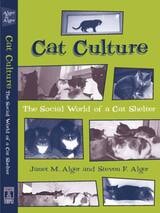
Cat Culture
The Social World Of A Cat ShelterJanet M. Alger and Steven F. Alger
Temple University Press, 2002
Even people who live with cats and have good reason to know better insist that cats are aloof and uninterested in relating to humans. Janet and Steven Alger contend that the anti-social cat is a myth; cats form close bonds with humans and with each other. In the potentially chaotic environment of a shelter that houses dozens of uncaged cats, they reveal a sense of self and build a culture—a shared set of rules, roles, and expectations that organizes their world and assimilates newcomers.As volunteers in a local cat shelter for eleven years, the Algers came to realize that despite the frequency of new arrivals and adoptions, the social world of the shelter remained quite stable and pacific. They saw even feral cats adapt to interaction with humans and develop friendships with other cats. They saw established residents take roles as welcomers and rules enforcers. That is, they saw cats taking an active interest in maintaining a community in which they could live together and satisfy their individual needs. Cat Culture's intimate portrait of life in the shelter, its engaging stories, and its interpretations of behavior, will appeal to general readers as well as academics interested in human and animal interaction.
[more]
Cetacean Societies
Field Studies of Dolphins and WhalesEdited by Janet Mann, Richard C. Connor, Peter L. Tyack, and Hal Whitehead
University of Chicago Press, 1999
"Part review, part testament to extraordinary dedication, and part call to get involved, Cetacean Societies highlights the achievements of behavioral ecologists inspired by the challenges of cetaceans and committed to the exploration of a new world."—from the preface by Richard Wrangham
Long-lived, slow to reproduce, and often hidden beneath the water's surface, whales and dolphins (cetaceans) have remained elusive subjects for scientific study even though they have fascinated humans for centuries. Until recently, much of what we knew about cetaceans came from commercial sources such as whalers and trainers for dolphin acts. Innovative research methods and persistent efforts, however, have begun to penetrate the depths to reveal tantalizing glimpses of the lives of these mammals in their natural habitats.
Cetacean Societies presents the first comprehensive synthesis and review of these new studies. Groups of chapters focus on the history of cetacean behavioral research and methodology; state-of-the-art reviews of information on four of the most-studied species: bottlenose dolphins, killer whales, sperm whales, and humpback whales; and summaries of major topics, including group living, male and female reproductive strategies, communication, and conservation drawn from comparative research on a wide range of species.
Written by some of the world's leading cetacean scientists, this landmark volume will benefit not just students of cetology but also researchers in other areas of behavioral and conservation ecology as well as anyone with a serious interest in the world of whales and dolphins.
Contributors are Robin Baird, Phillip Clapham, Jenny Christal, Richard Connor, Janet Mann, Andrew Read, Randall Reeves, Amy Samuels, Peter Tyack, Linda Weilgart, Hal Whitehead, Randall S. Wells, and Richard Wrangham.
[more]
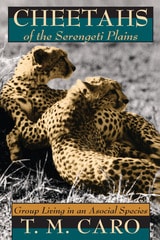
Cheetahs of the Serengeti Plains
Group Living in an Asocial SpeciesT. M. Caro
University of Chicago Press, 1994
Cheetahs of the Serengeti Plains is the most comprehensive account of carnivore social behavior to date. Synthesizing more than a decade of research in the wild, this book offers a detailed account of the behavior and ecology of cheetahs. Compared with other large cats, and other mammals, cheetahs have an unusual breeding system; whereas lions live in prides and tigers are solitary, some cheetahs live in groups while others live by themselves. Tim Caro explores group and solitary living among cheetahs and discovers that the causes of social behavior vary dramatically, even within a single species.
Why do cheetah cubs stay with their mother for a full year after weaning? Why do adolescents remain in groups? Why do adult males live in permanent associations with each other? Why do adult females live alone? Through observations on the costs and benefits of group living, Caro offers new insight into the complex behavior of this extraordinary species. For example, contrary to common belief about cooperative hunting in large carnivores, he shows that neither adolescents nor adult males benefit from hunting in groups.
With many surprising findings, and through comparisons with other cat species, Caro enriches our understanding of the evolution of social behavior and offers new perspectives on conservation efforts to save this charismatic and endangered carnivore.
[more]
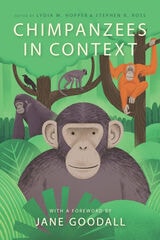
Chimpanzees in Context
A Comparative Perspective on Chimpanzee Behavior, Cognition, Conservation, and WelfareEdited by Lydia M. Hopper and Stephen R. Ross
University of Chicago Press, 2020
The study of the chimpanzee, one of the human species’ closest relatives, has led scientists to exciting discoveries about evolution, behavior, and cognition over the past half century. In this book, rising and veteran scholars take a fascinating comparative approach to the culture, behavior, and cognition of both wild and captive chimpanzees. By seeking new perspectives in how the chimpanzee compares to other species, the scientists featured offer a richer understanding of the ways in which chimpanzees’ unique experiences shape their behavior. They also demonstrate how different methodologies provide different insights, how various cultural experiences influence our perspectives of chimpanzees, and how different ecologies in which chimpanzees live affect how they express themselves.
After a foreword by Jane Goodall, the book features sections that examine chimpanzee life histories and developmental milestones, behavior, methods of study, animal communication, cooperation, communication, and tool use. The book ends with chapters that consider how we can apply contemporary knowledge of chimpanzees to enhance their care and conservation. Collectively, these chapters remind us of the importance of considering the social, ecological, and cognitive context of chimpanzee behavior, and how these contexts shape our comprehension of chimpanzees. Only by leveraging these powerful perspectives do we stand a chance at improving how we understand, care for, and protect this species.
After a foreword by Jane Goodall, the book features sections that examine chimpanzee life histories and developmental milestones, behavior, methods of study, animal communication, cooperation, communication, and tool use. The book ends with chapters that consider how we can apply contemporary knowledge of chimpanzees to enhance their care and conservation. Collectively, these chapters remind us of the importance of considering the social, ecological, and cognitive context of chimpanzee behavior, and how these contexts shape our comprehension of chimpanzees. Only by leveraging these powerful perspectives do we stand a chance at improving how we understand, care for, and protect this species.
[more]

Coloniality in the Cliff Swallow
The Effect of Group Size on Social BehaviorCharles R. Brown and Mary Bomberger Brown
University of Chicago Press, 1996
Many animal species live and breed in colonies. Although biologists have documented numerous costs and benefits of group living, such as increased competition for limited resources and more pairs of eyes to watch for predators, they often still do not agree on why coloniality evolved in the first place.
Drawing on their twelve-year study of a population of cliff swallows in Nebraska, the Browns investigate twenty-six social and ecological costs and benefits of coloniality, many never before addressed in a systematic way for any species. They explore how these costs and benefits are reflected in reproductive success and survivorship, and speculate on the evolution of cliff swallow coloniality.
This work, the most comprehensive and detailed study of vertebrate coloniality to date, will be of interest to all who study social animals, including behavioral ecologists, population biologists, ornithologists, and parasitologists. Its focus on the evolution of coloniality will also appeal to evolutionary biologists and to psychologists studying decision making in animals.
[more]
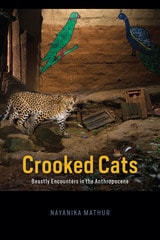
Crooked Cats
Beastly Encounters in the AnthropoceneNayanika Mathur
University of Chicago Press, 2021
Big cats—tigers, leopards, and lions—that make prey of humans are commonly known as “man-eaters.” Anthropologist Nayanika Mathur reconceptualizes them as cats that have gone off the straight path to become “crooked.” Building upon fifteen years of research in India, this groundbreaking work moves beyond both colonial and conservationist accounts to place crooked cats at the center of the question of how we are to comprehend a planet in crisis.
There are many theories on why and how a big cat comes to prey on humans, with the ecological collapse emerging as a central explanatory factor. Yet, uncertainty over the precise cause of crookedness persists. Crooked Cats explores in vivid detail the many lived complexities that arise from this absence of certain knowledge to offer startling new insights into both the governance of nonhuman animals and their intimate entanglements with humans. Through creative ethnographic storytelling, Crooked Cats illuminates the Anthropocene in three critical ways: as method, as a way of reframing human-nonhuman relations on the planet, and as a political tool indicating the urgency of academic engagement. Weaving together “beastly tales” spun from encounters with big cats, Mathur deepens our understanding of the causes, consequences, and conceptualization of the climate crisis.
There are many theories on why and how a big cat comes to prey on humans, with the ecological collapse emerging as a central explanatory factor. Yet, uncertainty over the precise cause of crookedness persists. Crooked Cats explores in vivid detail the many lived complexities that arise from this absence of certain knowledge to offer startling new insights into both the governance of nonhuman animals and their intimate entanglements with humans. Through creative ethnographic storytelling, Crooked Cats illuminates the Anthropocene in three critical ways: as method, as a way of reframing human-nonhuman relations on the planet, and as a political tool indicating the urgency of academic engagement. Weaving together “beastly tales” spun from encounters with big cats, Mathur deepens our understanding of the causes, consequences, and conceptualization of the climate crisis.
[more]