Results by title
81 books match the query 'Belonging' and 5 start with c
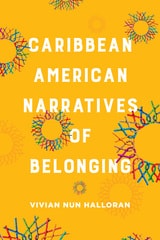
Caribbean American Narratives of Belonging
Vivian Nun Halloran
The Ohio State University Press, 2023
In Caribbean American Narratives of Belonging, Vivian Nun Halloran analyzes memoirs, picture books, comic books, young adult novels, musicals, and television shows through which Caribbean Americans recount and celebrate their contributions to contemporary politics, culture, and activism in the United States. The writers, civil servants, illustrators, performers, and entertainers whose work is discussed here show what it is like to fit in and be included within the body politic. From civic memoirs by Sonia Sotomayor and others, to West Side Story, Hamilton, and Into the Spider-Verse, these texts share a forward-looking perspective, distinct from the more nostalgic rhetoric of traditional diasporic texts that privilege connections to the islands of origin.
There is no one way of being Caribbean. Diasporic communities exhibit a broad spectrum of ethnic, racial, religious, linguistic, and political qualities. Claiming a Caribbean American identity asks wider society to recognize and affirm hybridity in ways that challenge binaristic conceptions of race and nationality. Halloran provides a common language and critical framework to discuss the achievements of members of the Caribbean diaspora and their considerable cultural and political capital as evident in their contributions to literature and popular culture.

Citizenship, Belonging, and Political Community in Africa
Dialogues between Past and PresentEmma Hunter
Ohio University Press, 2016
Africa, it is often said, is suffering from a crisis of citizenship. At the heart of the contemporary debates this apparent crisis has provoked lie dynamic relations between the present and the past, between political theory and political practice, and between legal categories and lived experience. Yet studies of citizenship in Africa have often tended to foreshorten historical time and privilege the present at the expense of the deeper past.
Citizenship, Belonging, and Political Community in Africa provides a critical reflection on citizenship in Africa by bringing together scholars working with very different case studies and with very different understandings of what is meant by citizenship. By bringing historians and social scientists into dialogue within the same volume, it argues that a revised reading of the past can offer powerful new perspectives on the present, in ways that might also indicate new paths for the future.
The project collects the works of up-and-coming and established scholars from around the globe. Presenting case studies from such wide-ranging countries as Sudan, Mauritius, South Africa, Côte d’Ivoire, and Ethiopia, the essays delve into the many facets of citizenship and agency as they have been expressed in the colonial and postcolonial eras. In so doing, they engage in exciting ways with the watershed book in the field, Mahmood Mamdani’s Citizen and Subject.
Contributors: Samantha Balaton-Chrimes, Frederick Cooper, Solomon M. Gofie, V. Adefemi Isumonah, Cherry Leonardi, John Lonsdale, Eghosa E.Osaghae, Ramola Ramtohul, Aidan Russell, Nicole Ulrich, Chris Vaughan, and Henri-Michel Yéré.
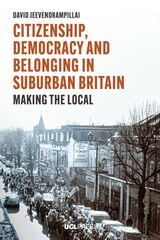
Citizenship, Democracy and Belonging in Suburban Britain
Making the LocalDavid Jeevendrampillai
University College London, 2021
An activist group in outer London’s Surbiton suburb, the Seething Villagers commemorate a fictional local history through tongue-in-cheek community festivals. These admittedly “stupid” gatherings celebrate a mythical village of Seething and its many adventures, including a run-in with a mountain-crushing giant. Citizenship, Democracy and Belonging in Suburban Britain explores how the Seething Villagers and other suburbanite fantasies fashion community in the face of neoliberal isolation. By taking the artists’ playfulness seriously, David Jeevendrampillai demonstrates how suburbanites develop fellow-feeling without access to traditional community centers.
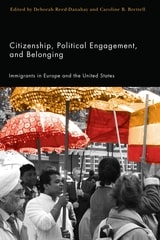
Citizenship, Political Engagement, and Belonging
Immigrants in Europe and the United StatesReed-Danahay, Deborah
Rutgers University Press, 2008
Immigration is continuously and rapidly changing the face of Western countries. While newcomers are harbingers of change, host nations also participate in how new populations are incorporated into their social and political fabric.
Bringing together a transcontinental group of anthropologists, this book provides an in-depth look at the current processes of immigration, political behavior, and citizenship in both the United States and Europe. Essays draw on issues of race, national identity, religion, and more, while addressing questions, including: How should citizenship be defined? In what ways do immigrants use the political process to achieve group aims? And, how do adults and youth learn to become active participants in the public sphere?
Among numerous case studies, examples include instances of racialized citizenship in “Algerian France,” Ireland’s new citizenship laws in response to asylum-seeking mothers, the role of Evangelical Christianity in creating a space for the construction of an identity that transcends state borders, and the Internet as one of the new public spheres for the expression of citizenship, be it local, national, or global.
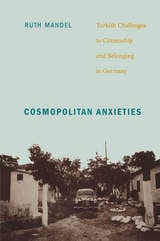
Cosmopolitan Anxieties
Turkish Challenges to Citizenship and Belonging in GermanyRuth Mandel
Duke University Press, 2008
Mandel explains that within Germany the popular understanding of what it means to be German is often conflated with citizenship, so that a German citizen of Turkish background can never be a “real German.” This conflation of blood and citizenship was dramatically illustrated when, during the 1990s, nearly two million “ethnic Germans” from Eastern Europe and the former Soviet Union arrived in Germany with a legal and social status far superior to that of “Turks” who had lived in the country for decades. Mandel analyzes how representations of Turkish difference are appropriated or rejected by Turks living in Germany; how subsequent generations of Turkish immigrants are exploring new configurations of identity and citizenship through literature, film, hip-hop, and fashion; and how migrants returning to Turkey find themselves fundamentally changed by their experiences in Germany. She maintains that until difference is accepted as unproblematic, there will continue to be serious tension regarding resident foreigners, despite recurrent attempts to realize a more inclusive and “demotic” cosmopolitan vision of Germany.