Results by title
221 books match the query 'Beyond' and 7 start with c

Chicago Apartments
A Century and Beyond of Lakefront LuxuryNeil Harris and Teri J. Edelstein
University of Chicago Press, 2020
Classics, the Culture Wars, and Beyond
Eric Adler
University of Michigan Press, 2016
Beginning with a short intellectual history of the academic culture wars, Eric Adler’s book examines popular polemics including those by Allan Bloom and Dinesh D’Souza, and considers the oddly marginal role of classical studies in these conflicts. In presenting a brief history of classics in American education, the volume sheds light on the position of the humanities in general.
Adler dissects three significant controversies from the era: the so-called AJP affair, which supposedly pitted a conservative journal editor against his feminist detractors; the brouhaha surrounding Martin Bernal’s contentious Black Athena project; and the dustup associated with Victor Davis Hanson and John Heath’s fire-breathing jeremiad, Who Killed Homer? He concludes by considering these controversies as a means to end the crisis for classical studies in American education. How can the study of antiquity—and the humanities—thrive in the contemporary academy? This book provides workable solutions to end the crisis for classics and for the humanities as well.
This major work also includes findings from a Web survey of American classical scholars, offering the first broadly representative impression of what they think about their discipline and its prospects for the future. Adler also conducted numerous in-depth interviews with participants in the controversies discussed, allowing readers to gain the most reliable information possible about these controversies.
Those concerned about the liberal arts and the best way to educate young Americans should read this book. Accessible and jargon-free, this narrative of scholarly scandals and their context makes for both enjoyable and thought-provoking reading.
Climate Change Solutions
Beyond the Capital-Climate ContradictionDiana Stuart, Ryan Gunderson, and Brian Petersen
University of Michigan Press, 2020
College Writing and Beyond
A New Framework for University Writing InstructionAnne Beaufort
Utah State University Press, 2007
Composition research consistently demonstrates that the social context of writing determines the majority of conventions any writer must observe. Still, most universities organize the required first-year composition course as if there were an intuitive set of general writing "skills" usable across academic and work-world settings.
In College Writing and Beyond: A New Framework for University Writing Instruction, Anne Beaufort reports on a longitudinal study comparing one student’s experience in FYC, in history, in engineering, and in his post-college writing. Her data illuminate the struggle of college students to transfer what they learn about "general writing" from one context to another. Her findings suggest ultimately not that we must abolish FYC, but that we must go beyond even genre theory in reconceiving it.
Accordingly, Beaufort would argue that the FYC course should abandon its hope to teach a sort of general academic discourse, and instead should systematically teach strategies of responding to contextual elements that impinge on the writing situation. Her data urge attention to issues of learning transfer, and to developmentally sound linkages in writing instruction within and across disciplines. Beaufort advocates special attention to discourse community theory, for its power to help students perceive and understand the context of writing.
Corruption in Cuba
Castro and BeyondBy Sergio Díaz-Briquets and Jorge Pérez-López
University of Texas Press, 2006
While Fidel Castro maintained his longtime grip on Cuba, revolutionary scholars and policy analysts turned their attention from how Castro succeeded (and failed), to how Castro himself would be succeeded—by a new government. Among the many questions to be answered was how the new government would deal with the corruption that has become endemic in Cuba. Even though combating corruption cannot be the central aim of post-Castro policy, Sergio Díaz-Briquets and Jorge Pérez-López suggest that, without a strong plan to thwart it, corruption will undermine the new economy, erode support for the new government, and encourage organized crime. In short, unless measures are taken to stem corruption, the new Cuba could be as messy as the old Cuba.
Fidel Castro did not bring corruption to Cuba; he merely institutionalized it. Official corruption has crippled Cuba since the colonial period, but Castro's state-run monopolies, cronyism, and lack of accountability have made Cuba one of the world's most corrupt states. The former communist countries in Eastern Europe were also extremely corrupt, and analyses of their transitional periods suggest that those who have taken measures to control corruption have had more successful transitions, regardless of whether the leadership tilted toward socialism or democracy. To that end, Díaz-Briquets and Pérez-López, both Cuban Americans, do not advocate any particular system for Cuba's next government, but instead prescribe uniquely Cuban policies to minimize corruption whatever direction the country takes after Castro. As their work makes clear, averting corruption may be the most critical obstacle in creating a healthy new Cuba.
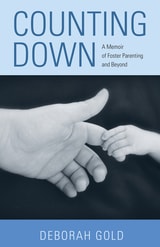
Counting Down
A Memoir of Foster Parenting and BeyondDeborah Gold
Ohio University Press, 2017
When Deborah Gold and her husband signed up to foster parent in their rural mountain community, they did not foresee that it would lead to a roller-coaster fifteen years of involvement with a traumatized yet resilient birth family. They fell in love with Michael (a toddler when he came to them), yet they had to reckon with the knowledge that he could leave their lives at any time.
In Counting Down, Gold tells the story of forging a family within a confounding system. We meet social workers, a birth mother with the courage to give her children the childhood she never had herself, and a father parenting from prison. We also encounter members of a remarkable fellowship of Appalachian foster parents—gay, straight, right, left, evangelical, and atheist—united by love, loss, and quality hand-me-downs.
Gold’s memoir is one of the few books to deliver a foster parent’s perspective (and, through Michael’s own poetry and essays, that of a former foster child). In it, she shakes up common assumptions and offers a powerfully frank and hopeful look at an experience often portrayed as bleak.
Crime and Justice, Volume 18
Beyond the Law: Crime in Complex OrganizationsEdited by Michael Tonry and Albert J. Reiss Jr.
University of Chicago Press Journals, 1993