Results by title
82 books match the query 'Birdwatching Guides' and 4 start with c
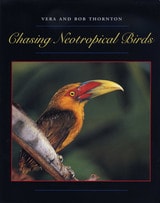
Chasing Neotropical Birds
Text by Bob Thornton, Photography by Vera and Bob Thornton
University of Texas Press, 2005
From Belize to Brazil, the forests of the American neotropics are home to an astonishing array of birds—over 3,700 different species, or nearly 40 percent of all the birds on earth. Because of this overwhelming abundance, birders come from all over the world to try to catch glimpses of species that can be found nowhere else, such as toucans and antbirds, motmots and manakins, bellbirds and cocks-of-the-rock, and practically all of the planet's hummingbirds. Two such birding enthusiasts are Vera and Bob Thornton, who have spent fifteen years photographing these special and exotic birds in the rainforests of eleven different countries of Central and South America. In this book, you'll find more than a hundred spectacular color photographs they took during their travels, along with a highly entertaining account of their adventures—and misadventures—in chasing these exotic neotropicals.
The birds pictured here are among the Thorntons' personal favorites—birds that, in their words, "either dazzled us with their beauty, or charmed us by their behavior, or, in a few cases, simply challenged us by the mystique of their rarity." This latter category includes such elusive and sought-after birds as the Black-crowned Antpitta, the Zigzag Heron, the Rufous-vented Ground-Cuckoo, the Bare-necked Umbrellabird, and the monkey-eating Harpy Eagle. In the accompanying text, Bob Thornton engagingly describes the challenges as well as the magic of negotiating the neotropical rainforests in search of colorful birds to photograph. For those who would like to follow in the Thorntons' footsteps, there are also helpful tips about photographic gear and techniques, preferred places to see the birds, lodging, and guides. For everyone who enjoys excellent nature photography, Chasing Neotropical Birds is a must-have volume on the coffee table or in the library.
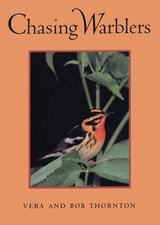
Chasing Warblers
By Vera and Bob Thornton
University of Texas Press, 1999
Honorable Mention, Southern Books Competition, 1999
Known to many as "the butterflies of the bird world," wood warblers allure even the most experienced and discriminating birders. Their annual migrations to and from nesting areas in the United States and Canada draw thousands of birders to places such as High Island, Texas; Crane Creek, Ohio; and Point Pelee, Ontario, where warblers stop to rest and feed during the long journey. There birders have a chance to see and photograph these colorful, elusive songbirds whose quick, darting flight among high branches and thick cover makes them some of the most challenging birds to observe and identify.
In this entertaining, beautifully illustrated book, Bob Thornton recounts his and Vera Thornton's cross-continent adventures in finding and photographing all 52 species of wood warblers that nest in the United States. In addition to describing where and how they photographed each species, Thornton tells marvelous stories of the colorful characters they encountered along the way. He also touches on the current human threats to wood warblers that come from loss of habitat.
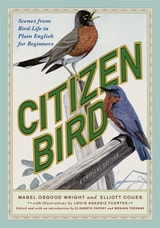
Citizen Bird
Scenes from Bird-Life in Plain English for Beginners, A Critical EditionMabel Osgood Wright
Rutgers University Press, 2025
Born of a collaboration between naturalist Mabel Osgood Wright, ornithologist Elliott Coues, and bird artist Louis Agassiz Fuertes, the book is vital to the history of birding and the broader study of nineteenth-century American culture and literature. This new edition of Citizen Bird preserves the original book’s 111 drawings and adds explanatory footnotes, supplemental historical material, and a new introduction. More than a century and a quarter after its original publication, Elizabeth Cherry and Meghan Freeman contextualize the book in the tradition and history of birding and discuss the roles of its authors and illustrator in birding history. A landmark text in the history of American conservationism, Citizen Bird is a timeless classic that will bring joy to birdwatchers of all ages.

Coloniality in the Cliff Swallow
The Effect of Group Size on Social BehaviorCharles R. Brown and Mary Bomberger Brown
University of Chicago Press, 1996
Drawing on their twelve-year study of a population of cliff swallows in Nebraska, the Browns investigate twenty-six social and ecological costs and benefits of coloniality, many never before addressed in a systematic way for any species. They explore how these costs and benefits are reflected in reproductive success and survivorship, and speculate on the evolution of cliff swallow coloniality.
This work, the most comprehensive and detailed study of vertebrate coloniality to date, will be of interest to all who study social animals, including behavioral ecologists, population biologists, ornithologists, and parasitologists. Its focus on the evolution of coloniality will also appeal to evolutionary biologists and to psychologists studying decision making in animals.