Results by title
83 books match the query 'Birth' and 2 start with c
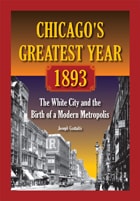
Chicago's Greatest Year, 1893
The White City and the Birth of a Modern MetropolisJoseph Gustaitis
Southern Illinois University Press, 2013
In 1893, the 27.5 million visitors to the Chicago World’s Fair feasted their eyes on the impressive architecture of the White City, lit at night by thousands of electric lights. In addition to marveling at the revolutionary exhibits, most visitors discovered something else: beyond the fair’s 633 acres lay a modern metropolis that rivaled the world’s greatest cities. The Columbian Exposition marked Chicago’s arrival on the world stage, but even without the splendor of the fair, 1893 would still have been Chicago’s greatest year.
An almost endless list of achievements took place in Chicago in 1893. Chicago’s most important skyscraper was completed in 1893, and Frank Lloyd Wright opened his office in the same year. African American physician and Chicagoan Daniel Hale Williams performed one of the first known open-heart surgeries in 1893. Sears and Roebuck was incorporated, and William Wrigley invented Juicy Fruit gum that year. The Field Museum, the Art Institute of Chicago, and the Museum of Science and Industry all started in 1893. The Cubs’ new ballpark opened in this year, and an Austro-Hungarian immigrant began selling hot dogs outside the World’s Fair grounds. His wares became the famous “Chicago hot dog.”
“Cities are not buildings; cities are people,” writes author Joseph Gustaitis. Throughout the book, he brings forgotten pioneers back to the forefront of Chicago’s history, connecting these important people of 1893 with their effects on the city and its institutions today. The facts in this history of a year range from funny to astounding, showcasing innovators, civic leaders, VIPs, and power brokers who made 1893 Chicago about so much more than the fair.
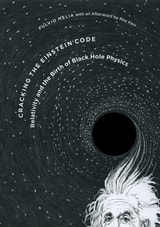
Cracking the Einstein Code
Relativity and the Birth of Black Hole PhysicsFulvio Melia
University of Chicago Press, 2009
Albert Einstein’s theory of general relativity describes the effect of gravitation on the shape of space and the flow of time. But for more than four decades after its publication, the theory remained largely a curiosity for scientists; however accurate it seemed, Einstein’s mathematical code—represented by six interlocking equations—was one of the most difficult to crack in all of science. That is, until a twenty-nine-year-old Cambridge graduate solved the great riddle in 1963. Roy Kerr’s solution emerged coincidentally with the discovery of black holes that same year and provided fertile testing ground—at long last—for general relativity. Today, scientists routinely cite the Kerr solution, but even among specialists, few know the story of how Kerr cracked Einstein’s code.
Fulvio Melia here offers an eyewitness account of the events leading up to Kerr’s great discovery. Cracking the Einstein Code vividly describes how luminaries such as Karl Schwarzschild, David Hilbert, and Emmy Noether set the stage for the Kerr solution; how Kerr came to make his breakthrough; and how scientists such as Roger Penrose, Kip Thorne, and Stephen Hawking used the accomplishment to refine and expand modern astronomy and physics. Today more than 300 million supermassive black holes are suspected of anchoring their host galaxies across the cosmos, and the Kerr solution is what astronomers and astrophysicists use to describe much of their behavior.
By unmasking the history behind the search for a real world solution to Einstein’s field equations, Melia offers a first-hand account of an important but untold story. Sometimes dramatic, often exhilarating, but always attuned to the human element, Cracking the Einstein Code is ultimately a showcase of how important science gets done.