Results by title
81 books match the query 'Boston' and 3 start with c
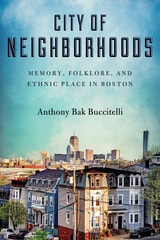
City of Neighborhoods
Memory, Folklore, and Ethnic Place in BostonAnthony Bak Buccitelli
University of Wisconsin Press, 2016
East Boston has long been known as an Italian neighborhood and Southie as an Irish one, while nearby North Quincy has seen in recent decades an influx of Chinese Americans and immigrants. Such urban spaces in America can become intimately intertwined with ethnic identities (Little Italy, Greektown, Chinatown, Little Havana). Yet local residents often readily acknowledge an underlying diversity—both historically and as a result of more recent changes—that complicates such stereotypes.
Digging into the ever-shifting terrain of American ethnicity and urban spaces, Anthony Bak Buccitelli investigates folk practices, social memory, and local histories in three Boston-area neighborhoods. He looks at the ways locals represent their neighborhoods and themselves via events, symbols, stories, and landmarks, from the shamrock to the Chinese flag, whether the St. Patrick’s Day parade in Southie or the Columbus Day parade in East Boston, from urban graffiti and websites to the Dorchester Heights Monument. City of Neighborhoods exposes the processes of selection and emphasis that produce, sustain, challenge, and change understandings of urban spaces as ethnic places.
Honorable mention, Wayland Hand Prize for Folklore and History, American Folklore Society
[more]
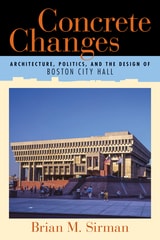
Concrete Changes
Architecture, Politics, and the Design of Boston City HallBrian M. Sirman
University of Massachusetts Press, 2018
From the 1950s to the end of the twentieth century, Boston transformed from a city in freefall into a thriving metropolis, as modern glass skyscrapers sprouted up in the midst of iconic brick rowhouses. After decades of corruption and graft, a new generation of politicians swept into office, seeking to revitalize Boston through large-scale urban renewal projects. The most important of these was a new city hall, which they hoped would project a bold vision of civic participation. The massive Brutalist building that was unveiled in 1962 stands apart—emblematic of the city's rebirth through avant-garde design.
And yet Boston City Hall frequently ranks among the country's ugliest buildings. Concrete Changes seeks to answer a common question for contemporary viewers: How did this happen? In a lively narrative filled with big personalities and newspaper accounts, Brian M. Sirman argues that this structure is more than a symbol of Boston's modernization; it acted as a catalyst for political, social, and economic change.
And yet Boston City Hall frequently ranks among the country's ugliest buildings. Concrete Changes seeks to answer a common question for contemporary viewers: How did this happen? In a lively narrative filled with big personalities and newspaper accounts, Brian M. Sirman argues that this structure is more than a symbol of Boston's modernization; it acted as a catalyst for political, social, and economic change.
[more]
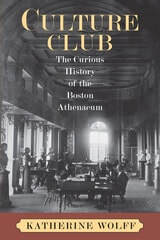
Culture Club
The Curious History of the Boston AthenaeumKatherine Wolff
University of Massachusetts Press, 2009
Founded in 1807, the successor to a literary club called the Anthology Society, the Boston Athenaeum occupies an important place in the early history of American intellectual life. At first a repository for books, to which works of art were later added, the Athenaeum attracted over time a following that included such literary luminaries as Ralph Waldo Emerson and Henry James.
Yet from the outset, Katherine Wolff shows, the Boston Athenaeum was more than a library; it was also a breeding ground for evolving notions of cultural authority and American identity. Though governed by the Boston elite, who promoted it as a way of strengthening their own clout in the city, the early Athenaeum reflected conflicting and at times contradictory aims and motives on the part of its membership. On the one hand, by drawing on European aesthetic models to reinforce an exalted sense of mission, Athenaeum leaders sought to establish themselves as guardians of a nascent American culture. On the other, they struggled to balance their goals with their concerns about an increasingly democratic urban populace. As the Boston Athenaeum opened its doors to women as well as men outside its inner circle, it eventually began to define itself against a more accessible literary institution, the Boston Public Library.
Told through a series of provocative episodes and generously illustrated, Culture Club offers a more complete picture than previously available of the cultural politics behind the making of a quintessentially American institution.
[more]