Results by title
96 books match the query 'Buddhism' and 7 start with c
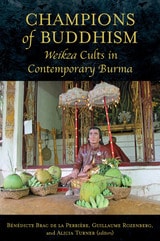
Champions of Buddhism
Weikza Cults in Contemporary BurmaEdited by Bénédicte Brac de la Perrière, Guillaume Rozenberg, and Alicia Turner
National University of Singapore Press, 2014
Hidden at the margins of Burmese Buddhism and culture, the cults of the weikza shape Burmese culture by bringing together practices of supernatural power and a mission to protect Buddhism. This exciting new research on an often hidden aspect of Burmese religion places weikza in relation to the Vipassana insight meditation movement and conventional Buddhist practices, as well as the contemporary rise of Buddhist fundamentalism. Featuring research based on fieldwork only possible in recent years, paired with reflective essays by senior Buddhist studies scholars, this book situates the weikza cult in relation to broader Buddhist and Southeast Asian contexts, offering interpretations and investigations as rich and diverse as the Burmese expressions of the weikza cults themselves. Champions of Buddhism opens the field to new questions, new problems, and new connections with the study of religion and Southeast Asia in general.
[more]
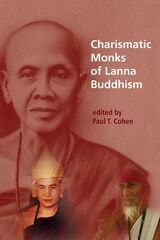
Charismatic Monks of Lanna Buddhism
Edited by Paul T. Cohen
National University of Singapore Press, 2017
Lanna Buddhism is a variant of Theravada Buddhism that evolved between the 13th and 16th centuries in northern Thailand and spread to neighbouring areas of the Upper Mekong region. A salient feature is the belief in charismatic monks, some of whom are renowned for their asceticism, supernatural powers and strivings to recreate a utopian ‘Buddha-land’. Issues highlighted in the book are the relationship of these charismatic monks to the state and state-controlled monkhood (sangha), the tendency for religious construction to spill over into economic development activities, and the diversity of lowland and highland devotional communities from Thailand and Myanmar. The book also explores contemporary influences on this religious tradition: the continuing marginalization of highland minorities and consequent devotion to messianic leaders, the incorporation for Lanna holy men into a national constellation of popular charismatic monks, the commercialization of Buddhism, and the patronage of wealthy urban elites. Charismatic Monks of Lanna Buddhism will appeal to scholars within the fields of Buddhist studies, Thai studies and the anthropology of religion as well as to those with an interest in the study of contemporary religious change in Thailand.
[more]
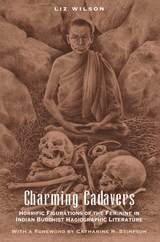
Charming Cadavers
Horrific Figurations of the Feminine in Indian Buddhist Hagiographic LiteratureLiz Wilson
University of Chicago Press, 1996
In this highly original study of sexuality, desire, the body, and women,
Liz Wilson investigates first-millennium Buddhist notions of
spirituality. She argues that despite the marginal role women played in
monastic life, they occupied a very conspicuous place in Buddhist
hagiographic literature. In narratives used for the edification of
Buddhist monks, women's bodies in decay (diseased, dying, and after
death) served as a central object for meditation, inspiring spiritual
growth through sexual abstention and repulsion in the immediate world.
Taking up a set of universal concerns connected with the representation
of women, Wilson displays the pervasiveness of androcentrism in Buddhist
literature and practice. She also makes persuasive use of recent
historical work on the religious lives of women in medieval
Christianity, finding common ground in the role of miraculous
afflictions.
This lively and readable study brings provocative new tools and insights
to the study of women in religious life.
[more]

Choose Peace
A Dialogue Between Johan Galtung and Daisaku IkedaJohan Galtung and Daisaku Ikeda
Pluto Press, 1995
[more]
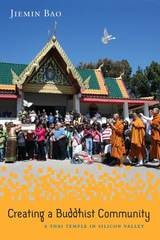
Creating a Buddhist Community
A Thai Temple in Silicon ValleyJiemin Bao
Temple University Press, 2015
The Wat Thai Buddhist Temple in Silicon Valley was founded in 1983 by a group of predominantly middle-class men and women with different ethnic and racial identities. The temple, which functions as a religious, social, economic, educational, and cultural hub, has become a place for the community members to engage in spiritual and cultural practices.
In Creating a Buddhist Community, Jiemin Bao shows how the Wat Thai participants practice Buddhism and rework gender relationships in the course of organizing temple space, teaching meditation, schooling children in Thai language and culture, merit making, fundraising, and celebrating festivals.
Bao’s detailed account of the process of creating an inclusive temple community with Thai immigrants as the majority helps to deconstruct the exoticized view of Buddhism in American culture. Creating a Buddhist Community also explores Wat Thai’s identification with both the United States and Thailand and how this transnational perspective reimagines and reterritorializes what is called American Buddhism.
[more]
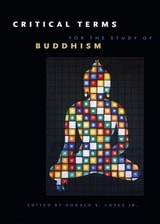
Critical Terms for the Study of Buddhism
Edited by Donald S. Lopez Jr.
University of Chicago Press, 2005
Over the past century, Buddhism has come to be seen as a world religion, exceeding Christianity in longevity and, according to many, philosophical wisdom. Buddhism has also increasingly been described as strongly ethical, devoted to nonviolence, and dedicated to bringing an end to human suffering. And because it places such a strong emphasis on rational analysis, Buddhism is considered more compatible with science than the other great religions. As such, Buddhism has been embraced in the West, both as an alternative religion and as an alternative to religion.
This volume provides a unique introduction to Buddhism by examining categories essential for a nuanced understanding of its traditions. Each of the fifteen essays here shows students how a fundamental term—from art to word—illuminates the practice of Buddhism, both in traditional Buddhist societies and in the realms of modernity. Apart from Buddha, the list of terms in this collection deliberately includes none that are intrinsic to the religion. Instead, the contributors explore terms that are important for many fields and that invite interdisciplinary reflection. Through incisive discussions of topics ranging from practice, power, and pedagogy to ritual, history, sex, and death, the authors offer new directions for the understanding of Buddhism, taking constructive and sometimes polemical positions in an effort both to demonstrate the shortcomings of assumptions about the religion and the potential power of revisionary approaches.
Following the tradition of Critical Terms for Religious Studies, this volume is not only an invaluable resource for the classroom but one that belongs on the short list of essential books for anyone seriously interested in Buddhism and Asian religions.
[more]
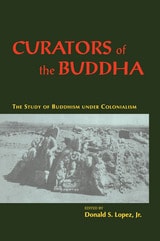
Curators of the Buddha
The Study of Buddhism under ColonialismEdited by Donald S. Lopez Jr.
University of Chicago Press, 1995
Curators of the Buddha is the first critical history of the study of Buddhism in the West and the first work to bring the insights of colonial and postcolonial cultural studies to bear on this field.
After an overview of the origins of Buddhist studies in the early nineteenth century, the essays focus on important "curators of the Buddha," such as Aurel Stein, D. T. Suzuki, and Carl Jung, who, as they created and maintained the discipline, played a significant role in disseminating knowledge about Buddhism in the West. The essays bring to life many of the important but unexamined social, political, and cultural conditions that have shaped the course of Buddhist studies for more than a century—and have frequently distorted the understanding of a complex set of traditions. Contributors Charles Hallisey, Gustavo Benavides, Stanley Abe, Luis Gómez, Robert Sharf, and Donald Lopez challenge some of the most enduring ideas in Buddhist studies: that Zen Buddhism is, above all, an experience; that Tibetan Buddhism is polluted, or pristine; that the Buddha image is of Greek or Roman origin; that the classical text supersedes the vernacular, as the manuscript supersedes the informant; and many others.
After an overview of the origins of Buddhist studies in the early nineteenth century, the essays focus on important "curators of the Buddha," such as Aurel Stein, D. T. Suzuki, and Carl Jung, who, as they created and maintained the discipline, played a significant role in disseminating knowledge about Buddhism in the West. The essays bring to life many of the important but unexamined social, political, and cultural conditions that have shaped the course of Buddhist studies for more than a century—and have frequently distorted the understanding of a complex set of traditions. Contributors Charles Hallisey, Gustavo Benavides, Stanley Abe, Luis Gómez, Robert Sharf, and Donald Lopez challenge some of the most enduring ideas in Buddhist studies: that Zen Buddhism is, above all, an experience; that Tibetan Buddhism is polluted, or pristine; that the Buddha image is of Greek or Roman origin; that the classical text supersedes the vernacular, as the manuscript supersedes the informant; and many others.
[more]