Results by title
53 books match the query 'Capital punishment' and 3 start with c
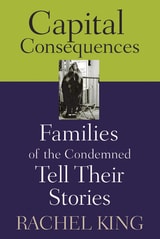
Capital Consequences
Families of the Condemned Tell Their StoriesKing, Rachel
Rutgers University Press, 2004
Those who support capital punishment often claim that they do so because it provides justice and closure for the victims’ families. In Capital Consequences, attorney Rachel King reminds us that there are other families and other victims who must be considered in the debate over the death penalty.
Combining a narrative voice with vivid, passionate, and painful accounts of the families of death row inmates, the book demonstrates that crimes that lead to death sentences also devastate the families of those convicted. These families, King argues, are the unseen victims of capital punishment.
King challenges readers to question the morality of a punishment that victimizes families of the condemned and ripples out through future generations. Chapters tell the stories of families that have lost life savings supporting an accused loved one, endured intense public scrutiny, been subjected to harassment by the media, and are struggling to live with the inhumane treatment that their loved ones receive on death row. The author also explores the unique nature of the grief that these families suffer. Because their pain tends to elicit less attention and empathy than that of the crime victims’ families, King shows how it becomes much more desperate and isolating.
On a human level, this book is a powerful reminder that tragic events have tragic consequences that far outreach their immediate victims. At the same time, the accounts illustrate many of the flaws inherent in the judicial system—racial and economic bias, incompetent counsel, prosecutorial misconduct, the execution of juveniles, and wrongful convictions, some of which are only now being overturned because of recent advances in DNA technology.
Regardless of which side of the death penalty issue you are on, this book will lead you to pause and consider that all acts—criminal and retributive—have broader human implications than we are sometimes willing to realize.
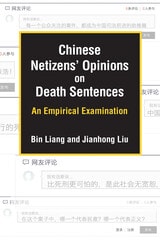
Chinese Netizens' Opinions on Death Sentences
An Empirical ExaminationBin Liang and Jianhong Liu
University of Michigan Press, 2021
Few social issues have received more public attention and scholarly debate than the death penalty. While the abolitionist movement has made a successful stride in recent decades, a small number of countries remain committed to the death penalty and impose it with a relatively high frequency. In this regard, the People’s Republic of China no doubt leads the world in both numbers of death sentences and executions. Despite being the largest user of the death penalty, China has never conducted a national poll on citizens’ opinions toward capital punishment, while claiming “overwhelming public support” as a major justification for its retention and use.
Chinese Netizens’ Opinions on Death Sentences: An Empirical Examination uses a forum of public comments to explore and examine Chinese netizens’ opinions on the death penalty. Based on a content analysis of 38,512 comments collected from 63 cases in 2015, this study examines the diversity and rationales of netizens’ opinions, netizens’ interactions, and their evaluation of China’s criminal justice system. In addition, the book discusses China’s social, systemic, and structural problems and critically examines the rationality of netizens’ opinions based on Habermas’s communicative rationality framework. Readers will be able to contextualize Chinese netizens’ discussions and draw conclusions about commonalities and uniqueness of China’s death penalty practice.
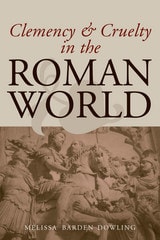
Clemency and Cruelty in the Roman World
Melissa Barden Dowling
University of Michigan Press, 2006
In this first thorough study of the origins of clemency, Dowling provides a vivid look at the ideology of clemency and new philosophies of mercy and cruelty in Western society, through an examination of ancient art, literature, historical documents, and archaeological artifacts. By illuminating the emergence of mercy and forgiveness as social concepts, and the mechanisms by which peoples are transformed in response to changes in power structures, Dowling makes an important contribution to the study of the ancient Roman world, as well as to modern Western culture.