50 books match the query 'Case' and 6 start with c

cover of Caribbean Literature After Independence: The Case of Earl Lovelace

Caribbean Literature After Independence

The Case of Earl Lovelace

Edited by Bill Schwarz

University of London Press, 2008

Trinidad, historically located at the crossroads of the Americas, has produced an incomparable national literature, fashioning genres that have informed the Caribbean region as a whole. One of the greatest contemporary Trinidadian writers is Earl Lovelace. His novelistic performative epics combine the rhythms of steelband and calypso with the narrative complexity of Faulkner. Lovelace was an early enthusiast for Black Power and remains an indefatigable critic of the inequalities bequeathed by the post-Independence state. Embracing an aesthetic that seeks out the darkness of the nation - the traces of Africa, the passions of the black dispossessed, the liturgies of the Shouter churches - he strives to imagine a society which might at last break free from its colonial past, dramatizing the political and psychic struggles of the poor for selfhood. This is the first published volume to assess Lovelace's fiction and also his larger role in Caribbean letters. The contributors to this book include: J. Dillon Brown (Washington University, St.
Louis), Chris Campbell (Queen Mary, University of London), Louis James (emeritus professor, University of Kent), Nicole King (Royal Holloway, University of London), Aaron Love (New York University), Patricia Murray (London Metropolitan University), James Procter (Newcastle University), Kate Quinn (Institute for the Study of the Americas, University of London), Tina K. Ramnarine (Royal Holloway, University of London), Bill Schwarz (Queen Mary, University of London), Lawrence Scott (University of Trinidad and Tobago), and John Thieme (University of East Anglia).

[more]
cover of Case Marking and Grammatical Relations in Polynesian

Case Marking and Grammatical Relations in Polynesian

By Sandra Chung

University of Texas Press, 1978

Case Marking and Grammatical Relations in Polynesian makes an outstanding contribution to both Polynesian and historical linguistics. It is at once a reference work describing Polynesian syntax, an investigation of the role of grammatical relations in syntax, and a discussion of ergativity, case marking, and other areas of syntactic diversity in Polynesian. In its treatment of the history of case marking in Polynesian, it attempts to specify what counts as evidence in syntactic reconstruction and how syntactic reanalysis progresses. It therefore represents a first step toward a general theory of syntactic change.

Chung first describes the basic syntax of the Polynesian languages, discussing Maori, Tongan, Samoan, Kapingamarangi, and Pukapukan in depth. She then presents an investigation of the grammatical relations of these languages and their relevance to syntax and shows that the syntax of all these languages—even those with ergative case marking—revolves around the familiar grammatical relations subject and direct object. Finally the book traces the historical development of the different case systems from their origins in Proto-Polynesian.

[more]
cover of Catching a Case: Inequality and Fear in New York City's Child Welfare System

Catching a Case

Inequality and Fear in New York City's Child Welfare System

Lee, Tina

Rutgers University Press, 2016

Influenced by news reports of young children brutalized by their parents, most of us see the role of child services as the prevention of severe physical abuse. But as Tina Lee shows in Catching a Case, most child welfare cases revolve around often ill-founded charges of neglect, and the parents swept into the system are generally struggling but loving, fighting to raise their children in the face of crushing poverty, violent crime, poor housing, lack of childcare, and failing schools.
 
Lee explored the child welfare system in New York City, observing family courts, interviewing parents and following them through the system, asking caseworkers for descriptions of their work and their decision-making processes, and discussing cases with attorneys on all sides. What she discovered about the system is troubling. Lee reveals that, in the face of draconian budget cuts and a political climate that blames the poor for their own poverty, child welfare practices have become punitive, focused on removing children from their families and on parental compliance with rules. Rather than provide needed help for families, case workers often hold parents to standards almost impossible for working-class and poor parents to meet. For instance, parents can be accused of neglect for providing inadequate childcare or housing even when they cannot afford anything better. In many cases, child welfare exacerbates family problems and sometimes drives parents further into poverty while the family court system does little to protect their rights. 
 
Catching a Case is a much-needed wake-up call to improve the child welfare system, and to offer more comprehensive social services that will allow all children to thrive. 
 
[more]
cover of Closet Writing/Gay Reading: The Case of Melville's Pierre

Closet Writing/Gay Reading

The Case of Melville's Pierre

James Creech

University of Chicago Press, 1994

One of the most urgent tasks for gay studies today, James Creech argues, is the retrieval of a repressed, "closeted" literary heritage. But contradictions and problems cloud even the most basic theoretical questions: What does a lesbian or gay reading of a literary text require or presume? Can we talk about a homosexual writer expressing him- or herself before the invention of "homosexuality"? Was it possible for a writer like Herman Melville, for example, to create literary works linked to his own prohibited eros?

In Closet Writing/Gay Reading, Creech shows how a literary critic can be receptive to implicit and closeted sexual content. Forcefully advocating a tactic of identification and projection in literary analysis, he lends renewed currency to the kind of "sentimental" response to literature that continental theory—particularly deconstruction—has sought to discredit.

In the second half of his book, Creech sets out to analyze what he considers the exemplary novel of the nineteenth-century closet, Melville's Pierre, or: The Ambiguities. By approaching Pierre as the gay man Melville longed to have as its reader, Creech is able to decipher the novel's "encrypted erotics" and to reveal that Melville's apparent tale of incest is actually a homosexual novel in disguise. The closeted "address" to queer-sensitive readers that Pierre disseminates finally receives a critical reading that strives to be explicit, shareable, and public.
[more]
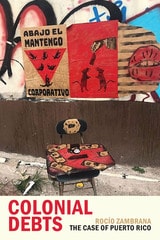
cover of Colonial Debts: The Case of Puerto Rico

Colonial Debts

The Case of Puerto Rico

Rocío Zambrana

Duke University Press, 2021
With the largest municipal debt in US history and a major hurricane that destroyed much of the archipelago's infrastructure, Puerto Rico has emerged as a key site for the exploration of neoliberalism and disaster capitalism. In Colonial Debts Rocío Zambrana develops the concept of neoliberal coloniality in light of Puerto Rico's debt crisis. Drawing on decolonial thought and praxis, Zambrana shows how debt functions as an apparatus of predation that transforms how neoliberalism operates. Debt functions as a form of coloniality, intensifying race, gender, and class hierarchies in ways that strengthen the colonial relationship between Puerto Rico and the United States. Zambrana also examines the transformation of protest in Puerto Rico. From La Colectiva Feminista en Construcción's actions, long-standing land rescue/occupation in the territory, to the July 2019 protests that ousted former governor Ricardo “Ricky” Rosselló, protests pursue variations of decolonial praxis that subvert the positions of power that debt installs. As Zambrana demonstrates, debt reinstalls the colonial condition and adapts the racial/gender order essential to it, thereby emerging as a key site for political-economic subversion and social rearticulation.
[more]
cover of Cultivating Ecologies for Digital Media Work: The Case of English Studies

Cultivating Ecologies for Digital Media Work

The Case of English Studies

Catherine C. Braun

Southern Illinois University Press, 2014

The onslaught of the digital age has rapidly redefined the parameters of virtually every aspect of daily life, and the world of academic scholarship is no exception. In English departments across American institutions of higher education, faculty members face an uphill battle in the struggle for professional recognition of their digital works. In Cultivating Ecologies for Digital Media Work, author Catherine C. Braun calls for a shift in thinking about the professional methods and digital goals of the English studies discipline and its central texts.

Braun’s in-depth study documents English professors and the challenges they face in both career and classroom as they attempt to gain appropriate value for digital teaching and creation within their field, departments, and institutions. Braun proposes that to move English studies into the future, three main questions must be addressed. First, what counts as a text? How should we approach the reading of texts? Finally, how should we approach the production of texts? In addition to reconsidering the nature of texts in English studies, she calls for crucial changes in higher-education institutional procedures themselves, including new methods of evaluating digital scholarship on an even playing field with other forms of work during the processes for promotion and tenure.

With insightful expertise, Braun analyzes how the new age of digital scholarship not only complements the traditional values of the English studies discipline but also offers constructive challenges to old ideas about texts, methods, and knowledge production. Cultivating Ecologies for Digital Media Work is the first volume to offer specific examination of the digital shift’s impact on English studies and provides the scaffold upon which productive conversations about the future of the field and digital pedagogy can be built.

[more]