Results by title
63 books match the query 'Cases' and 3 start with c
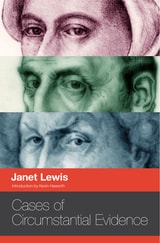
Cases of Circumstantial Evidence
Janet Lewis
Ohio University Press, 2013
This is the first digital version of Cases of Circumstantial Evidence, a collection of three historical novels by noted American writer Janet Lewis. For the first time, these works have been brought together in a single edition, each with a new introduction by Kevin Haworth:
The Wife of Martin Guerre
Based on a notorious trial in sixteenth-century France, The Wife of Martin Guerre follows Bertrande de Rois and her lost-and-returned husband through a tale of impersonation, conspiracy, and small-town intrigue. Their fascinating story has also inspired a bestselling historical study and two films, including The Return of Martin Guerre.
The Trial of Sören Qvist
Although set in seventeenth-century Denmark, The Trial of Sören Qvist has a contemporary feel and has been praised for its intriguing plot and for Lewis’s powerful writing. In this second novel in the Cases of Circumstantial Evidence, Lewis recounts the story of a murder, an investigation, and a pious town pastor who confesses to the crime, driven perhaps more by a recognition of his own moral flaws than by guilt for the acts of which he stood accused.
The Ghost of Monsieur Scarron
The court of Louis XIV and a modest Paris street provide the incongruous settings for this tale of a humble bookbinder, his wife, and the young craftsman who seduces her and blackmails her husband into covering up a terrible crime. This third and last case of circumstantial evidence bristles with character, the smell of blood, and considerable suspense against a backdrop of national political unrest in the cruel and dingy Paris of the seventeenth century.
Church State Corporation
Construing Religion in US LawWinnifred Fallers Sullivan
University of Chicago Press, 2020
Through readings of the opinions of the US Supreme Court and other legal texts, Sullivan shows how “the church” as a religious collective is granted special privilege in US law. In-depth analyses of Hosanna-Tabor v. EEOC and Burwell v. Hobby Lobby reveal that the law tends to honor the religious rights of the group—whether in the form of a church, as in Hosanna-Tabor, or in corporate form, as in Hobby Lobby—over the rights of the individual, offering corporate religious entities an autonomy denied to their respective members. In discussing the various communities that construct the “church-shaped space” in American law, Sullivan also delves into disputes over church property, the legal exploitation of the black church in the criminal justice system, and the recent case of Masterpiece Cakeshop v. Colorado Civil Rights Commission. Brimming with insight, Church State Corporation provocatively challenges our most basic beliefs about the ties between religion and law in ostensibly secular democracies.
Constitutional Judiciary in a New Democracy
The Hungarian Constitutional CourtLaszlo Solyom and Georg Brunner, Editors
University of Michigan Press, 2000
How was it possible that a new Court established in 1990, in a country just released from forty years of Communist rule, was able to enforce a Constitution, maintain the rule of law, and protect the freedom of its citizens in a way comparable to the U.S. Supreme Court? This new Court has issued decisions on topics ranging from the establishment of democracy and a market economy--privatization, compensation for the nationalization of property, and retroactive criminal legislation--as well as such issues as the constitutionality of capital punishment, abortion, freedom of speech and the media, and the separation of powers.
U.S. Supreme Court Justice Stephen Breyer provides the foreword and introduces the two essays that begin the book. In the first essay, Georg Brunner explains how the Court was set up and what its procedures are. In the second, Lázszló Sólyom describes systematically the emergence of the case-law of the Court and its jurisprudence on constitutional rights and on the powers and procedures of the other branches of government. The models followed by the Court are outlined, and its contribution to global constitutionalism explored.
Lázszló Sólyom is President of the Constitutional Court of Hungary and Professor of Law, ELTE University of Budapest. Georg Brunner is Professor of Law, University of Cologne, Germany.