475 books match the query 'Catholic' and 32 start with c
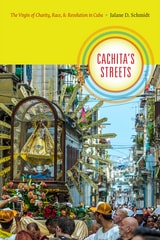
cover of Cachita's Streets: The Virgin of Charity, Race, and Revolution in Cuba

Cachita's Streets

The Virgin of Charity, Race, and Revolution in Cuba

Jalane D. Schmidt

Duke University Press, 2015
Cuba’s patron saint, the Virgin of Charity of El Cobre, also called Cachita, is a potent symbol of Cuban national identity. Jalane D. Schmidt shows how groups as diverse as Indians and African slaves, Spanish colonial officials, Cuban independence soldiers, Catholic authorities and laypeople, intellectuals, journalists and artists, practitioners of spiritism and Santería, activists, politicians, and revolutionaries each have constructed and disputed the meanings of the Virgin. Schmidt examines the occasions from 1936 to 2012 when the Virgin's beloved, original brown-skinned effigy was removed from her national shrine in the majority black- and mixed-race mountaintop village of El Cobre and brought into Cuba's cities. There, devotees venerated and followed Cachita's image through urban streets, amassing at large-scale public ceremonies in her honor that promoted competing claims about Cuban religion, race, and political ideology. Schmidt compares these religious rituals to other contemporaneous Cuban street events, including carnival, protests, and revolutionary rallies, where organizers stage performances of contested definitions of Cubanness. Schmidt provides a comprehensive treatment of Cuban religions, history, and culture, interpreted through the prism of Cachita.
[more]
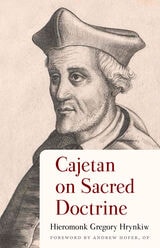
cover of Cajetan on Sacred Doctrine

Cajetan on Sacred Doctrine

Hieromonk Gregory Hrynkiw

Catholic University of America Press, 2020
Cardinal Tommaso de Vio (1469-1534), commonly known as Cajetan, remains a misunderstood figure. Cajetan on Sacred Doctrine is the first ever monograph on Cajetan as a theologian in his own right, and it fills an immense lacuna in the debate on the nature of sacred doctrine from the Thomism of the Renaissance. Confirming Cajetan as a key protagonist within the emergent Reformation, this work delivers an indispensable immersion into his theological method in relation to his closest predecessors and contemporaries: Hervaeus Natalis, Blessed Duns Scotus, Gregory of Rimini, Johannes Capreolus, Silvestro Mazzolini da Prierio, Martin Luther, and others. The first ever commentary on St. Thomas Aquinas’s entire Summa Theologiae was published by Cajetan. This monograph focuses primarily on the Summa Theologiae Ia pars, question 1, concerning sacred doctrine, and how Cajetan unpacks the potency of Aquinas’s opening syllogism, setting forth a coherent division of the question, and ultimately touching the mind of Aquinas when revealing the articles of the Apostles’ Creed as the Summa Theologiae’s macrostructure. Finally, we are shown how Cajetan emphasizes the essential link between ecclesiology and the communication of sacred doctrine, especially the papacy’s role in guaranteeing the proposal and explication of the faith. Cajetan’s accomplishments as a biblical exegete established him as a renowned Renaissance scholar and a forerunner of future ecumenical dialogue. Furthermore, his grasp of theology’s perennial properties continue to make him an important interlocutor in the renewed quest for a unity in theology in an ever more fragmented aggregation of theologies. Cajetan’s theological labor is a perpetuation of the via antiqua, a biblical-theological worldview handed down through Tradition. St. Gregory the Theologian (329-390), the via antiqua’s preeminent Eastern representative and chief theological constructor of Christendom, offers the monograph’s author--himself a Byzantine Hieromonk--a prime opportunity for a few closing insights on the innate symphony between two very distant periods and distinct theological traditions within the one ecumenical Church.
[more]
cover of Called to Holiness

Called to Holiness

Pope Emeritus Benedict XVI Pope Emeritus Benedict XVI

Catholic University of America Press, 2017
This edited collection is the first to gather in one volume the most relevant addresses, speeches, and homilies of His Holiness, Pope Emeritus Benedict XVI to seminarians and consecrated men and women into a single volume for the English-speaking world.
[more]
cover of Canon Law in the Age of Reforms (c. 1000 to c. 1150)

Canon Law in the Age of Reforms (c. 1000 to c. 1150)

Christof Rolker

Catholic University of America Press, 2023

This monograph addresses the history of canon law in Western Europe between ca. 1000 and ca. 1150, specifically the collections compiled and the councils held in that time. The main part consists of an analysis of all major collections, taking into account their formal and material sources, the social and political context of their origin, the manuscript transmission, and their reception more generally. As most collections are not available in reliable editions, a considerable part of the discussion involves the analysis of medieval manuscripts. Specialized research is available for many but not all these works, but tends to be scattered across miscellaneous publications in English, German, French, Italian, and Spanish; one purpose of the book is thus to provide relatively uniform, up-to-date accounts of all major collections of the period. At the same time, the book argues that the collections are much more directly influenced by the social milieux from which they emerged, and that more groups were involved in the development of high medieval canon law than it has previously been thought. In particular, the book seeks to replace the still widely held belief that the development of canon law in the century before Gratian’s Decretum (ca. 1140) was largely driven by the Reform papacy. Instead, it is crucial to take into account the contribution of bishops, monks, and other groups with often conflicting interests. Put briefly, local needs and conflicts played a considerably more important role than central (papal) ‘reform’, on which older scholarship has largely focused.
[more]
cover of Canonizing Francisco Solano: Devotion, Politics, and a New Model of Sanctity in the Early Americas

Canonizing Francisco Solano

Devotion, Politics, and a New Model of Sanctity in the Early Americas

Carlos Piccone Camere

Catholic University of America Press, 2026
Francisco Solano (1549–1610), a Spanish-born Franciscan friar, spent roughly half of his religious life in the Viceroyalty of Peru, where he became known as a zealous preacher, tireless missionary, a friar devoted to prayer and penance, and a reputed wonderworker. Among the many exemplary missionaries of the early modern Catholic world, he acquired an extraordinary reputation for sanctity in the decades following his death. Yet despite being one of the earliest officially promoted canonization causes from the Americas, and despite an initially auspicious process, his canonization advanced only slowly through a long and complex path. Canonizing Francisco Solano offers the first full-length study in English of Solano’s canonization process and uses his case to illuminate the making of sainthood in the Spanish Empire. Moving beyond official papal documents and conventional hagiographic narratives, the book draws on archival research in Rome, Madrid, Seville, and Lima to examine how sanctity was not only recognized but also debated, promoted, delayed, and reshaped by competing interests and institutional priorities. The book demonstrates how the slow progress of Solano’s cause was shaped by changing Roman procedures after the Council of Trent, tensions within the Franciscan world, competition with other causes such as that of Rosa de Lima, and the political priorities of the papacy, the Spanish monarchy, and colonial elites. In this account, canonization appears not merely as a devotional or theological process, but also as a field of negotiation in which papal authority, imperial ambition, religious orders, and local aspirations all played a role. Solano’s case opens a new perspective on colonial Peru, early modern Rome, and the wider Catholic world, while offering a broader contribution to the history of sanctity, canonization, and the relationship between religion and power in the early Americas.
[more]
cover of Catholic Influence on American Colonial Policies, 1898-1904

Catholic Influence on American Colonial Policies, 1898-1904

By Frank T. Reuter

University of Texas Press, 1967

At the close of the Spanish-American War the United States found itself in possession of a colonial empire. The role played by the American Catholic Church in influencing administrative policy for the new, and predominately Catholic, dependencies is the subject of this incisive study by Frank T. Reuter.

Reuter discusses the centuries-old intricate involvement of the Spanish crown and the native Roman Catholic Church in the civil, social, and charitable institutions of Cuba, Puerto Rico, Guam, and the Philippines. He explores the attempts of United States officials to apply the traditional doctrine of separation of church and state in resolving the problems of a Church-run school system, the alleged desecration of native Catholic churches by American forces in the Philippines, the native antagonism toward the Spanish friars, and the disposition of Church property in dependencies with a deeply rooted correlation between the Catholic Church and the state.

Recounting the development of the Catholic Church in America, which felt responsible for maintaining the islands’ religious structure after Spanish control was removed, Reuter sees the reaction of the Church to the war with Spain and to colonial policy in the early postwar period as voiced not by a monolithic political force, but by diverse spokesmen—in particular the unofficial voice of the Catholic press. He traces the growth of the Church in the United States from a disparate group of dioceses clinging to European backgrounds, disunited by a divided hierarchy, and attacked by the wave of the anti-Catholic, nativistic sentiments of the last two decades of the nineteenth century, to a church body unified by the problems in the colonies. Catholic opinion, although not utilized to its full political potential, achieved a common focus through the formation of the Federation of American Catholic Societies and the debate in Congress over the Philippine Government Bill.

This study of American and native Catholic attitudes toward the formulation of United States policy in the insular dependencies and the attitude of the United States government toward the Catholic interests in the dependencies details the interplay of personalities and organizations: Presidents William McKinley and Theodore Roosevelt; William Howard Taft, civil governor of the Philippines; James Cardinal Gibbons, moderator between Catholic factions and official spokesman of the hierarchy to the Papacy and the United States government; Archbishop Placide L. Chapelle, apostolic delegate of the Vatican to the Philippines; Archbishop John Ireland, friend of President McKinley; the Philippine Commissions; and the Taft Mission to the Vatican in 1902.
[more]
cover of Catholic Lives, Contemporary America

Catholic Lives, Contemporary America

Thomas J. Ferraro, ed.

Duke University Press, 1997

What does it mean to be—or to have been raised—Catholic in America today, now that formally nonpracticing Catholics outnumber the memberships of any other single denomination? Catholic Lives, Contemporary America is a collection of informed and spirited essays focusing on Catholic lay practices not commonly recognized or, at times, officially sanctioned. For the formidable array of scholars and writers gathered here, being Catholic is not simply a matter of going to confession or attending Mass, and Catholicism’s contributions to American cultural identity remain open to question.
Edited and with an introduction by Thomas J. Ferraro, Catholic Lives, Contemporary America offers a banquet of essays and interviews, at once subtle and accessible, treating American Catholic lives and legacies with compassion and flair.

Contributors. Patrick Allitt, Paul Crowley, Thomas J. Ferraro, James T. Fisher, Paul Giles, Mary Gordon, Stanley Hauerwas, Frank Lentricchia, Robert A. Orsi, Camille Paglia, David Plante, Richard Rodriguez, Kathy Rudy, Andrew Sullivan, Mary Jo Weaver

[more]
cover of Catholic Lives/Contemporary America, Volume 93

Catholic Lives/Contemporary America, Volume 93

Thomas J. Ferraro

Duke University Press, 0
[more]
cover of Catholic Pacifist: The Long and Lonely Quest of Gordon Zahn

Catholic Pacifist

The Long and Lonely Quest of Gordon Zahn

Benjamin Peters

Catholic University of America Press, 2026
A study of the life and work of Gordon Zahn (1918-2007), one of the most significant and formative figures in the history of the US Catholic peace movement. During World War II, Zahn was one of only a handful of US Catholic conscientious objectors, an experience that first put him in contact with Dorothy Day and the Catholic Worker. Following the war, Zahn completed a PhD in sociology at The Catholic University of America where Paul Hanly Furfey’s “supernatural sociology” had a profound effect on him. After joining the faculty at Loyola University, Chicago, Zahn won a Fulbright year in Germany (1956-57) where he discovered the story of Franz Jägerstätter, the Austrian Catholic farmer, husband, and father who was beheaded by the Nazis in 1943 for refusing to participate in Hitler’s military. It was Zahn’s 1964 book In Solitary Witness that introduced Jägerstätter to an international audience and led to his beatification by Pope Benedict XVI in 2007. This work, along with Zahn’s several other books, secured his place as a leading intellectual in the Catholic peace movement. His work influenced the discussions of war and peace at the Second Vatican Council and he was enlisted as an expert witness during the drafting of the US Catholic Bishops’ pastoral letter on nuclear weapons, The Challenge of Peace (1983). Zahn made one of the most intellectually developed cases in the US for "Catholic pacifism"—two terms that both Catholics and pacifists had long regarded as deeply incompatible. Forging a Catholic pacifist position led him to be far more perceptive and critical of US political and military institutions than most of fellow US Catholics. Ultimately, Zahn saw the Catholic Church as the only institution capable of resisting, and support those who resist, modern warfare and the modern war-making state. His traditional view of the Church grounded his claim that Catholics can be pacifist and his further assertion that the Church should serve as a “source of dissent” for Catholics and others, especially during times of war. While marginalized within the broader US Catholic intellectual community, Zahn found common cause with other Catholic luminaries who are now seen to be ahead of their time, including Dorothy Day, Thomas Merton, and Daniel Berrigan. Gordon Zahn’s story serves as a template for telling the broader story of the US Catholic peace movement and the development of Catholic attitudes on war and conscientious objection that took place within the twentieth century.
[more]
cover of Catholicism and Liberal Democracy: Forgotten Roots and Future Prospects

Catholicism and Liberal Democracy

Forgotten Roots and Future Prospects

James Martin Carr

Catholic University of America Press, 2022
Catholicism and Liberal Democracy seeks to clarify if there is a place for Catholicism in the public discourse of modern liberal democracy, bringing secular liberalism, as articulated by Jürgen Habermas, into conversation with the Catholic tradition. James Martin Carr explores three aspects of the Catholic tradition relevant to this debate: the Church’s response to democracy from the nineteenth century up until the eve of the Second Vatican Council; the Council’s engagement with modernity, in particular through Gaudium et spes and Dignitatis humanae; and Joseph Ratzinger’s theology of politics as a particularly incisive (and influential) articulation of the Catholic tradition in this area. Jürgen Habermas’s theorization of the place of religion in modern democracy, both in his earlier secularist phase and after his ‘post-secular’ turn, is evaluated. The adequacy of Habermas’s recent attempts to accommodate religious citizens are critically examined and it is argued that developments in his later thought logically require a more thoroughgoing revision of his earlier theory. These developments, it is argued, create tantalizing openings for fruitful dialogue between Habermas and the Catholic tradition. Using analytical tools drawn from communications theory, the debates on same-sex marriage at Westminster and in the Irish referendum campaign are analyzed, assessing whether Catholic contributions to these debates comply with Habermasian rules of civic discourse. In light of this analysis, the prospects of, and impediments to, Catholic participation in public discourse are appraised. Carr concludes by proposing a Ratzingerian critique of contemporary attempts to redefine marriage within a broader, more fundamental critique of the modern democratic state as currently configured. A political system founded upon secularist monism cannot but regard Christian Gelasianism, and its Catholic variant in particular, as an existential threat. Thus, Catholics, however Habermasian their political behavior, can never be more than uneasy bedfellows with modern liberal democracy.
[more]
cover of Catholicism and Politics in Communist Societies

Catholicism and Politics in Communist Societies

Pedro Ramet, ed.

Duke University Press, 1990

This book is volume two of a three-volume work, Christianity Under Stress, which focuses on the experiences of Christian churches in contemporary communist and socialist societies. In this volume a distinguished group of experts examines the changing relationship of the Catholic church to contemporary communist and socialist societies in Eastern Europe, Latin America, and Asia.
Catholicism has, on the one hand, traditionally regarded earthly life as of secondary importance—as an instrument of spiritual transformation—and, on the other, has ascribed great value to the early institutions of the church, taking great interest in temporal matters that affects its institutional concerns. Against the backdrop of this duality, the church has changed over the centuries, adapting to local and national conditions. Catholicism and Politics in Communist Societies surveys these local and national adaptations in their historical contexts, linking the past experience of the church to its present circumstances. Organized around themes of tradition vs. modernity, hierarchy vs. lower clergy, and institutional structure vs. grass-roots organization, this comprehensive volume presents a detailed, country-by-country portrait of the political and social status of the church today in communist and socialist settings.

Contributors. Pedro Ramet, Arthur F. McGovern, Roman Solchanyk, Ivan Hvat, Robert F. Goeckel, C. Chrypinski, Milan J. Reban, Leslie Laszlo, Janice Broun, Eric O. Hanson, Stephen Denney, Thomas E. Quigley, Humberto Belli, Hansjakob Stehle, George H. Williams
[more]
cover of Catholics and Jews in Twentieth-Century America

Catholics and Jews in Twentieth-Century America

Egal Feldman

University of Illinois Press, 2006

Rich with the insights of prominent Catholic and Jewish commentators and religious leaders, Catholics and Jews in Twentieth-Century America recounts the amazing transformation of a relationship of irreconcilable enmity to one of respectful coexistence and constructive dialogue.

Focusing primarily on the Catholic doctrinal view of the Jews and its ramifications, Egal Feldman traces the historicalroots of anti-Semitism, examining tenacious Catholic beliefsincluding the idea that the Jews lost their place as the chosen people with the coming of Christianity, deicide, and the conviction that their purported responsibility for the Crucifixion justified subsequent Jewish misery.

A new era of Catholic-Jewish relations opened in 1962 with Vatican II’s Declaration on the Jews, reversing the theology of contempt. Feldman explores the strides made in improving relations, such as the Vatican’s diplomatic recognition of the Jewish state, as well as a number of recent issues.
[more]
cover of Católicos: Resistance and Affirmation in Chicano Catholic History

Católicos

Resistance and Affirmation in Chicano Catholic History

By Mario T. García

University of Texas Press, 2008

Chicano Catholicism—both as a popular religion and a foundation for community organizing—has, over the past century, inspired Chicano resistance to external forces of oppression and discrimination including from other non-Mexican Catholics and even the institutionalized church. Chicano Catholics have also used their faith to assert their particular identity and establish a kind of cultural citizenship.

Based exclusively on original research and sources, Mario T. García here offers the first major historical study to explore the various dimensions of the role of Catholicism in Chicano history in the twentieth century. This is also one of the first significant studies in the still limited field of Chicano religious history.

Topics range from how early Chicano Catholic intellectuals and civil rights leaders were influenced by Catholic Social Doctrine, to the role that popular religion has played in the lives of ordinary men and women in both rural and urban areas. García also examines faith-based Chicano community movements like Católicos Por La Raza in the 1960s and the Sanctuary movement in Los Angeles in the 1980s.

While Latino/a history and culture has been, for the most part, inextricably linked with the tenets and practices of Catholicism, there has been very little written, until recently, about Chicano Catholic history. García helps to fill that void and explore the impact—both positive and negative—that the Catholic experience has had on the Chicano community.
[more]
cover of Chicago Católico: Making Catholic Parishes Mexican

Chicago Católico

Making Catholic Parishes Mexican

Deborah E. Kanter

University of Illinois Press, 2020

Today, over one hundred Chicago-area Catholic churches offer Spanish language mass to congregants. How did the city's Mexican population, contained in just two parishes prior to 1960, come to reshape dozens of parishes and neighborhoods?

Deborah E. Kanter tells the story of neighborhood change and rebirth in Chicago's Mexican American communities. She unveils a vibrant history of Mexican American and Mexican immigrant relations as remembered by laity and clergy, schoolchildren and their female religious teachers, parish athletes and coaches, European American neighbors, and from the immigrant women who organized as guadalupanas and their husbands who took part in the Holy Name Society. Kanter shows how the newly arrived mixed memories of home into learning the ways of Chicago to create new identities. In an ever-evolving city, Mexican immigrants and Mexican Americans’ fierce devotion to their churches transformed neighborhoods such as Pilsen.

The first-ever study of Mexican-descent Catholicism in the city, Chicago Católico illuminates a previously unexplored facet of the urban past and provides present-day lessons for American communities undergoing ethnic integration and succession.
[more]
cover of Church, State, and Society: An Introduction to Catholic Social Doctrine

Church, State, and Society

An Introduction to Catholic Social Doctrine

J. Brian Benestad

Catholic University of America Press, 2011
Church, State, and Society explains the nuanced understanding of human dignity and the common good found in the Catholic intellectual tradition.
[more]
cover of Church, State, and Society: An Introduction to Catholic Social Doctrine, Second Edition

Church, State, and Society

An Introduction to Catholic Social Doctrine, Second Edition

J. Brian Benestad

Catholic University of America Press, 2025
Church, State, and Society explains the nuanced understanding of human dignity and the common good found in the Catholic intellectual tradition. It makes the case that liberal-arts education is an essential part of the common good because it helps people understand their dignity and all that justice requires. The book is divided into four parts. The first treats key themes of social life: the dignity of the human person, human rights, natural law, and the common good. Part two focuses on the three principal mediating institutions of civil society: the family, the Church, and the Catholic university. Part three considers the economy, work, poverty, immigration, and the environment, while part four focuses on the international community and just war principles. The conclusion discusses tension between Catholic Social Doctrine and liberal democracy. This second edition contains new chapters on religious liberty, cooperation with evil, issues around gender ideology, and contemporary questions of Catholics in political life, including regarding the reception of the sacraments. The book also includes new material on economic and social teaching of the Magisterium promulgated since the first edition, especially related to the teaching of Benedict XVI.
[more]
cover of Collectio CCCC capituloru, The Collection in 400 Chapters: Introduction and Text

Collectio CCCC capituloru, The Collection in 400 Chapters

Introduction and Text

Sven Meeder

Catholic University of America Press, 2024
Surviving in three ninth-century manuscripts, the collection of canon law known as the Collectio 400 capitulorum is a remarkable and understudied witness to the scholarly vitality of the Carolingian period. Its 404 chapters offer ecclesiastical rules and moral guidelines taken from an unusually wide variety of authoritative sources. In addition to the customary canonical texts, such as the acts of the ecumenical councils and papal letters, the compiler of this collection drew his canons from the bible, Roman law, local Gallic synods, the Church Fathers, as well as Frankish and Insular penitential works. Although the Collectio 400 capitulorum is a so-called systematic collection, eminent scholars of canon law commented on its lack of structure. Even ‘with the best will in the world’, the collection’s system eluded them. Despite its flaws, however, there is evidence that the collection gained some popularity in the ninth century, apparently providing the basis for the Poenitentiale Martenianum, directly or indirectly influencing Hrabanus Maurus and Benedictus Levita. The ninth-century appreciation is understandable for, as one of the many products of the vigorous canonical activity of the eighth and ninth centuries, the Collectio 400 capitulorum impresses in its handling of the canonical material as well as the breadth of sources and the topics covered. This book constitutes the first in-depth study of this intriguing canonical collection, with a detailed description of the extant manuscript witnesses, its sources, and its influence. The critical edition offers scholars of the early Middle Ages in general and canon law in particular access to an instructive, if unpolished, product of Carolingian legal thought.
[more]
cover of Colonial Rosary: The Spanish and Indian Missions of California

Colonial Rosary

The Spanish and Indian Missions of California

Alison Lake

Ohio University Press, 2006

California would be a different place today without the imprint of Spanish culture and the legacy of Indian civilization. The colonial Spanish missions that dot the coast and foothills between Sonoma and San Diego are relics of a past that transformed California’s landscape and its people.

In a spare and accessible style, Colonial Rosary looks at the complexity of California’s Indian civilization and the social effects of missionary control. While oppressive institutions lasted in California for almost eighty years under the tight reins of royal Spain, the Catholic Church, and the government of Mexico, letters and government documents reveal the missionaries’ genuine concern for the Indian communities they oversaw for their health, spiritual upbringing, and material needs.

With its balanced attention to the variety of sources on the mission period, Colonial Rosary illuminates ongoing debates over the role of the Franciscan missions in the settlement of California.

By sharing the missions’ stories of tragedy and triumph, author Alison Lake underlines the importance of preserving these vestiges of California’s prestatehood period. An illustrated tour of the missions as well as a sensitive record of their impact on California history and culture, Colonial Rosary brings the story of the Spanish missions of California alive.

[more]
cover of Commentaries on the Psalms, Volume

Commentaries on the Psalms, Volume

St. Hilary of Poitiers

Catholic University of America Press, 2027
Hilary of Poitiers (d. 367), famous for his role in the Trinitarian debates of the fourth century, was a key figure in the emergence of Western, Latin theology and biblical exegesis. His writings reflect his deep engagement with the major Greek thinkers of his time as well as his distinctive approach to the moral and spiritual meaning of Scripture. His extensive treatment of the Psalms, translated here into English for the first time, is the earliest that survives from the Latin West. The work, which Hilary composed between 364 and his death in 367, reflects his mature theology, comprising an Instructio or introduction, as well as commentary on fifty-seven Psalms (1, 2, 9, 13, 14, 51–69, 91, 119 to 150; LXX numbering) and an extended treatise on Psalm 118. While the Commentaries have received relatively little scholarly attention, they reward close reading. They reflect not only Hilary’s own keen interest in the linguistic and theological features of the biblical text, but also his debts to the traditions of interpretation that were circulating among the pro-Nicene thinkers of his time. Close study of this work reveals how Hilary supplemented his own earlier methods of figurative exegesis by engaging Greek sources, especially the thought of Origen of Alexandria (c. 185–c. 255), and by incorporating insights from his developing pro-Nicene theology. Although Hilary attends to the historical meaning of the Psalms, he regularly views Christ as the true author of the prayers. Thus, the Commentaries are closely linked to his Christological and Trinitarian writings, as well as to his theology of kenosis and deification.
[more]
cover of Commentary on the Songs of Songs

Commentary on the Songs of Songs

Vittorio Rupert of Deutz

Catholic University of America Press, 2024

This is the first English translation of a major work by Rupert of Deutz, arguably the most prolific Christian author since Augustine. During his lifetime, which spanned the eleventh and twelfth centuries, Rupert engaged in controversies on the Eucharist and on predestination and composed works on the Trinity, salvation in Christ, and other major theological topics. An ardent defender of a monastic theology that focused on the interpretation of Scripture and the liturgy, Rupert is well known also for his distinctive hermeneutical approach to the Bible. His Commentary on the Songs of Songs builds on the long Hebrew-Christian tradition of allegorical interpretation of this Old Testament book but adds a radically original dimension to it: it interprets the text as a dialogue between Jesus and Mary and unfolds in this context a novel approach to Mary, who is presented as the teacher of the apostles and assumed to have participated in the Apostolic Council, described in Acts 15. Rupert has prefaced his commentary with a letter to Thietmar, bishop of Verden (in northern Germany), as well as a prologue in which he reflects on his experience of being called to perform this exegetical task. The complete translation by Jieon Kim and Vittorio Hösle of this major work (up to now translated only into German) is preceded by an introduction that discusses Rupert's life and works, as well as the history of the interpretation of the Song of Songs, and offers hermeneutical reflections on Rupert's methodology.
[more]
cover of Confessions of St. Augustine in Latin

Confessions of St. Augustine in Latin

Andrew Beer

Catholic University of America Press, 2026
This book will fill a gap in the current resources available to students of the Confessions in Latin. The scope, method, and intended readership will align not only in college Latin classrooms, but also by high school students who have completed their study of elementary Latin grammar; or by any non-specialist who would benefit from generous lexical and grammatical help in a first attempt to read the Confessions in Latin. Greek and Latin philology and classical education have long privileged classical pagan authors to the neglect of early Christian ones. This lack of attention is felt most keenly at the level of aids for intermediate students. While the Classics profession has begun to shift towards greater inclusion of Late Antique and early Christian authors, at least at the level of scholarly activity, the provision of corresponding aids for Classics students lags behind. The current AP Latin syllabus is a case in point: No opportunity is offered for the study of authors whose works comprise an enormous portion of the corpus of Latin literature and were, arguably, no less seminal to medieval and modern culture than the works of Virgil and Caesar. This book will thus serve as a vital educational tool for all persons engaged in studying and teaching the Confessions in Latin.
[more]
cover of Confessions of a Gay Priest: A Memoir of Sex, Love, Abuse, and Scandal in the Catholic Seminary

Confessions of a Gay Priest

A Memoir of Sex, Love, Abuse, and Scandal in the Catholic Seminary

Tom Rastrelli

University of Iowa Press, 2020

Tom Rastrelli is a survivor of clergy-perpetrated sexual abuse who then became a priest in the early days of the Catholic Church’s ongoing scandals. Confessions of a Gay Priest divulges the clandes­tine inner workings of the seminary, providing an intimate and unapologetic look into the psychosexual and spiritual dynamics of celibacy and lays bare the “formation” system that perpetuates the cycle of abuse and cover-up that continues today.

Under the guidance of a charismatic college campus minister, Rastrelli sought to reconcile his homosexuality and childhood sexual abuse. When he felt called to the priesthood, Rastrelli be­gan the process of “priestly discernment.” Priests welcomed him into a confusing clerical culture where public displays of piety, celibacy, and homophobia masked a closeted underworld in which elder priests preyed upon young recruits.

From there he ventured deeper into the seminary system seeking healing, hoping to help others, and striving not to live a double life. Trained to treat sexuality like an addiction, he and his brother seminarians lived in a world of cliques, competition, self-loathing, alcohol, hidden crushes, and closeted sex. Ultimately, the “for­mation” intended to make Rastrelli a compliant priest helped to liberate him.
[more]
cover of Consolation to Stagirius

Consolation to Stagirius

Robert G.T. St. John Chrysostom

Catholic University of America Press, 2025
John Chrysostom (d. 407) was first a priest in Antioch and later the short-lived archbishop of Constantinople. Although best known as a preacher, throughout his career he also wrote a number of letters and treatises, primarily to ascetic and clerical audiences. The Consolation to Stagirius is one of these treatises, written early in his career. Over three books, Chrysostom seeks to comfort his acquaintance, Stagirius, both for the suffered experienced at the hands of a demon – manifesting in nightmares and seizures – and for the melancholy he was experiencing due to estrangement with his father. The sources that Chrysostom draws on for this consolation are primarily biblical narratives: the lives of the scriptural saints. The first book comprises mainly arguments for God’s providence over Stagirius’ life and the lives of all the saints. Stagirius is to find comfort in the fact that God directs all things—including those that seem evil—for the benefit of those whom he loves. The second and third books are then extended narrations of the sufferings of the patriarchs and the prophets and, much more briefly, the apostles. Stagirius is to compare his sufferings to those who went before and to learn that suffering is no indication of a lack of God’s providential care. This treatise thus contributes to our understanding of early Christian attitudes towards the problem of suffering and the means of God’s providence in the lives of the saints.
[more]
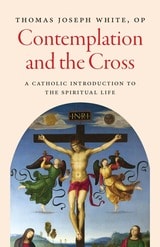
cover of Contemplation and the Cross: A Catholic Introduction to the Spiritual Life

Contemplation and the Cross

A Catholic Introduction to the Spiritual Life

Thomas Joseph White, OP

Catholic University of America Press, 2025
What are the aims of the Christian spiritual life and how can we deepen our life in Christ? What is the Catholic form of the spiritual life and what are its causes? This book serves as an introduction to Catholic spirituality by examining the mystery of Jesus Christ- His Crucifixion, and His Resurrection- as the center of our spiritual life. The central argument of the book is that the life, death, and resurrection of Jesus present us with the form or essence of the Christian spiritual life and orient us toward union with the Trinity as the final end or aim of human existence. The means of union with God through sacraments, the interior life of the theological virtues (faith, hope, and charity), and the virtue of religion are considered as vehicles by which we rejoin God in Christ. The effects of the Cross are considered in our life by a study of the spiritual and corporal works of mercy. The Virgin Mary is considered as a model of the spiritual life. What results is a Christ-centered spirituality that is sacramental and Marian, and that depicts the life of the Church living in contemplative charity as the basic expression of Catholic spirituality.
[more]
cover of Contemporary Catholic Approaches to the People, State, and Land of Israel

Contemporary Catholic Approaches to the People, State, and Land of Israel

Gavin D'Costa

Catholic University of America Press, 2021
After Vatican II, the Roman Catholic Church began a process of stripping away anti-Jewish sentiments within its theological culture. One question that has arisen and received very scant attention regards the theological significance of the founding of the state of Israel in 1948 – and the attendant nakba, the plight of the Palestinian people. Some American evangelical Christians have developed a theology around the state of Israel, associating themselves with Zionism. Some Christian groups have developed a theology around the suffering of the Palestinian people and demand resistance to Zionism. This unique collection of essays from leading Catholic theologians from the United States, Germany, France, Italy, Switzerland, England, and the Middle East reflect on the theological status of the land of Israel. These essays represent an exhaustive range of views. None avoid the new Catholic theology regarding the Jewish people. Some contributors see this as leading towards a positive theological affirmation of the state of Israel, while distancing themselves from Christian Zionists. All contributors are committed to rights of the Palestinian people. Some affirm the need for strong diplomatic and political support for Israel along with equal support for Palestinians, arguing that this is as far as the Church can go. Others argue that the Church’s emerging theology represents the guilt conscience of Europe at the cost of the Palestinian people. None deny the right of Jews to live in the land. Two Jewish scholars respond to the essays creating an atmosphere of genuine interfaith dialogue which serves Catholics to think further through these issues.
[more]
cover of Contraception and Persecution

Contraception and Persecution

Charles E. Rice

St. Augustine's Press, 2014
“Contraceptive sex,” wrote social science researcher Mary Eberstadt in 2012, “is the fundamental social fact of our time.” In this important and pointed book, Charles E. Rice, of the Notre Dame Law School, makes the novel claim that the acceptance of contraception is a prelude to persecution. He makes the striking point that contraception is not essentially about sex. It is a First Commandment issue: Who is God? It was at the Anglican Lambeth Conference of 1930 when for the first time a Christian denomination said that contraception could ever be a moral choice. The advent of the Pill in the 1960s made the practice of contraception practically universal. This involved a massive displacement of the Divine Law as a normative measure of conduct, not only on sex but across the board. Nature abhors a vacuum. The State moved in to occupy the place formerly held by God as the ultimate moral Lawgiver. The State put itself on a collision course with religious groups and especially with the Catholic Church, which continues to insist on that traditional teacher. A case in point is the Obama Regime’s Health Care Mandate, coercing employees to provide, contrary to conscience, abortifacients and contraceptives to their employees. The first chapter describes that Mandate, which the Catholic bishops have vowed not to obey. Rice goes on to show that the duty to disobey an unjust law that would compel you to violate the Divine Law does not confer a general right to pick and choose what laws you will obey. The third chapter describes the “main event,” which is the bout to determine whether the United States will conform its law and culture to the homosexual (LGBTQ) lifestyle in all its respects. “The main event is well underway and LGBTQ is well ahead on points.” Professor Rice follows with a clear analysis of the 2013 Supreme Court decision on same-sex marriage. Part II presents some “underlying causes” of the accelerating persecution of the Catholic Church. The four chapter headings in this part outline the picture: The Dictatorship of Relativism; Conscience Redefined; The Constitution: Moral Neutrality; and The Constitution: Still Taken Seriously? The answer to the last question, as you might expect, is: No. Part III, the controversial heart of the book, prese nts contraception as “an unacknowledged cause” of persecution. The first chapter argues that contraception is not just a “Catholic issue.” The next chapter describes the “consequences” of contraception and the treatment of women as objects. The third chapter spells out in detail the reality that contraception is a First Commandment issue and that its displacement of God as the ultimate moral authority opened the door for the State to assume that role, bringing on a persecution of the Church. The last chapter, “A Teaching Untaught,” details the admitted failure of the American Catholic bishops to teach Pope Paul VI’s 1968 encyclical, Humanae Vitae. But Rice offers hope that the bishops are now getting their act together Part IV offers as a “response” to the persecution of the Church three remedies: Speak the Truth with clarity and charity; Trust God; and, most important, Pray. As the last sentence in the book puts it: “John Paul II wrote in a letter to U.S. bishops in 1993: ‘America needs much prayer – lest it lose its soul.’” This readable and provocative book is abundantly documented with a detailed index of names and subjects.
[more]
cover of Contradiction and Conflict: The Popular Church in Nicaragua

Contradiction and Conflict

The Popular Church in Nicaragua

Debra Sabia

University of Alabama Press, 2013

Contradiction and Conflict explores the rich history, ideology, and development of the popular church in Nicaragua. From careful assessments within the context of Nicaragua's revolutionary period (1970s-1990), this book explains the historical conditions that worked to unify members of the Christian faith and the subsequent factors that fragmented the Christian community into at least four identifiable groups with religious and political differences, contradictions, and conflicts.

Debra Sabia describes and analyzes the rise, growth, and fragmentation of the popular church and assesses the effect of the Christian base communities on religion, politics, and the nation's social revolutionary experiment.
[more]
cover of Correspondence on Christology and Grace

Correspondence on Christology and Grace

Rob Roy McGregor

Catholic University of America Press, 2013
Between the years AD 519 and 523, Fulgentius engaged in correspondence with a group of Latin-speaking monks from Scythia, and that correspondence is translated into English--almost all of it for the first time--in this volume.
[more]
cover of Creation through Evolution: New Perspectives from Thomistic Theology and Philosophy

Creation through Evolution

New Perspectives from Thomistic Theology and Philosophy

Nicanor Pier Giorgio Austriaco

Catholic University of America Press, 2025
Written and revised over the past three years, Creation through Evolution contains ten new essays that directly respond to the most common philosophical and theological objections put forward by Catholics who are skeptical about evolutionary theory. Significantly, the authors use the conceptual framework of St. Thomas Aquinas as a starting point to engage in the faith and science dialogue and they take the Catechism of the Catholic Church as their starting point. The contributors believe that the solutions proposed by these essays to the disputed questions raised by skeptics are novel and robust. The contents of the essays were presented at colloquia at the University of Oxford and Providence College and were revised in response to criticisms and comments raised by the other participants at these meetings. The chapters were written to respond to Catholic skeptics of Darwinian evolution. They are meant to be read not only by scholars but also by graduate and undergraduate students. Creation through Evolution will be of interest to the informed Catholic reader who is struggling to reconcile evolutionary theory with the claims of the Catechism of the Catholic Church.
[more]
cover of Criminal-Inquisitorial Trials in English Church Trials: From the Middle Ages to the Reformation

Criminal-Inquisitorial Trials in English Church Trials

From the Middle Ages to the Reformation

Henry Ansgar Kelly

Catholic University of America Press, 2023
After inquisitorial procedure was introduced at the Fourth Lateran Council in Rome in 1215 (the same year as England’s first Magna Carta), virtually all court trials initiated by bishops and their subordinates were inquisitions. That meant that accusers were no longer needed. Rather, the judges themselves leveled charges against persons when they were publicly suspected of specific offenses—like fornication, or witchcraft, or simony. Secret crimes were off limits, including sins of thought (like holding a heretical belief). Defendants were allowed full defenses if they denied charges. These canonical rules were systematically violated by heresy inquisitors in France and elsewhere, especially by forcing self-incrimination. But in England, due process was generally honored and the rights of defendants preserved, though with notable exceptions. In this book, Henry Ansgar Kelly, a noted forensic historian, describes the reception and application of inquisition in England from the thirteenth century onwards and analyzes all levels of trial proceedings, both minor and major, from accusations of sexual offenses and cheating on tithes to matters of religious dissent. He covers the trials of the Knights Templar early in the fourteenth century and the prosecutions of followers of John Wyclif at the end of the century. He details how the alleged crimes of “criminous clerics” were handled, and demonstrates that the judicial actions concerning Henry VIII’s marriages were inquisitions in which the king himself and his queens were defendants. Trials of Alice Kyteler, Margery Kempe, Eleanor Cobham, and Anne Askew are explained, as are the unjust trials condemning Bishop Reginald Pecock of error and heresy (1457-59) and Richard Hunne for defending English Bibles (1514). He deals with the trials of Lutheran dissidents at the time of Thomas More’s chancellorship, and trials of bishops under Edward VI and Queen Mary, including those against Stephen Gardiner and Thomas Cranmer. Under Queen Elizabeth, Kelly shows, there was a return to the letter of papal canon law (which was not true of the papal curia). In his conclusion he responds to the strictures of Sir John Baker against inquisitorial procedure, and argues that it compares favorably to the common-law trial by jury.
[more]
cover of Crossing Parish Boundaries: Race, Sports, and Catholic Youth in Chicago, 1914-1954

Crossing Parish Boundaries

Race, Sports, and Catholic Youth in Chicago, 1914-1954

Timothy B. Neary

University of Chicago Press, 2016

Controversy erupted in spring 2001 when Chicago’s mostly white Southside Catholic Conference youth sports league rejected the application of the predominantly black St. Sabina grade school. Fifty years after Brown v. Board of Education, interracialism seemed stubbornly unattainable, and the national spotlight once again turned to the history of racial conflict in Catholic parishes. It’s widely understood that midcentury, working class, white ethnic Catholics were among the most virulent racists, but, as Crossing Parish Boundaries shows, that’s not the whole story.
            In this book, Timothy B. Neary reveals the history of Bishop Bernard Sheil’s Catholic Youth Organization (CYO), which brought together thousands of young people of all races and religions from Chicago’s racially segregated neighborhoods to take part in sports and educational programming. Tens of thousands of boys and girls participated in basketball, track and field, and the most popular sport of all, boxing, which regularly filled Chicago Stadium with roaring crowds. The history of Bishop Sheil and the CYO shows a cosmopolitan version of American Catholicism, one that is usually overshadowed by accounts of white ethnic Catholics aggressively resisting the racial integration of their working-class neighborhoods. By telling the story of Catholic-sponsored interracial cooperation within Chicago, Crossing Parish Boundaries complicates our understanding of northern urban race relations in the mid-twentieth century.
[more]
cover of Cultivating the Good Student: Fostering the Moral Virtues of the Intellectual Life

Cultivating the Good Student

Fostering the Moral Virtues of the Intellectual Life

Douglas LeBlanc

Catholic University of America Press, 2026

What exactly is a "good student," and how do educators foster this individual? As Douglas LeBlanc argues, the good student is the individual who—more than being intelligent—is morally virtuous in the realm of study. The classical and Christian traditions divide the moral virtues under the cardinal virtues of temperance, fortitude, justice, and prudence. In order to foster good students, then, teachers must foster the sub-virtue of each of the cardinal virtues that is most related to learning. LeBlanc identifies these virtues as studiosity (temperance), magnanimity (fortitude), docility (justice), and self-knowledge (prudence). Each of these four is given a historical and philosophical analysis in its own chapter; therein, it is demonstrated that each virtue is needed in order for young adults to have a moral intellectual life. Additionally, for each of these four virtues, another chapter is dedicated to the practical means whereby teachers and administrators can foster these virtues. LeBlanc shows educators how they can guide students in the practice of the virtue in question. Additionally, he describes the ways educators must practice these four virtues themselves, insisting that teachers and administrators must serve as models of what it means to be one who possesses a moral intellectual life. In the conclusion, he argues that these four virtues are not just needed by young adults and their teachers. They are ultimately needed by everyone, for all adults are called to have moral intellectual lives. By fostering studiosity, magnanimity, docility, and self-knowledge, teachers empower their students to be life-long learners—life-long "good students."
[more]