Results by title
86 books match the query 'Chile' and 9 start with c
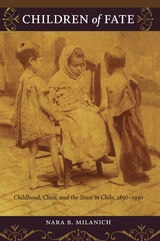
Children of Fate
Childhood, Class, and the State in Chile, 1850–1930Nara B. Milanich
Duke University Press, 2009
Milanich pays particular attention to family law, arguing that liberal legal reforms wrought in the 1850s, which left the paternity of illegitimate children purposely unrecorded, reinforced not only patriarchal power but also hierarchies of class. Through vivid stories culled from judicial and notarial sources and from a cache of documents found in the closet of a Santiago orphanage, she reveals how law and bureaucracy helped create an anonymous underclass bereft of kin entitlements, dependent on the charity of others, and marginalized from public bureaucracies. Milanich also challenges the recent scholarly emphasis on state formation by highlighting the enduring importance of private, informal, and extralegal relations of power within and across households. Children of Fate demonstrates how the study of children can illuminate the social organization of gender and class, liberalism, law, and state power in modern Latin America.

Chile and the Inter-American Human Rights System
Edited by Karinna Fernández, Cristian Peña, and Sebastián Smart
University of London Press, 2017
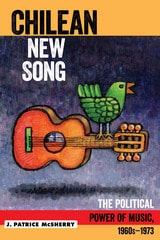
Chilean New Song
The Political Power of Music, 1960s - 1973J Patrice McSherry
Temple University Press, 2015
In Chilean New Song, J. Patrice McSherry deftly combines a political-historical view of Chile with a narrative of its cultural development. She examines the democratizing power of this music and, through interviews with key protagonists, the social roles of politically committed artists who participated in a movement for change. McSherry explores the impact of Chilean New Song and the way this artistic/cultural phenomenon related to contemporary politics to capture the passion, pain, and hope of millions of Chileans.
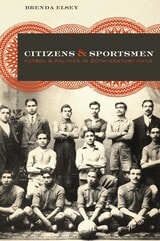
Citizens and Sportsmen
Fútbol and Politics in Twentieth-Century ChileBy Brenda Elsey
University of Texas Press, 2011
Fútbol, or soccer as it is called in the United States, is the most popular sport in the world. Millions of people schedule their lives and build identities around it. The World Cup tournament, played every four years, draws an audience of more than a billion people and provides a global platform for displays of athletic prowess, nationalist rhetoric, and commercial advertising. Fútbol is ubiquitous in Latin America, yet few academic histories of the sport exist, and even fewer focus on its relevance to politics in the region. To fill that gap, this book uses amateur fútbol clubs in Chile to understand the history of civic associations, popular culture, and politics.
In Citizens and Sportsmen, Brenda Elsey argues that fútbol clubs integrated working-class men into urban politics, connected them to parties, and served as venues of political critique. In this way, they contributed to the democratization of the public sphere. Elsey shows how club members debated ideas about class, ethnic, and gender identities, and also how their belief in the uniquely democratic nature of Chile energized state institutions even as it led members to criticize those very institutions. Furthermore, she reveals how fútbol clubs created rituals, narratives, and symbols that legitimated workers' claims to political subjectivity. Her case study demonstrates that the relationship between formal and informal politics is essential to fostering civic engagement and supporting democratic practices.
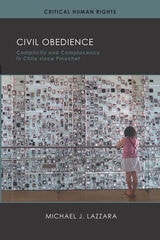
Civil Obedience
Complicity and Complacency in Chile since PinochetMichael J. Lazzara
University of Wisconsin Press, 2020
Michael J. Lazzara boldly argues that today's Chile is a product of both complicity and complacency. Combining historical analysis with deft literary, political, and cultural critique, he scrutinizes the post-Pinochet rationalizations made by politicians, artists, intellectuals, bystanders, former revolutionaries-turned-neoliberals, and common citizens. He looks beyond victims and perpetrators to unveil the ambiguous, ethically vexed realms of memory and experience that authoritarian regimes inevitably generate.
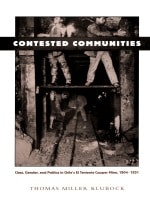
Contested Communities
Class, Gender, and Politics in Chile’s El Teniente Copper Mine, 1904-1951Thomas Miller Klubock
Duke University Press, 1998
Klubock shows how a militant working-class community was established through the interplay between capitalist development, state formation, and the ideologies of gender. In describing how the North American copper company attempted to reconfigure and reform the work and social-cultural lives of men and women who migrated to the mine, Klubock demonstrates how struggles between labor and capital took place on a gendered field of power and reconstituted social constructions of masculinity and femininity. As a result, Contested Communities describes more accurately than any previous study the nature of grassroots labor militancy, working-class culture, and everyday politics of gender relations during crucial years of the Chilean Popular Front in the 1930s and 1940s.
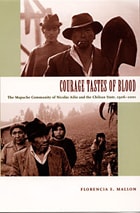
Courage Tastes of Blood
The Mapuche Community of Nicolás Ailío and the Chilean State, 1906-2001Florencia E. Mallon
Duke University Press, 2005
Mallon recounts the land usurpation Nicolás Ailío endured in the first decades of the twentieth century and the community’s ongoing struggle for restitution. Facing extreme poverty and inspired by the agrarian mobilizations of the 1960s, some community members participated in the agrarian reform under the government of socialist president Salvador Allende. With the military coup of 1973, they suffered repression and desperate impoverishment. Out of this turbulent period the Mapuche revitalization movement was born. What began as an effort to protest the privatization of community lands under the military dictatorship evolved into a broad movement for cultural and political recognition that continues to the present day. By providing the historical and local context for the emergence of the Mapuche revitalization movement, Courage Tastes of Blood offers a distinctive perspective on the evolution of Chilean democracy and its rupture with the military coup of 1973.
Criminalization of Women
Abortion, Inequity, and Resistance in ChileMichele Eggers-Barison
University of Illinois Press, 2025
Eggers-Barison uncovers the narratives of economically disadvantaged, Indigenous, and immigrant women who broke the Chilean law by terminating a pregnancy. Their stories reveal how laws and policies that regulate and control women’s reproductive lives also construct women as criminals. As Eggers-Barison shows, systems of inequality legitimize and sustain harmful attitudes and practices while creating concrete expressions of discrimination and other forms of violence against women. Their experience with abortion remains hidden within spaces of illegality and only becomes visible due to health or legal consequences. Yet despite the obstacles, women used individual and collective forms of group action to resist anti-abortion laws.
Timely and vivid, Criminalization of Women shows how abortion’s illegality inscribes itself on a woman’s body and reality.
Cultural Residues
Chile In TransitionNelly Richard
University of Minnesota Press, 2004
A complex portrait of postdictatorial Chile by one of that country’s most incisive cultural critics, this book uses memoirs, photographs, the plastic arts, novels, and other texts—the “residues” of a culture—to analyze the political-cultural Chilean landscape in the wake of Augusto Pinochet’s seventeen-year military rule. Such residual areas reveal the flaws and lapses in Chile’s transition from violent military dictatorship to electoral democracy.
Nelly Richard's analysis ranges from an exploration of false memories of the recent past—especially memories of violence—to a discussion of the university under neoliberalism; from debates about the use of the word “gender” to an examination of refractory texts and cultural activities such as Diamela Eltit’s “testimonio” of a schizophrenic vagabond, Eugenio Dittborn’s use of photography in art installations, and transvestite performances. In Cultural Residues, each instance becomes a suggestive metaphor for understanding a rapidly modernizing Chile attempting to re-democratize its public life.