Results by title
255 books match the query 'Church of Jesus Christ of Latter-day Saints (Mormon)' and 14 start with c
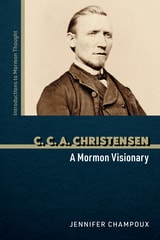
C. C. A. Christensen
A Mormon VisionaryJennifer Champoux
University of Illinois Press, 2026
Drawing on the artist’s voluminous writings, Jennifer Champoux illuminates Christensen’s influential art, including recently rediscovered works. Christensen received Church commissions and approval and helped shape Latter-day Saints’ vision of themselves. Over time the work of other artists eclipsed his achievements, but a twenty-first century revival of interest began to restore his reputation. Champoux also profiles how Christensen’s expansive activities outside of the art world gave him a unique vantage point for chronicling how the Latter-day Saint faith and culture evolved in Utah.
A revealing intellectual biography, C. C. A. Christensen offers a rare in-depth look at a major Latter-day Saint artist.
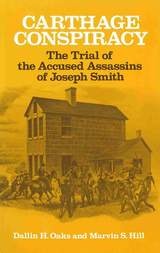
Carthage Conspiracy
The Trial of the Accused Assassins of Joseph SmithDallin H. Oaks and Marvin S. Hill
University of Illinois Press, 1975
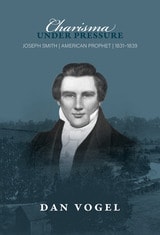
Charisma under Pressure
Joseph Smith, American Prophet, 1831–1839Dan Vogel
Signature Books, 2023
But just who was Joseph Smith? What motivated him? In examining Smith’s life during his Ohio and Missouri sojourns, Vogel seeks to answer those questions. But, Vogel is quick to note, “There are, in fact, many possible constructions of Joseph Smith, and depending on how one assesses the evidence for his truth-claims, a completely different Joseph Smith emerges. But this is probably as Smith wanted it.”
During this period, Smith established a temple, printing presses, additional scripture, expanded church offices, and built a bank—all indicating a sense of permanence and strength for his young church at one level while causing its near collapse at another.
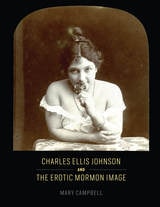
Charles Ellis Johnson and the Erotic Mormon Image
Mary Campbell
University of Chicago Press, 2016
Mary Campbell tells the story of this remarkable religious transformation in Charles Ellis Johnson and the Erotic Mormon Image. One of the church’s favorite photographers, Johnson (1857–1926) spent the 1890s and early 1900s taking pictures of Mormonism’s most revered figures and sacred sites. At the same time, he did a brisk business in mail-order erotica, creating and selling stereoviews that he referred to as his “spicy pictures of girls.” Situating these images within the religious, artistic, and legal culture of turn-of-the-century America, Campbell reveals the unexpected ways in which they worked to bring the Saints into the nation’s mainstream after the scandal of polygamy.
Engaging, interdisciplinary, and deeply researched, Charles Ellis Johnson and the Erotic Mormon Image demonstrates the profound role pictures played in the creation of both the modern Church of Jesus Christ of Latter-day Saints and the modern American nation.
Chosen Path
A MemoirD. Michael Quinn
Signature Books, 2022
From the age of nine, Quinn felt convicted he would one day serve as an apostle of the Church of Jesus Christ of Latter-day Saints. He chose the path he believed would take him there, eventually living as a straight LDS family man in a mixed-orientation marriage. In the 1970s and 1980s he became a BYU professor and one of Mormonism’s most promising, prolific, and respected historians. But his uncompromising commitment to total honesty about his religion’s history, along with his homosexuality, set him on a collision course with church leaders and the end of his seemingly idyllic Mormon life. Throughout his telling, Quinn unflinchingly opens up about his feelings and experiences that shaped his enigmatic life.
Clogs and Shawls
Mormons, Moorlands, and the Search for ZionAnn Chamberlin
University of Utah Press, 2019
Chamberlin interviewed her grandmother and six of her surviving great-aunts for Clogs and Shawls, the relatives who had made their way to Mormon Zion. She weaves novelistic passages with their first-person narratives to create a singular work of oral immigrant family history that is both lively and revealing.
Confessions of a Mormon Historian
The Diaries of Leonard J. Arrington, 1971-1997: Volume 1, Church Historian, 1971-75Gary James Bergera
Signature Books, 2018
Leonard Arrington (1917–99) was born an Idaho chicken rancher whose early interests seemed not to extend much beyond the American west. Throughout his life, he tended to project a folksy persona, although nothing was farther from the truth.
He was, in fact, an intellectually oriented, academically driven young man, determined to explore the historical, economic, cultural, and religious issues of his time. After distinguishing himself at the University of North Carolina (Chapel Hill) and serving in the army during World War II in North Africa and Italy, Arrington accepted a professorship at Utah State University. In 1972 he was called as the LDS Church Historian—an office he held for ten years until, following a stormy tenure full of controversy over whether the “New Mormon History” he championed was appropriate for the church, he was quietly released and transferred, along with the entire Church History Division, to Brigham Young University. It was hoped that this would remove the impression in people’s minds that his writings were church-approved.
His personal diaries reveal a man who was firmly committed to his church, as well as to rigorous historical scholarship. His eye for detail made him an important observer of “church headquarters culture.”
Confessions of a Mormon Historian
The Diaries of Leonard J. Arrington, 1971-1997: Volume 3, Exile, 1980-97Gary James Bergera
Signature Books, 2018
Leonard Arrington (1917–99) was born an Idaho chicken rancher whose early interests seemed not to extend much beyond the American west. Throughout his life, he tended to project a folksy persona, although nothing was farther from the truth.
He was, in fact, an intellectually oriented, academically driven young man, determined to explore the historical, economic, cultural, and religious issues of his time. After distinguishing himself at the University of North Carolina (Chapel Hill) and serving in the army during World War II in North Africa and Italy, Arrington accepted a professorship at Utah State University. In 1972 he was called as the LDS Church Historian—an office he held for ten years until, following a stormy tenure full of controversy over whether the “New Mormon History” he championed was appropriate for the church, he was quietly released and transferred, along with the entire Church History Division, to Brigham Young University. It was hoped that this would remove the impression in people’s minds that his writings were church-approved.
His personal diaries reveal a man who was firmly committed to his church, as well as to rigorous historical scholarship. His eye for detail made him an important observer of “church headquarters culture.”
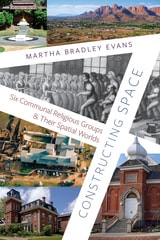
Constructing Space
Six Communal Religious Groups and Their Spatial WorldsMartha Bradley Evans
University of Utah Press, 2025
Religion transforms and inspires specific ways of living in the world. Through architecture and the built environment, members of religious communities communicate intangible beliefs about God, gender and family, the sacred and profane, and more. This captivating volume explores the spatial worlds of six different religious communities— the Latter-day Saints, the Oneida Colony, the Shakers, the Branch Davidians, the FLDS, and Adidam—through the architecture and cultural landscapes they built.
What does the strict order and regularity of a Shaker village tell us about the community’s hierarchies and relationships? How might a temple building site affect an LDS Church member’s daily life? Constructing Space reveals the hidden language of meaning, association, and identity that religious persons speak as they mold their faith into concrete forms, and how they interpret the meanings of those spaces within their practices.
Contemporary Mormon Pageantry
Seeking After the DeadMegan Sanborn Jones
University of Michigan Press, 2018
Contemporary Mormonism
SOCIAL SCIENCE PERSPECTIVESEdited by Marie Cornwall, Tim B. Heaton, and Lawrence A. Young
University of Illinois Press, 1994
Continuing Revelation
Essays on DoctrineBryan Buchanan
Signature Books, 2021
Determining what is and what is not Mormon doctrine is a difficult endeavor. The Church of Jesus Christ of Latter-day Saints embraces four books of scripture as its canon, but also believes the church is led by a living prophet. Additions to the canon have been rare since the death of church founder Joseph Smith. Joseph Fielding Smith, tenth church president, said that if the prophet ever contradicts canon, canon prevails. On the other hand, Ezra Taft Benson, the church’s thirteenth president, said that the living prophet’s words are more important than cannon. Such messages create no shortage of confusion among church members.
The question “What is doctrine?” opens the door for theologians and historians to wrestle over the answer, and to do so thoughtfully and insightfully. In Continuing Revelation, editor Bryan Buchanan has compiled essays that seek greater understanding about what doctrine is and why it matters.
The Challenge of Defining LDS Doctrine, by Loyd Isao Ericson • LDS Theology and the Omnis: The Dangers of Theological Speculation, by David H. Bailey • Crawling out of the Primordial Soup: A Step toward the Emergence of an LDS Theology Compatible with Organic Evolution, by Steven L. Peck • “To Destroy the Agency of Man”: The War in Heaven in LDS Thought, by Boyd Petersen • Three Sub-Degrees in the Celestial Kingdom?, by Shannon P. Flynn • Heavenly Mother: The Mother of All Women, by Blaire Ostler • Mormonism and the Problem of Heterodoxy, by Kelli D. Potter • Women at the Gates of Mortality: Relief Society Birth and Death Rituals, by Susanna Morrill • “Shake Off the Dust of Thy Feet”: The Rise and Fall of Mormon Ritual Cursing, by Samuel R. Weber • “Satan Mourns Naked Upon the Earth: Locating Mormon Possession and Exorcism Rituals in the American Religious Landscape, 1830–1977, by Stephen C. Taysom
Count Me In
Young, Darlene
Signature Books, 2024
Cultures In Conflict
A Documentary History of the Mormon War in IllinoisJohn Hallwas and Roger Launius
Utah State University Press, 1999