Results by title
79 books match the query 'Circuits' and 10 start with c
CMOS Digital Integrated Circuits
A first courseCharles Hawkins
The Institution of Engineering and Technology, 2013
Circuit Analysis and Design
Fawwaz T. Ulaby, Michel M. Mahabiz, & Cynthia M. Furse
Michigan Publishing Services, 2018
Circuit Analysis and Design
Fawwaz T. Ulaby, Michel M. Mahabiz, & Cynthia M. Furse
Michigan Publishing Services, 2018
(1) It should introduce the fundamental principles of circuit analysis and equip the student with the skills necessary to analyze any planar, linear circuit, including those driven by dc or ac sources, or by more complicated waveforms such as pulses and exponentials.
(2) It should start the student on the journey of circuit design.
(3) It should guide the student into the seemingly magical world of domain transformations—such as the Laplace and Fourier transforms, not only as circuit analysis tools, but also as mathematical languages that are “spoken” by many fields of science and engineering.
(4) It should expand the student’s technical horizon by introducing him/her to some of the many allied fields of science and technology.
Circuit Analysis and Design
Fawwaz Ulaby
Michigan Publishing Services, 2025
(1) It should introduce the fundamental principles of circuit analysis and equip the student with the skills necessary to analyze any planar, linear circuit, including those driven by dc or ac sources, or by more complicated waveforms such as pulses and exponentials.
(2) It should start the student on the journey of circuit design.
(3) It should guide the student into the seemingly magical world of domain transformations—such as the Laplace and Fourier transforms, not only as circuit analysis tools, but also as mathematical languages that are “spoken” by many fields of science and engineering.
(4) It should expand the student’s technical horizon by introducing him/her to some of the many allied fields of science and technology.
This book aims to accomplish exactly those objectives. Among its distinctive features are:
Technology Briefs: The book contains 32 Technology Briefs, each providing an overview of a topic that every electrical and computer engineering professional should become familiar with. Electronic displays, data storage media, sensors and actuators, supercapacitors, and 3-D imaging are typical of the topics shared with the reader. The Briefs are presented at a technical level intended to introduce the student to how the concepts in the chapter are applied in real-world applications and to interest the reader in pursuing the subject further on his/her own. Technology Briefs cover applications in circuits, medicine, the physical world, optics, signals and systems, and more.
Application Notes: Most chapters include a section focused on how certain devices or circuits might be used in practical applications. Examples include power supplies, CMOS inverters in computer processors, signal modulators, and several others.
Multisim and MathScript: Multisim is a SPICE circuit simulator available from National Instruments (see cad.eecs.umich.edu for details). Multisim is highlighted through many end-of-chapter demonstrations. The student is strongly encouraged to take advantage of this rich resource. The Math-Script software can perform matrix inversion and many other calculations, much like the MathWorks, Inc. MATLAB® software.
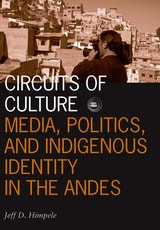
Circuits of Culture
Media, Politics, and Indigenous Identity in the AndesJeff D. Himpele
University of Minnesota Press, 2007
Set against the background of Bolivia’s prominent urban festival parades and the country’s recent appearance on the front lines of antiglobalization movements, Circuits of Culture is the first social analysis of Bolivian film and television, their circulation through the social and national landscape, and the emergence of the country’s indigenous video movement.
At the heart of Jeff Himpele’s examination is an ethnography of the popular television program, The Open Tribunal of the People. The indigenous and underrepresented majorities in La Paz have used the talk show to publicize their social problems and seek medical and legal assistance from the show’s hosts and the political party they launched. Himpele studies the program in order to identify the possibilities of the mass media as a site for political discourse and as a means of social action.
Charting as well the history of Bolivia’s media culture, Himpele perceptively investigates cinematic media as sites for understanding the modernization of Bolivia, its social movements, and the formation of indigenous identities, and in doing so provides a new framework for exploring the circulation of culture as a way of creating publics, political movements, and producing media.
Jeff D. Himpele is associate director for the McGraw Center for Teaching and Learning at Princeton University. He is an anthropologist and documentary filmmaker; his films include the award-winning Incidents of Travel in Chichen Itza and Taypi Kala: Six Visions of Tiwanaku.

Circuits of Desire, Volume 2
Yukiko Hanawa
Duke University Press, 0

Circuits of the Sacred
A Faggotology in the Black Latinx CaribbeanCarlos Ulises Decena
Duke University Press, 2023

Coaxial Electrical Circuits for Interference-Free Measurements
Shakil Awan
The Institution of Engineering and Technology, 2011
Control Circuits in Power Electronics
Practical issues in design and implementationMiguel Castilla
The Institution of Engineering and Technology, 2016

Cyber-Marx
Cycles and Circuits of Struggle in High Technology CapitalismNick Dyer-Witheford
University of Illinois Press, 1999
Dyer-Witheford maps the dynamics of modern capitalism, showing how capital depends for its operations not just on exploitation in the immediate workplace, but on the continuous integration of a whole series of social sites and activities, from public health and maternity to natural resource allocation and the geographical reorganization of labor power. He also shows how these sites and activities may become focal points of subversion and insurgency, as new means of communication vital for the smooth flow of capital also permit otherwise isolated and dispersed points of resistance to connect and combine with one another.
Cutting through the smokescreen of high-tech propaganda, Dyer-Witheford predicts the advent of a reinvented, "autonomist" Marxism that will rediscover the possibility of a collective, communist transformation of society. Refuting the utopian promises of the information revolution, he discloses the real potentialities for a new social order in the form of a twenty-first-century communism based on the common sharing of wealth.