Results by title
67 books match the query 'Civil rights workers' and 4 start with c
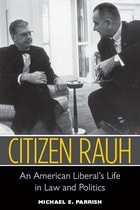
Citizen Rauh
An American Liberal's Life in Law and PoliticsMichael E. Parrish
University of Michigan Press, 2011
"Joe Rauh was the type of lawyer who comes along maybe once in a generation---talented, politically astute, effective, and stubbornly devoted to principles, the type of person who not only could but did make a difference. He deserves a biography that explores not only his persona, but the America in which he lived and worked, and how he made a difference to so many people. Michael Parrish has given us just such a book, an exceedingly fine, well-written story that will make clear to another generation not only who Joe Rauh was, but why we as a nation will always need someone like him."
---Melvin I. Urofsky, Professor of Law and Public Policy, Virginia Commonwealth University
"Michael Parrish has captured the life of this great civil libertarian in splendid fashion. His biography of this energetic New Deal liberal weaves effortlessly between public and private, friend and foe, victory and defeat. With Parrish as a sure guide, Citizen Rauh transports the reader through an American history that begins with Sacco and Vanzetti and ends as he battles CIA skullduggery in the 1980s. This biography should be on your shelf and in your heart."
---Nelson Lichtenstein, MacArthur Foundation Professor of History and Director of the Center for the Study of Work, Labor, and Democracy, University of California, Santa Barbara
"Michael Parrish has fashioned a biography filled with Rauh's spirit, achievements, his losses, and above all, the importance of his presence. This is a wonderful account of a giant of late 20th century political and legal affairs."
---Stanley Kutler, E. Gordon Fox Professor Emeritus of American Institutions, History, and Law, University of Wisconsin, Madison
Citizen Rauh tells the story of American lawyer Joseph L. Rauh Jr., who kept alive the ideals of New Deal liberalism and broadened those ideals to include a commitment to civil rights. Rauh's clients included Arthur Miller, Lillian Hellman, A. Philip Randolph, and the Mississippi Freedom Democratic Party. With good reason Freedom Rider John Lewis once called him "the blackest white man I ever knew."
No lawyer in the post-1945 era did more to protect the economic interests of working-class Americans than Rauh, who fought for the unions as they struggled for legitimacy and against them when they betrayed their own members. No lawyer stood more courageously against repressive anticommunism during the 1950s or advanced the cause of racial justice more vigorously in the 1960s and 1970s. No lawyer did more to defend the constitutional vision of the Warren Court and resist the efforts of Richard Nixon and Ronald Reagan to undo its legacy.
Throughout his life, Rauh continued to articulate a progressive vision of law and politics, ever confident that his brand of liberalism would become vital once again when the cycle of American politics took another turn.
Michael E. Parrish is Distinguished Professor of History at the University of California, San Diego, where he has taught for forty years. A specialist in the legal and constitutional history of the United States, he has also taught at Nanjing University in the People's Republic of China, the University of Edinburgh, the University of Glasgow, and the University of Helsinki, where he was the Fulbright Bicentennial Professor of American Studies.
Parrish is the author of five other books: Securities Regulation and the New Deal; Felix Frankfurter and His Times; Anxious Decades: America in Prosperity and Depression; The Hughes Court: Justices, Rulings, and Legacy; and The Supreme Court and Capital Punishment: Judging Death. His articles have appeared in the American Historical Review, the Historian, Diplomatic History, the Journal of the Supreme Court Historical Society, and the Yale Law Journal.
Jacket design by Paula Newcomb
Jacket photograph: Joseph L. Rauh Jr. with President Lyndon B. Johnson. Courtesy of the Estate of Olie W. Rauh.
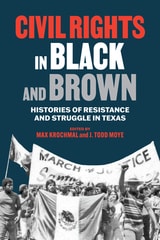
Civil Rights in Black and Brown
Histories of Resistance and Struggle in TexasEdited by Max Krochmal and J. Todd Moye
University of Texas Press, 2021
2022 Best Book Award, Oral History Association
Hundreds of stories of activists at the front lines of the intersecting African American and Mexican American liberation struggle
Not one but two civil rights movements flourished in mid-twentieth-century Texas, and they did so in intimate conversation with one another. Far from the gaze of the national media, African American and Mexican American activists combated the twin caste systems of Jim Crow and Juan Crow. These insurgents worked chiefly within their own racial groups, yet they also looked to each other for guidance and, at times, came together in solidarity. The movements sought more than integration and access: they demanded power and justice.
Civil Rights in Black and Brown draws on more than 500 oral history interviews newly collected across Texas, from the Panhandle to the Piney Woods and everywhere in between. The testimonies speak in detail to the structure of racism in small towns and huge metropolises—both the everyday grind of segregation and the haunting acts of racial violence that upheld Texas’s state-sanctioned systems of white supremacy. Through their memories of resistance and revolution, the activists reveal previously undocumented struggles for equity, as well as the links Black and Chicanx organizers forged in their efforts to achieve self-determination.
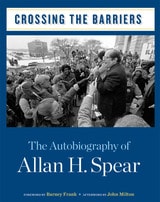
Crossing the Barriers
The Autobiography of Allan H. SpearAllan H. Spear
University of Minnesota Press, 2010
Spear's memoirs are fascinating and moving: in early chapters on his childhood and college years, he writes with great introspection about his growing self-awareness of being gay. Later he writes about his development as an intellectual, particularly as a white man fighting to win legitimacy for the study of African-American history and culture. During his time at the University of Minnesota, Spear became deeply involved with the Minnesota Democratic-Farmer-Labor Party (DFL) and the antiwar movement. At the same time, Spear became increasingly active in the emerging gay rights movement and began the process of coming out to his friends and colleagues.
After a failed run for the Minnesota House in 1968, Spear was elected to the Minnesota Senate in 1972 and served as Senate president from 1993-2000. In 1993, he was instrumental in the passage of the Minnesota Human Rights Act, which protected LGBT people from discrimination in housing, education, and employment-an achievement he considered one of the finest of his career. A skilled parliamentarian, he remained a progressive leader in the legislature until his retirement in 2000.
Spear passed away on October 11, 2008, leaving his memoir slightly incomplete. A stirring afterword by John Milton completes the story of Spear's life, chronicling the recognition of his accomplishments as a politician and activist during his final years.
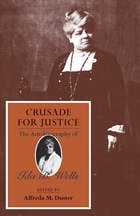
Crusade for Justice
The Autobiography of Ida B. WellsIda B. Wells
University of Chicago Press, 1970
"No student of black history should overlook Crusade for Justice."—William M. Tuttle, Jr., Journal of American History
"Besides being the story of an incredibly courageous and outspoken black woman in the face of innumerable odds, the book is a valuable contribution to the social history of the United States and to the literature of the women's movement as well."—Elizabeth Kolmer, American Quarterly
"[Wells was] a sophisticated fighter whose prose was as thorough as her intellect."—Walter Goodman, New York Times
"An illuminating narrative of a zealous, race-conscious, civic- and church-minded black woman reformer, whose life story is a significant chapter in the history of Negro-White relations."—Thelma D. Perry, Negro History Bulletin