Results by title
90 books match the query 'Civilization, Modern' and 5 start with c

Collective Action
A Bad Subjects AnthologyEdited by Megan Shaw Prelinger and Joel Schalit
Pluto Press, 2004

Constructing the Pluriverse
The Geopolitics of KnowledgeBernd Reiter, editor
Duke University Press, 2018
Contributors. Zaid Ahmad, Manuela Boatcă, Hans-Jürgen Burchardt, Raewyn Connell, Arturo Escobar, Sandra Harding, Ehsan Kashfi, Venu Mehta, Walter D. Mignolo, Ulrich Oslender, Issiaka Ouattara, Bernd Reiter, Manu Samnotra, Catherine E. Walsh, Aram Ziai
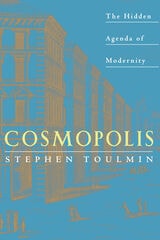
Cosmopolis
The Hidden Agenda of ModernityStephen Toulmin
University of Chicago Press, 1992
In the seventeenth century, a vision arose which was to captivate the Western imagination for the next three hundred years: the vision of Cosmopolis, a society as rationally ordered as the Newtonian view of nature. While fueling extraordinary advances in all fields of human endeavor, this vision perpetuated a hidden yet persistent agenda: the delusion that human nature and society could be fitted into precise and manageable rational categories. Stephen Toulmin confronts that agenda—its illusions and its consequences for our present and future world.
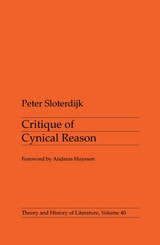
Critique Of Cynical Reason
Peter Sloterdijk
University of Minnesota Press, 1988
In 1983, two centuries after the publication of Kant's Critique of Pure Reason, another philosophical treatise-polemical in nature, with a title that conscious and disrespectfully alludes to the earlier work —appeared in West Germany. Pete Sloterdijk's Critique of Cynical Reason stirred both critical acclaim and consternation and attracted a wide readership, especially among those who had come of age in the 1960s. Sloterdijk finds cynicism the dominant mode in contemporary culture in personal and institutional settings; his book is less a history of the impulse than. an investigation of its role in the postmodern 1970s and 1980s, among those whose earlier hopes for social change had crumbled and faded away. Sloterdijk thus brings into cultural and political discourse an issue which, though central to the mood of a generation, has remained submerged throughout the current debate about modernity and postmodernity.
With Adorno and Horkeimer's Dialectic of Enlightenment as his primary jumping-off point, Sloterdijk also draws upon, and contends with, the poststructuralist concepts of Deleuze and Guattari. He defines cynicism as enlightened false consciousness—a sensibility "well off and miserable at the same time," able to function in the workaday world yet assailed by doubt and paralysis; and, as counterstrategy, proposes the kynicism of antiquity—the sensuality and loud, satiric laughter of Diogenes. Above all, Sloterdijk is determined to resist the amnesia inherent in cynicism. The twentieth-century German historical experience lies behind his work, which closes with a brilliant essay on the Weimar Republic —the fourteen years between a lost war and Hitler's ascent to power, and a time when the cynical mode first achieved cultural dominance.
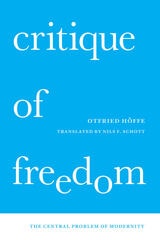
Critique of Freedom
The Central Problem of ModernityOtfried Höffe
University of Chicago Press, 2020
Neither rejecting nor defending freedom and modernity, he instead explores both from a Kantian point of view, looking closely at the facets of freedom’s role and the fundamental position it has taken at the heart of modern life. Expanding beyond traditional philosophy, Critique of Freedom develops the building blocks of a critical theory of technology, environmental protection, economics, politics, medicine, and education. With a sophisticated yet straightforward style, Höffe draws on a range of disciplines in order to clearly distinguish and appreciate the many meanings of freedom and the indispensable role they play in liberal society.