Results by title
145 books match the query 'Classical' and 11 start with c
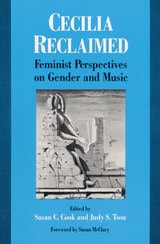
Cecilia Reclaimed
Feminist Perspectives on Gender and MusicEdited by Susan C. Cook and Judy S. Tsou
University of Illinois Press, 1994
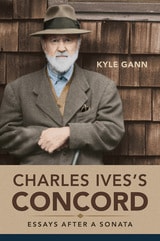
Charles Ives's Concord
Essays after a SonataKyle Gann
University of Illinois Press, 2021
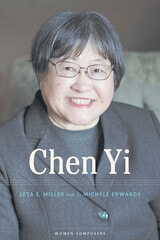
Chen Yi
Leta E. Miller and J. Michele Edwards
University of Illinois Press, 2020
Winner of the Leila Webster Memorial Music Award for the International Alliance for Women in Music of the 2022 Pauline Alderman Awards for Outstanding Scholarship on Women in Music
Chen Yi is the most prominent woman among the renowned group of new wave composers who came to the US from mainland China in the early 1980s. Known for her creative output and a distinctive merging of Chinese and Western influences, Chen built a musical language that references a breathtaking range of sources and crisscrosses geographical and musical borders without eradicating them.
Leta E. Miller and J. Michele Edwards provide an accessible guide to the composer's background and her more than 150 works. Extensive interviews with Chen complement in-depth analyses of selected pieces from Chen's solos for Western or Chinese instruments, chamber works, choral and vocal pieces, and compositions scored for wind ensemble, chamber orchestra, or full orchestra. The authors highlight Chen's compositional strategies, her artistic elaborations, and the voice that links her earliest and most recent music. A concluding discussion addresses questions related to Chen's music and issues such as gender, ethnicity and nationality, transnationalism, border crossing, diaspora, exoticism, and identity.
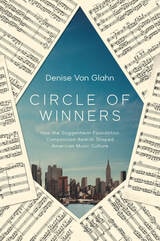
Circle of Winners
How the Guggenheim Foundation Composition Awards Shaped American Music CultureDenise Von Glahn
University of Illinois Press, 2023
An essential high culture institution, the John Simon Guggenheim Memorial Foundation has both supported and molded American musical culture. Denise Von Glahn examines the Foundation and its immense influence from the organization’s prehistory and origins through the onset of World War II.
Funded by the Guggenheim mining fortune, the Foundation took early shape from the efforts of Carroll Wilson, Frank Aydelotte, and Henry Allen Moe--three Rhodes Scholars who initially struggled to envision and implement the organization’s ambitious goals. Von Glahn also examines the career of the longtime musical advisor Thomas Whitney Surette while profiling early awardees Aaron Copland, Ruth Crawford Seeger, William Grant Still, Roger Sessions, George Antheil, and Carlos Chàvez. She examines the processes behind their selection, their values and aesthetics, and their relationships with the insiders and others who championed their work.
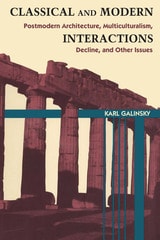
Classical and Modern Interactions
Postmodern Architecture, Multiculturalism, Decline, and Other IssuesBy Karl Galinsky
University of Texas Press, 1992
Postmodernism, multiculturalism, the alleged decline of the United States, deconstruction, leadership, and values—these topics have been at the forefront of contemporary intellectual and cultural debate and are likely to remain so for the near future. Participants in the debate can usefully enlarge the perspective to a comparison between the Greco-Roman world and contemporary society. In this thought-provoking work, a noted classics scholar tests the ancient-modern comparison, showing what it can add to the contemporary debates and what its limitations are.
Writing for intellectually adventurous readers, Galinsky explores Greece and Rome as multicultural societies, debates the merits of classicism in postmodern architecture, discusses the reign of Augustus in terms of modern leadership theories, and investigates the modern obsession with finding parallels between the supposed "decline and fall" of Rome and the "decay" of U.S. society.
Within these discussions, Galinsky shows the continuing vitality of the classical tradition in the contemporary world. The Greek and Roman civilizations have provided us not only with models for conscious adaptation but also points for radical departures. This ability to change and innovate from classical models is crucial, Galinsky maintains. It creates a reciprocal process whereby contemporary issues are projected into the past while aspects of the ancient world are redefined in terms of current approaches.
These essays result in a balanced assessment and stimulating restatement of some major issues in both contemporary U.S. society and the Greco-Roman world. The book, which speaks to a wide interdisciplinary audience, is based on a series of lectures that Galinsky gave as a national visiting scholar for Phi Beta Kappa. It concludes with a discussion of the role of classical studies in the United States today.
Composing Capital
Classical Music in the Neoliberal EraMarianna Ritchey
University of Chicago Press, 2019
Composing Capital
Classical Music in the Neoliberal EraMarianna Ritchey
University of Chicago Press, 2019
This is an auto-narrated audiobook edition of this book.
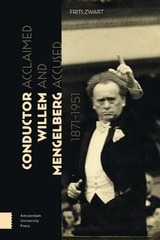
Conductor Willem Mengelberg, 1871-1951
Acclaimed and AccusedFrits Zwart
Amsterdam University Press, 2018
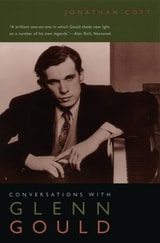
Conversations with Glenn Gould
Jonathan Cott
University of Chicago Press, 2005
Jonathan Cott, a prolific author and poet praised by Larry McMurtry as "the ideal interviewer," was one of the very few people to whom Gould ever granted an interview. Cott spoke with Gould in 1974 for Rolling Stone and published the transcripts in two long articles; after Gould's death, Cott gathered these interviews in Conversations with Glenn Gould, adding an introduction, a selection of photographs, a list of Gould's recorded repertoire, a filmography, and a listing of Gould's programs on radio and TV. A brilliant one-on-one in which Gould discusses his dislike of Mozart's piano sonatas, his partiality for composers such as Orlando Gibbons and Richard Strauss, and his admiration for the popular singer Petula Clark (and his dislike of the Beatles), among other topics, Conversations with Glenn Gould is considered by many, including the subject, to be the best interview Gould ever gave and one of his most remarkable performances.
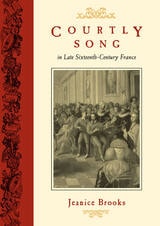
Courtly Song in Late Sixteenth-Century France
Jeanice Brooks
University of Chicago Press, 2001
Brooks concentrates on a period in which the court's importance in projecting the symbolic centrality of monarchy was growing rapidly and considers the role of the air in defining patronage hierarchies at court and in enhancing courtly visions of masculine and feminine virtue. Her study illuminates the court's relationship to the world beyond its own confines, represented first by Italy, then by the countryside. In addition to the 40 editions of airs de cour printed between 1559 and 1589, Brooks draws on memoirs, literary works, and iconographic evidence to present a rounded vision of French Renaissance culture.
The first book-length examination of the history of air de cour, this work also sheds important new light on a formative moment in French history.
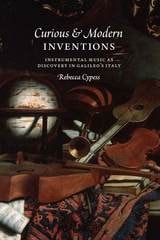
Curious and Modern Inventions
Instrumental Music as Discovery in Galileo's ItalyRebecca Cypess
University of Chicago Press, 2016
Rebecca Cypess shows that early modern thinkers were fascinated with instrumental technologies. The telescope, the clock, the pen, the lute—these were vital instruments for leading thinkers of the age, from Galileo Galilei to Giambattista Marino. No longer used merely to remake an object or repeat a process already known, instruments were increasingly seen as tools for open-ended inquiry that would lead to new knowledge. Engaging with themes from the history of science, literature, and the visual arts, this study reveals the intimate connections between instrumental music and the scientific and artisanal tools that served to mediate between individuals and the world around them.