Results by title
52 books match the query 'Cognitive Science' and 6 start with c

Chemically Imbalanced
Everyday Suffering, Medication, and Our Troubled Quest for Self-MasteryJoseph E. Davis
University of Chicago Press, 2020
Everyday suffering—those conditions or feelings brought on by trying circumstances that arise in everyone’s lives—is something that humans have grappled with for millennia. But the last decades have seen a drastic change in the way we approach it. In the past, a person going through a time of difficulty might keep a journal or see a therapist, but now the psychological has been replaced by the biological: instead of treating the heart, soul, and mind, we take a pill to treat the brain.
Chemically Imbalanced is a field report on how ordinary people dealing with common problems explain their suffering, how they’re increasingly turning to the thin and mechanistic language of the “body/brain,” and what these encounters might tell us. Drawing on interviews with people dealing with struggles such as underperformance in school or work, grief after the end of a relationship, or disappointment with how their life is unfolding, Joseph E. Davis reveals the profound revolution in consciousness that is underway. We now see suffering as an imbalance in the brain that needs to be fixed, usually through chemical means. This has rippled into our social and cultural conversations, and it has affected how we, as a society, imagine ourselves and envision what constitutes a good life. Davis warns that what we envision as a neurological revolution, in which suffering is a mechanistic problem, has troubling and entrapping consequences. And he makes the case that by turning away from an interpretive, meaning-making view of ourselves, we thwart our chances to enrich our souls and learn important truths about ourselves and the social conditions under which we live.
Chemically Imbalanced is a field report on how ordinary people dealing with common problems explain their suffering, how they’re increasingly turning to the thin and mechanistic language of the “body/brain,” and what these encounters might tell us. Drawing on interviews with people dealing with struggles such as underperformance in school or work, grief after the end of a relationship, or disappointment with how their life is unfolding, Joseph E. Davis reveals the profound revolution in consciousness that is underway. We now see suffering as an imbalance in the brain that needs to be fixed, usually through chemical means. This has rippled into our social and cultural conversations, and it has affected how we, as a society, imagine ourselves and envision what constitutes a good life. Davis warns that what we envision as a neurological revolution, in which suffering is a mechanistic problem, has troubling and entrapping consequences. And he makes the case that by turning away from an interpretive, meaning-making view of ourselves, we thwart our chances to enrich our souls and learn important truths about ourselves and the social conditions under which we live.
[more]
Chemically Imbalanced
Everyday Suffering, Medication, and Our Troubled Quest for Self-MasteryJoseph E. Davis
University of Chicago Press, 2020
This is an auto-narrated audiobook version of this book.
Everyday suffering—those conditions or feelings brought on by trying circumstances that arise in everyone’s lives—is something that humans have grappled with for millennia. But the last decades have seen a drastic change in the way we approach it. In the past, a person going through a time of difficulty might keep a journal or see a therapist, but now the psychological has been replaced by the biological: instead of treating the heart, soul, and mind, we take a pill to treat the brain.
Chemically Imbalanced is a field report on how ordinary people dealing with common problems explain their suffering, how they’re increasingly turning to the thin and mechanistic language of the “body/brain,” and what these encounters might tell us. Drawing on interviews with people dealing with struggles such as underperformance in school or work, grief after the end of a relationship, or disappointment with how their life is unfolding, Joseph E. Davis reveals the profound revolution in consciousness that is underway. We now see suffering as an imbalance in the brain that needs to be fixed, usually through chemical means. This has rippled into our social and cultural conversations, and it has affected how we, as a society, imagine ourselves and envision what constitutes a good life. Davis warns that what we envision as a neurological revolution, in which suffering is a mechanistic problem, has troubling and entrapping consequences. And he makes the case that by turning away from an interpretive, meaning-making view of ourselves, we thwart our chances to enrich our souls and learn important truths about ourselves and the social conditions under which we live.
[more]
Chimpanzees in Context
A Comparative Perspective on Chimpanzee Behavior, Cognition, Conservation, and WelfareEdited by Lydia M. Hopper and Stephen R. Ross
University of Chicago Press, 2020
The study of the chimpanzee, one of the human species’ closest relatives, has led scientists to exciting discoveries about evolution, behavior, and cognition over the past half century. In this book, rising and veteran scholars take a fascinating comparative approach to the culture, behavior, and cognition of both wild and captive chimpanzees. By seeking new perspectives in how the chimpanzee compares to other species, the scientists featured offer a richer understanding of the ways in which chimpanzees’ unique experiences shape their behavior. They also demonstrate how different methodologies provide different insights, how various cultural experiences influence our perspectives of chimpanzees, and how different ecologies in which chimpanzees live affect how they express themselves.
After a foreword by Jane Goodall, the book features sections that examine chimpanzee life histories and developmental milestones, behavior, methods of study, animal communication, cooperation, communication, and tool use. The book ends with chapters that consider how we can apply contemporary knowledge of chimpanzees to enhance their care and conservation. Collectively, these chapters remind us of the importance of considering the social, ecological, and cognitive context of chimpanzee behavior, and how these contexts shape our comprehension of chimpanzees. Only by leveraging these powerful perspectives do we stand a chance at improving how we understand, care for, and protect this species.
After a foreword by Jane Goodall, the book features sections that examine chimpanzee life histories and developmental milestones, behavior, methods of study, animal communication, cooperation, communication, and tool use. The book ends with chapters that consider how we can apply contemporary knowledge of chimpanzees to enhance their care and conservation. Collectively, these chapters remind us of the importance of considering the social, ecological, and cognitive context of chimpanzee behavior, and how these contexts shape our comprehension of chimpanzees. Only by leveraging these powerful perspectives do we stand a chance at improving how we understand, care for, and protect this species.
[more]
Cognitive Science, Religion, and Theology
From Human Minds to Divine MindsJustin L. Barrett
Templeton Press, 2011
Cognitive Science, Religion, and Theology is the eighth title published in the Templeton Science and Religion Series, in which scientists from a wide range of fields distill their experience and knowledge into brief tours of their respective specialties. In this volume, well-known cognitive scientist Justin L. Barrett offers an accessible overview of this interdisciplinary field, reviews key findings in this area, and discusses the implications of these findings for religious thought and practice.
Cognitive science is the interdisciplinary study of minds and mental activity, and as such, it addresses a fundamental feature of what it is to be human. Further, as religious traditions concern ideas and beliefs about the nature of humans, the nature of the world, and the nature of the divine, cognitive science can contribute directly and indirectly to these theological concerns. Barrett shows how direct contributions come from the growing area called cognitive science of religion (CSR), which investigates how human cognitive systems inform and constrain religious thought, experience, and expression. CSR attempts to answer questions such as: Why do humans tend to be religious? And why are specific ideas (e.g., the possibility of an afterlife) so cross-culturally recurrent? Barrett also covers the indirect implications that cognitive science has for theology, such as human similarities and differences with the animal world, freedom and determinism, and the relationship between minds and bodies.
Cognitive Science, Religion, and Theology critically reviews the research on these fascinating questions and discusses the many implications that arise from them. In addition, this short volume also offers suggestions for future research, making it ideal not only for those looking for an overview of the field thus far but also for those seeking a glimpse of where the field might be going in the future.
[more]
Constructions
A Construction Grammar Approach to Argument StructureAdele E. Goldberg
University of Chicago Press, 1995
Drawing on work in linguistics, language acquisition, and computer science, Adele E. Goldberg proposes that grammatical constructions play a central role in the relation between the form and meaning of simple sentences. She demonstrates that the syntactic patterns associated with simple sentences are imbued with meaning—that the constructions themselves carry meaning independently of the words in a sentence.
Goldberg provides a comprehensive account of the relation between verbs and constructions, offering ways to relate verb and constructional meaning, and to capture relations among constructions and generalizations over constructions. Prototypes, frame semantics, and metaphor are shown to play crucial roles. In addition, Goldberg presents specific analyses of several constructions, including the ditransitive and the resultative constructions, revealing systematic semantic generalizations.
Through a comparison with other current approaches to argument structure phenomena, this book narrows the gap between generative and cognitive theories of language.
[more]
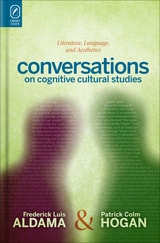
Conversations on Cognitive Cultural Studies
Literature, Language, and AestheticsFrederick Luis Aldama and Patrick Colm Hogan
The Ohio State University Press, 2014
In recent years, few areas of research have advanced as rapidly as cognitive science, the study of the human mind and brain. A fundamentally interdisciplinary field, cognitive science has both inspired and been advanced by work in the arts and humanities. In Conversations on Cognitive Cultural Studies: Literature, Language, and Aesthetics, Frederick Luis Aldama and Patrick Colm Hogan, two of the most prominent experts on the intersection of mind, brain, and culture, engage each other in a lively dialog that sets out the foundations of a cognitive neuroscientific approach to literature. Despite their shared premises, Aldama and Hogan differ—sometimes sharply—on key issues; their discussion therefore presents the reader not with a single doctrine, but with options for consideration—an appropriate result in this dynamic field.
With clarity and learning, Aldama and Hogan consider five central topics at the intersection of literature and cognitive science. They begin with the fundamental question of the nature of the self. From here, they turn to language, communication, and thought before moving on to the central issue of the structure and operation of narrative. The book concludes with thought-provoking explorations of aesthetics and politics. Illustrating their arguments with work that ranges from graphic fiction and popular cinema to William Faulkner and Bertolt Brecht, Aldama and Hogan leave the reader with a clear sense of what cognitive cultural studies have already achieved and the significant promise the discipline holds for the future.
With clarity and learning, Aldama and Hogan consider five central topics at the intersection of literature and cognitive science. They begin with the fundamental question of the nature of the self. From here, they turn to language, communication, and thought before moving on to the central issue of the structure and operation of narrative. The book concludes with thought-provoking explorations of aesthetics and politics. Illustrating their arguments with work that ranges from graphic fiction and popular cinema to William Faulkner and Bertolt Brecht, Aldama and Hogan leave the reader with a clear sense of what cognitive cultural studies have already achieved and the significant promise the discipline holds for the future.
[more]