Results by title
104 books match the query 'Colombia' and 11 start with c
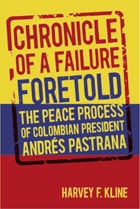
Chronicle of a Failure Foretold
The Peace Process of Colombian President Andrés PastranaHarvey Kline
University of Alabama Press, 2007
Charts the progress and failure of Colombian President Andrés Pastrana’s efforts to bring an end to sixty years of civil war.
The civil war in Colombia has waxed and waned for almost sixty years with shifting goals, programs, and tactics among the contending parties and with bursts of appalling violence punctuated by uneasy truces, cease-fires, and attempts at reconciliation. Varieties of Marxism, the economics of narco-trafficking, peasant land hunger, poverty, and oppression mix together in a toxic stew that has claimed uncounted lives of (most often) peasants, conscript soldiers, and people who just got in the way.
Hope for resolution of this conflict is usually confined to dreamers and millenialists of various persuasions, but occasionally an attempt is made at a breakthrough in the military stalemate between the government and the Marxist groups. One of the most promising such attempts was made by new Colombian President Andrés Pastrana at a time when the main rebel groups seemed receptive to serious dialogue. This book is an account of that effort at peace, accompanied at the outset by domestic and international support and hope, and yet doomed like so many others to eventual failure.
Through interviews with many of the actors in this drama, as well as an understanding of the various interest groups and economic forces at work in Colombia, Dr. Kline charts the progress and ultimate failure of this effort, and thereby hopes to increase understanding of the causes of its lack of success. The importance of the resolution of the conflict to the region and to ordinary citizens of this troubled land cannot be
overstated.
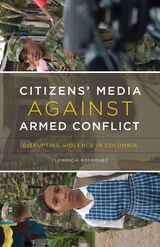
Citizens’ Media against Armed Conflict
Disrupting Violence in ColombiaClemencia Rodríguez
University of Minnesota Press, 2011
For two years, Clemencia Rodríguez did fieldwork in regions of Colombia where leftist guerillas, right-wing paramilitary groups, the army, and drug traffickers made their presence felt in the lives of unarmed civilians. Here, Rodríguez tells the story of the ways in which people living in the shadow of these armed intruders use community radio, television, video, digital photography, and the Internet to shield their communities from armed violence’s negative impacts.
Citizens’ media are most effective, Rodríguez posits, when they understand communication as performance rather than simply as persuasion or the transmission of information. Grassroots media that are deeply embedded in the communities they serve and responsive to local needs strengthen the ability of community members to productively react to violent incursions. Rodríguez demonstrates how citizens’ media privilege aspects of community life not hijacked by violence, providing people with the tools and the platform to forge lives for themselves and their families that are not entirely colonized by armed conflict and its effects.
Ultimately, Rodríguez shows that unarmed civilian communities that have been cornered by armed conflict can use community media to repair torn social fabrics, reconstruct eroded bonds, reclaim public spaces, resolve conflict, and sow the seeds of peace and stability.
Civilization And Violence
Regimes of Representation in Nineteenth-Century ColombiaCristina Rojas
University of Minnesota Press, 2001
Civilization and violence are not necessarily the antagonists we presume-withcivilization taming violence, and violence unmaking civilization. Focusing on postindependence Colombia, this book brings to light the ways in which violenceand civilization actually intertwined and reinforced each other in the development of postcolonial capitalism.
The narratives of civilization and violence, Cristina Rojas contends, play key roles in the formation of racial, gender, and class identities; they also provide pivotal logic to both the formation of the nation and the processes of capitalist development. During the Liberal era of Colombian history (1849-1878), a dominant creole elite enforced a "will to civilization" that sought to create a new world in its own image. Rojas explores different arenas in which this pursuit meant the violent imposition of white, liberal, laissez-faire capitalism. Drawing on a wide range of social theory, Rojas develops a new way of understanding the relationship between violence and the formation of national identity-not just in the history of Colombia, but also in the broader narratives of civilization.
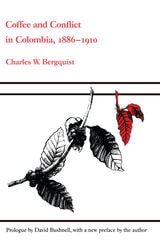
Coffee and Conflict in Colombia, 1886-1910
Charles W. Bergquist
Duke University Press, 1978

Conservative Thought in Twentieth Century Latin America
The Ideas of Laureano GomezJames D. Henderson
Ohio University Press, 1988
Laureano Gómez was president of Colombia in the early 1950s until overthrown by a military coup. He was also, for some fifty years, the leading exponent of Latin American conservatism, a political philosophy with roots in both nineteenth–century politics and religion. Focusing on Gómez, and other prominent conservative politicians, Henderson traces the evolution of Latin American conservatism and demonstrates the scope of its influence throughout the continent.
While much has been written about particular Marxist movements and right–wing regimes in contemporary Latin America, little attention has been devoted, in recent years, to the more moderate political institutions and individuals which dominate twentieth–century Latin America. This first account of Latin American conservatism should be of interest to all students of the history and politics of the region.
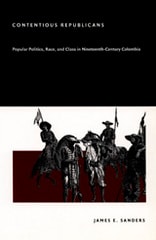
Contentious Republicans
Popular Politics, Race, and Class in Nineteenth-Century ColombiaJames E. Sanders
Duke University Press, 2004
Beginning in the late 1840s, subaltern groups entered the political arena to forge alliances, both temporary and enduring, with the elite Liberal and Conservative Parties. In the process, each group formed its own political discourses and reframed republicanism to suit its distinct needs. These popular liberals and popular conservatives bargained for the parties’ support and deployed a broad repertoire of political actions, including voting, demonstrations, petitions, strikes, boycotts, and armed struggle. By the 1880s, though, many wealthy Colombians of both parties blamed popular political engagement for social disorder and economic failure, and they successfully restricted lower-class participation in politics. Sanders suggests that these reactionary developments contributed to the violence and unrest afflicting modern Colombia. Yet in illuminating the country’s legacy of participatory politics in the nineteenth century, he shows that the current situation is neither inevitable nor eternal.
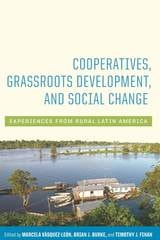
Cooperatives, Grassroots Development, and Social Change
Experiences from Rural Latin AmericaEdited by Marcela Vásquez-León, Brian J. Burke, and Timothy J. Finan
University of Arizona Press, 0
Cooperatives, Grassroots Development, and Social Change presents examples from Paraguay, Brazil, and Colombia, examining what is necessary for smallholder agricultural cooperatives to support holistic community-based development in peasant communities. Reporting on successes and failures of these cooperative efforts, the contributors offer analyses and strategies for supporting collective grassroots interests. Illustrating how poverty and inequality affect rural people, they reveal how cooperative organizations can support grassroots development strategies while negotiating local contexts of inequality amid the broader context of international markets and global competition.
The contributors explain the key desirable goals from cooperative efforts among smallholder producers. They are to provide access to more secure livelihoods, expand control over basic resources and commodity chains, improve quality of life in rural areas, support community infrastructure, and offer social spaces wherein small farmers can engage politically in transforming their own communities.
The stories in Cooperatives, Grassroots Development, and Social Change reveal immense opportunities and challenges. Although cooperatives have often been framed as alternatives to the global capitalist system, they are neither a panacea nor the hegemonic extension of neoliberal capitalism. Through one of the most thorough cross-country comparisons of cooperatives to date, this volume shows the unfiltered reality of cooperative development in highly stratified societies, with case studies selected specifically because they offer important lessons regarding struggles and strategies for adapting to a changing social, economic, and natural environment.
Contributors:
Luis Barros
Brian J. Burke
Charles Cox
Luis Alberto Cuéllar Gómez
Miguel Ricardo Dávila Ladrón de Guevara
Elisa Echagüe
Timothy J. Finan
Andrés González Aguilera
Sonia Carolina López Cerón
Joana Laura Marinho Nogueira
João Nicédio Alves Nogueira
Jessica Piekielek
María Isabel Ramírez Anaya
Rodrigo F. Rentería-Valencia
Lilliana Andrea Ruiz Marín
Marcela Vásquez-León
Corpse Magic
Echoes Active in the Slayer-Slain NexusMichael Taussig
University of Chicago Press, 2025
Corpse Magic is a response to the global ubiquity of violence. In this bracing new work, the influential anthropologist Michael Taussig puts killings in Colombia, by gangs and guerrillas, police and the military, and agents of agribusiness, in conversation with mass shootings and police killings, disproportionately of Black people, in the United States. In both contexts, he examines the effects of violent killing on its victims, its perpetrators, and those who witness and relive it through media footage.
Drawing from literature, religion, philosophy, and anthropology, Taussig traces the idea that the act of killing “infects” the killer and spreads outward, then connects this concept of contagion to beliefs in Colombia and elsewhere that the souls of the slain possess those of their slayers and that magic can be used to empower or thwart corpses as agents of vengeance. In this powerful and imaginative work, Taussig asks what kind of power the dead continue to have; what kinds of magic can manage that power; and what, if anything, can stop seemingly endless cycles of violence.
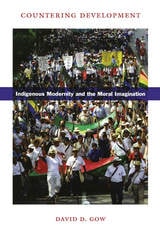
Countering Development
Indigenous Modernity and the Moral ImaginationDavid D. Gow
Duke University Press, 2008
Through ethnographic fieldwork conducted annually in Cauca from 1995 through 2002, Gow compares the development plans of the three communities, looking at both the planning processes and the plans themselves. In so doing, he demonstrates that there is no single indigenous approach to development and modernity. He describes differences in how each community defined and employed the concept of culture, how they connected a concern with culture to economic and political reconstruction, and how they sought to assert their own priorities while engaging with the existing development resources at their disposal. Ultimately, Gow argues that the moral vision advanced by the indigenous movement, combined with the growing importance attached to human rights, offers a fruitful way to think about development: less as a process of integration into a rigidly defined modernity than as a critical modernity based on a radical politics of inclusive citizenship.
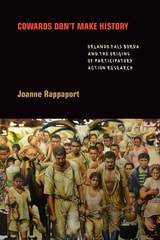
Cowards Don't Make History
Orlando Fals Borda and the Origins of Participatory Action ResearchJoanne Rappaport
Duke University Press, 2020
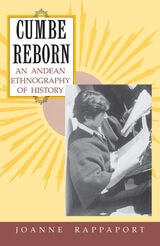
Cumbe Reborn
An Andean Ethnography of HistoryJoanne Rappaport
University of Chicago Press, 1993
Joanne Rappaport examines the Cumbales' reappropriation of history and the resulting reinvention of tradition. She explores the ways in which personal memories are interpreted in nonverbal expression, such as ritual and material culture, as well as in oral and written communication. This novel approach to historical consciousness is grounded on a unique combination of historical and ethnographical analysis.
Cumbe Reborn makes a significant contribution both to our understanding of ethnic militancy in the Americas and to the broader methodological discussion of non-western historical consciousness under colonial domination. It will attract a wide audience of anthropologists, historians, specialists in Andean ethnohistory and Latin American studies and literature, and folklore specialists interested in subaltern discourse.