Results by title
108 books match the query 'Comparative Religion' and 6 start with c
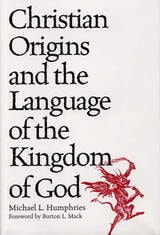
Christian Origins and the Language of the Kingdom of God
Michael L. Humphries. Foreword by Burton L. Mack
Southern Illinois University Press, 1999
Traditionally, scholars have traced the origin of Christianity to a single source—the kingdom of God as represented in the message of the historical Jesus. Through a rhetorical critical analysis of one of the most important texts in early Christian literature (the Beelzebul controversy), Michael L. Humphries addresses the issue of Christian origins, demonstrating how the language of the kingdom of God is best understood according to its locative or taxonomic effect where the demarcation of social and cultural boundaries contributes to the emergence of this new social foundation.
The Beelzebul controversy exists in two versions— Q and Mark—and thereby allows the study to engage the import of the kingdom language at the point of juxtaposition between two distinct textual representations. This makes it possible to deal directly with the issue of the disparity of texts in the synoptic tradition. Humphries suggests that these two versions of the same controversy indicate two distinct social trajectories wherein the kingdom of God comes to mean something quite different in each case but that nevertheless they demonstrate a similarity in theoretical effect where the language contributes to the emergence of relatively distinct social formations.
Humphries establishes the Q and Markan versions of the Beelzebul controversy as relatively sophisticated compositions that are formally identified as elaborate chreiai (a literary form used in the teaching of rhetoric at the secondary and post-secondary level of GrecoRoman education) and that offer an excellent example of the rhetorical manipulation of language in the development of social and cultural identity.

Christianity and Islam
The Struggling DialogueRichard Rousseau
University of Scranton Press, 1985
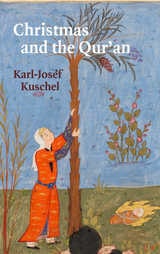
Christmas and the Qur'an
Karl-Josef Kuschel
Gingko, 2017
Christmas and the Qur’an is a sensitive and precise analysis of the Christmas story as it appears in the Gospels and the Qur’an. Karl-Josef Kuschel presents both scriptures in a convincing comparative exegesis and reveals startling similarities as well as significant differences. Kuschel explores how Christians and Muslims read these texts and reveals an intertwining legacy that serves as a base for greater understanding. Without leaving the realm of theology, Kuschel approaches his analysis in a theocentric way by emphasizing the shared belief that God is almighty, which, he argues, can act as a healing suture between Christianity and Islam. Christmas and the Qur’an gives the reader the chance to remember the message of hope that the birth of Jesus brings and invites to a dialogue between Muslims and Christians.
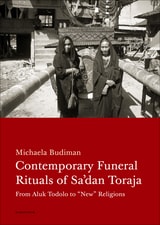
Contemporary Funeral Rituals of Sa'dan Toraja
From Aluk Todolo to "New" ReligionsMichaela Budiman
Karolinum Press, 2013
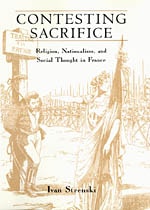
Contesting Sacrifice
Religion, Nationalism, and Social Thought in FranceIvan Strenski
University of Chicago Press, 2002
Strenski suggests that the annihilating spirituality rooted in the Catholic model of Eucharistic sacrifice persuaded the judges in the Dreyfus Case to overlook or play down his possible innocence because a scapegoat was needed to expiate the sins of France and save its army from disgrace. Strenski also suggests that the French army's strategy in World War I, French fascism, and debates over public education and civic morals during the Third Republic all owe much to Catholic theology of sacrifice and Protestant reinterpretations of it. Pointing out that every major theorist of sacrifice is French, including Bataille, Durkheim, Girard, Hubert, and Mauss, Strenski argues that we cannot fully understand their work without first taking into account the deep roots of sacrificial thought in French history.
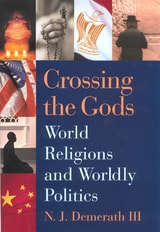
Crossing the Gods
World Religions and Worldly PoliticsDemerath, Jay
Rutgers University Press, 2003
Eminent sociologist of religion Jay Demerath traveled to Brazil, China, Egypt, Guatemala, India, Indonesia, Israel, Japan, Northern Ireland, Pakistan, Poland, Sweden, Turkey, and Thailand to explore the history and current relationship of religion, politics, and the state in each country. In the first part of this wide-ranging book, he asks, What are the basic fault lines along which current tensions and conflicts have formed? What are the trajectories of change from past to present, and how do they help predict the future?
In the book’s second part the author returns home to focus on the United States the only nation founded specifically on the principle of a separation between religion and state and examines the extent to which this principle actually holds and the consequences when it does not. Highlighting such issues as culture wars, violence, globalization, and the fluidity of individual religious identity, Demerath exposes the provincialism and fallacies underlying many of our views of religion and politics worldwide.
Finally, Demerath examines America’s status as the world’s most religious nation. He places that claim within a comparative context and argues that our country is not “more religious” but “differently religious.” He argues that it represents a unique combination of congregational religion, religious pluralism, and civil religion. But the United States also illustrates the universal tendency for the sacred to give way to the secular and for the secular to generate new forms of the sacred.