Results by title
214 books match the query 'Constitutional' and 15 start with c
Congress and the Constitution
Neal Devins and Keith E. Whittington, eds.
Duke University Press, 2005
Several contributors offer wide-ranging accounts of the workings of Congress. They look at lawmakers’ attitudes toward Congress’s role as a constitutional interpreter, the offices within Congress that help lawmakers learn about constitutional issues, Congress’s willingness to use its confirmation power to shape constitutional decisions by both the executive and the courts, and the frequency with which congressional committees take constitutional questions into account. Other contributors address congressional deliberation, paying particular attention to whether Congress’s constitutional interpretations are sound. Still others examine how Congress and the courts should respond to one another’s decisions, suggesting how the courts should evaluate Congress’s work and considering how lawmakers respond to Court decisions that strike down federal legislation. While some essayists are inclined to evaluate Congress’s constitutional interpretation positively, others argue that it could be improved and suggest institutional and procedural reforms toward that end. Whatever their conclusions, all of the essays underscore the pervasive and crucial role that Congress plays in shaping the meaning of the Constitution.
Contributors. David P. Currie, Neal Devins, William N. Eskridge Jr.. John Ferejohn, Louis Fisher, Elizabeth Garrett, Michael J. Gerhardt, Michael J. Klarman, Bruce G. Peabody, J. Mitchell Pickerill, Barbara Sinclair, Mark Tushnet, Adrian Vermeule, Keith E. Whittington, John C. Yoo
Constitution for a Disunited Nation
On Hungary's 2011 Fundamental LawGábor Attila Tóth
Central European University Press, 2013
Constitutional Conscience
The Moral Dimension of Judicial DecisionH. Jefferson Powell
University of Chicago Press, 2008
Powell argues that almost every controversial decision has more than one constitutionally defensible resolution. In such cases, he goes on to contend, the language and ideals of the Constitution require judges to decide in good faith, exercising what Powell calls the constitutional virtues: candor, intellectual honesty, humility about the limits of constitutional adjudication, and willingness to admit that they do not have all the answers. Constitutional Conscience concludes that the need for these qualities in judges—as well as lawyers and citizens—is implicit in our constitutional practices, and that without them judicial review would forfeit both its own integrity and the credibility of the courts themselves.

Constitutional Failure
Carl Schmitt in WeimarEllen Kennedy
Duke University Press, 2004
Kennedy reveals how Schmitt’s argument for a strong but neutral state supported the maximization of market freedom at the cost of the political constitution. She argues that the major fault lines of Weimar liberalism—emergency powers, the courts as “defenders of the constitution,” mass mobilization of anti-liberal politics, ethnic-identity politics, a culture of resentment and contested legitimacy—are not exceptions within the liberal-democratic orders of the West, but central to them. Contending that Schmitt’s thought remains vital today because liberal norms are inadequate to the political challenges facing constitutional systems as diverse as those of Eastern Europe and the United States, Kennedy develops a compelling, rigorous argument that unsettles many assumptions about liberalism, democracy, and dictatorship.
Constitutional History of the American Revolution, Volume I
The Authority Of RightsJohn Phillip Reid
University of Wisconsin Press, 1987
Constitutional History of the American Revolution
Volume I: The Authority of Rights
Volume II: The Authority to Tax
Volume III: The Authority to Legislate
Volume IV: The Authority of Law
John Phillip Reid addresses the central constitutional issues that divided the American colonists from their English legislators: the authority to tax, the authority to legislate, the security of rights, the nature of law, the foundation of constitutional government in custom and contractarian theory, and the search for a constitutional settlement.
Constitutional History of the American Revolution, Volume III
The Authority to LegislateJohn Phillip Reid
University of Wisconsin Press, 1992
This is the first comprehensive study of the constitutionality of the Parliamentary legislation cited by the American Continental Congress as a justification for its rebellion against Great Britain in 1776. The content and purpose of that legislation is well known to historians, but here Reid places it in the context of eighteenth-century constitutional doctrine and discusses its legality in terms of the intellectual premises of eighteenth-century Anglo-American legal values.
The third installment in a planned four-volume work, The Authority to Legislate follows The Authority to Tax and The Authority of Rights. In this volume, Reid shows that the inflexibility of British constitutional principle left no room for settlement or change; Parliament became entrapped by the imperatives of the constitution it was struggling to preserve. He analyzes the legal theories put forward in support of Parliament’s authority to legislate and the specific precedents cited as evidence of that authority.
Reid’s examination of both the debate over the authority to legislate and the constitutional theory underlying the debate shows the extent to which the American Revolution and the Declaration of Independence were actions taken in defense of the rule of law. Considered as a whole, Reid’s Constitutional History of the American Revolution contributes to an understanding of the central role of legal and constitutional standards, especially concern for rule by law, in the development of the American nation.
Constitutional History of the American Revolution, Volume IV
The Authority of LawJohn Phillip Reid
University of Wisconsin Press, 1993
This is the first comprehensive study of the constitutionality of the Parliamentary legislation cited by the American Continental Congress as a justification for its rebellion against Great Britain in 1776. The content and purpose of that legislation is well known to historians, but here John Phillip Reid places it in the context of eighteenth-century constitutional doctrine and discusses its legality in terms of the intellectual premises of eighteenth-century Anglo-American legal values.
The Authority of Law is the last of a four-volume work, preceded by The Authority to Tax, The Authority of Rights, and The Authority to Legislate. In these previous volumes, Reid argued that there would have been no rebellion had taxation been the only constitutional topic of controversy, that issues of rights actually played a larger role in the drafting of state and federal constitutions than they did in instigating a rebellion, and that the American colonists finally took to the battlefield against the British because of statutes that forced Americans to either concede the authority to legislate or leave the empire.
Expanding on the evidence presented in the first three volumes, The Authority of Law determines the constitutional issues dividing American whigs from British imperialists. Reid summarizes these issues as “the supremacy issue,” “the Glorious Revolution issue,” “the liberty issue,” and the “representation issue.” He then raises a compelling question: why, with so many outstanding lawyers participating in the debate, did no one devise a constitutionally legal way out of the standoff? Reid makes an original suggestion. No constitutional solution was found because the British were more threatened by American legal theory than the Americans were by British theory. British lawyers saw the future of liberty in Great Britain endangered by the American version of constitutional law.
Considered as a whole, Reid’s Constitutional History of the American Revolution contributes to an understanding of the central role of legal and constitutional standards, especially concern for rule by law, in the development of the American nation.
Constitutional Revolutions
Pragmatism and the Role of Judicial Review in American ConstitutionalismRobert Justin Lipkin
Duke University Press, 2000
Drawing on ethical theory, philosophy of science, and constitutional theory, Lipkin provides a progressive, postmodern, and pragmatic theory of constitutional law that justifies the critical role played by the judiciary in American democracy. Judicial review, he claims, operates as a mechanism to allow “second thought,” or principled reflection, on the values of the wider culture. Without this revolutionary function, American democracy would be left without an effective institutional means to formulate the community’s considered judgments about good government and individual rights. Although judicial review is not the only forum for protecting this dimension of constitutional democracy, Lipkin maintains that we would be wise not to abandon judicial review unless a viable alternative emerges.
Judges, lawyers, law professors, and constitutional scholars will find this book a valuable resource.
Constitutional Theory
Carl Schmitt
Duke University Press, 2008
Constitutional Theory is a significant departure from Schmitt’s more polemical Weimar-era works not just in terms of its moderate tone. Through a comparative history of constitutional government in Europe and the United States, Schmitt develops an understanding of liberal constitutionalism that makes room for a strong, independent state. This edition includes an introduction by Jeffrey Seitzer and Christopher Thornhill outlining the cultural, intellectual, and political contexts in which Schmitt wrote Constitutional Theory; they point out what is distinctive about the work, examine its reception in the postwar era, and consider its larger theoretical ramifications. This volume also contains extensive editorial notes and a translation of the Weimar Constitution.
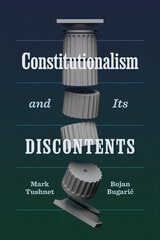
Constitutionalism and Its Discontents
Mark Tushnet and Bojan Bugaric
University of Chicago Press, 2026
A thoughtful and provocative meditation on both the potential and limits of constitutionalism.
In the early twenty-first century, constitutionalism confronts numerous pressures and critiques. Some prominent critics are concerned that constitutionalism’s modern form, in which high courts play a large role, limits popular self-governance. By committing their nations to detailed social and economic policies—from neoliberal requirements for balanced budgets to constitutionalized social welfare and environmental rights—many modern constitutions might make promises they cannot keep and be unduly rigid in the face of changing social, economic, and environmental conditions. Meanwhile, the rise of proto-authoritarian elected leaders around the world shows that constitutions are vulnerable to, and may even enable, democratic backsliding.
Mark Tushnet and Bojan Bugarič argue that addressing each of these serious concerns through constitutional design and innovation is potentially valuable, but paradoxically, every remedy also carries with it the possibility that it will intensify the very conditions it seeks to ameliorate. Instead, Tushnet and Bugarič propose a “thin” idea of constitutionalism and suggest that we should scale back our expectations for what constitutionalism can achieve. Political mobilization, led by people attuned to the economic and cultural causes of democratic backsliding, is a better bet.
Constitutionalism, Identity, Difference, and Legitimacy
Theoretical PerspectivesMichel Rosenfeld
Duke University Press, 1994
Sharing a common focus on the interplay between constitutional identity and individual or group diversity, these essays offer challenging new insights on subjects ranging from universal constitutional norms and whether constitutional norms can be successfully transplanted between cultures to a consideration of whether constitutionalism affords the means to reconcile a diverse society’s quest for identity with its need to properly account for its differences; from the relation between constitution-making and revolution to that between collective interests and constitutional liberty and equality.
This collection’s broad scope and nontechnical style will engage scholars from the fields of political theory, social theory, international studies, and law.
Contributors. Andrew Arato, Aharon Barak, Jon Elster, George P. Fletcher, Louis Henkin, Arthur J. Jacobson, Carlos Santiago Nino, Ulrich K. Preuss, David A. J. Richards, Michel Rosenfeld, Dominique Rousseau, András Sajó, Frederick Schauer, Bernhard Schlink, M. M. Slaughter, Cass R. Sunstein, Ruti G. Teitel, Robin West
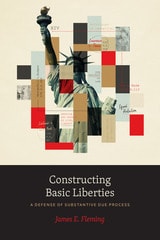
Constructing Basic Liberties
A Defense of Substantive Due ProcessJames E. Fleming
University of Chicago Press, 2022
From reproductive rights to marriage for same-sex couples, many of our basic liberties owe their protection to landmark Supreme Court decisions that have hinged on the doctrine of substantive due process. This doctrine is controversial—a battleground for opposing views around the relationship between law and morality in circumstances of moral pluralism—and is deeply vulnerable today.
Against recurring charges that the practice of substantive due process is dangerously indeterminate and irredeemably undemocratic, Constructing Basic Liberties reveals the underlying coherence and structure of substantive due process and defends it as integral to our constitutional democracy. Reviewing the development of the doctrine over the last half-century, James E. Fleming rebuts popular arguments against substantive due process and shows that the Supreme Court has constructed basic liberties through common law constitutional interpretation: reasoning by analogy from one case to the next and making complex normative judgments about what basic liberties are significant for personal self-government.
Elaborating key distinctions and tools for interpretation, Fleming makes a powerful case that substantive due process is a worthy practice that is based on the best understanding of our constitutional commitments to protecting ordered liberty and securing the status and benefits of equal citizenship for all.
Constructing Basic Liberties
A Defense of Substantive Due ProcessJames E. Fleming
University of Chicago Press, 2022
A strong and lively defense of substantive due process.
From reproductive rights to marriage for same-sex couples, many of our basic liberties owe their protection to landmark Supreme Court decisions that have hinged on the doctrine of substantive due process. This doctrine is controversial—a battleground for opposing views around the relationship between law and morality in circumstances of moral pluralism—and is deeply vulnerable today.
Against recurring charges that the practice of substantive due process is dangerously indeterminate and irredeemably undemocratic, Constructing Basic Liberties reveals the underlying coherence and structure of substantive due process and defends it as integral to our constitutional democracy. Reviewing the development of the doctrine over the last half-century, James E. Fleming rebuts popular arguments against substantive due process and shows that the Supreme Court has constructed basic liberties through common law constitutional interpretation: reasoning by analogy from one case to the next and making complex normative judgments about what basic liberties are significant for personal self-government.
Elaborating key distinctions and tools for interpretation, Fleming makes a powerful case that substantive due process is a worthy practice that is based on the best understanding of our constitutional commitments to protecting ordered liberty and securing the status and benefits of equal citizenship for all.
Cross Purposes
Pierce v. Society of Sisters and the Struggle over Compulsory Public EducationPaula Abrams
University of Michigan Press, 2009
"A definitive study of an extremely important, though curiously neglected, Supreme Court decision, Pierce v. Society of Sisters."
---Robert O'Neil, Professor of Law Emeritus, University of Virginia School of Law
---Richard W. Garnett, Professor of Law and Associate Dean, Notre Dame Law School
"A well-written, well-researched blend of law, politics, and history."
---Joan DelFattore, Professor of English and Legal Studies, University of Delaware
In 1922, the people of Oregon passed legislation requiring all children to attend public schools. For the nativists and progressives who had campaigned for the Oregon School Bill, it marked the first victory in a national campaign to homogenize education---and ultimately the populace. Private schools, both secular and religious, vowed to challenge the law. The Catholic Church, the largest provider of private education in the country and the primary target of the Ku Klux Klan campaign, stepped forward to lead the fight all the way to the U.S. Supreme Court.
In Pierce v. Society of Sisters (1925), the court declared the Oregon School Bill unconstitutional and ruled that parents have the right to determine how their children should be educated. Since then, Pierce has provided a precedent in many cases pitting parents against the state.
Paula Abrams is Professor of Constitutional Law at Lewis & Clark Law School.

Curating Community
Museums, Constitutionalism, and the Taming of the PoliticalStacy Douglas
University of Michigan Press, 2017
Curating Community is a book for academics, artists, curators, and constitutional designers interested in legacies of violence, transitional justice, and democracy.