Results by title
90 books match the query 'Constitutional history' and 14 start with c
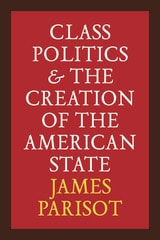
Class Politics and the Creation of the American State
James Parisot
University of Michigan Press, 2026
Why does the American federal government seem to prioritize elite capitalist interests over those of other groups? Class Politics and the Creation of the American State draws on a wide range of sources—personal letters, official government documents, private notes, and newspaper articles—to reveal that the federal government was built to give the emerging capitalist elite a way to consolidate and institutionalize their power. Challenging both liberal and conservative interpretations about what the US Constitution means, this book tells a new story about how the American state took shape.
The framers of the Constitution constructed an image of the state, enshrined in the Constitution, that presented their power as universal: a system meant to serve all Americans equally. This image helped legitimize the new order, even if the rising capitalist class stood to benefit most of all. Since the United States of the late 1780s was not yet a fully capitalist society, the state that was built opened space for less capitalistically incorporated social classes, including some artisans and yeoman farmers, to have limited representation. Class Politics and the Creation of the American State shows how the structure of the early American state worked primarily to advance capitalist interests, while incorporating other groups enough to maintain a sense of broad representation and inclusion.

Constitutional Failure
Carl Schmitt in WeimarEllen Kennedy
Duke University Press, 2004
Kennedy reveals how Schmitt’s argument for a strong but neutral state supported the maximization of market freedom at the cost of the political constitution. She argues that the major fault lines of Weimar liberalism—emergency powers, the courts as “defenders of the constitution,” mass mobilization of anti-liberal politics, ethnic-identity politics, a culture of resentment and contested legitimacy—are not exceptions within the liberal-democratic orders of the West, but central to them. Contending that Schmitt’s thought remains vital today because liberal norms are inadequate to the political challenges facing constitutional systems as diverse as those of Eastern Europe and the United States, Kennedy develops a compelling, rigorous argument that unsettles many assumptions about liberalism, democracy, and dictatorship.
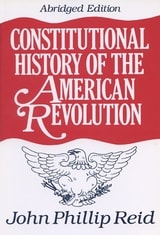
Constitutional History of the American Revolution
John Phillip Reid
University of Wisconsin Press, 1995
Designed for use in courses, this abridged edition of the four-volume Constitutional History of the American Revolution demonstrates how significant constitutional disputes were in instigating the American Revolution. John Phillip Reid addresses the central constitutional issues that divided the American colonists from their English legislators: the authority to tax, the authority to legislate, the security of rights, the nature of law, the foundation of constitutional government in custom and contractarian theory, and the search for a constitutional settlement. Reid's distinctive analysis discusses the irreconcilable nature of this conflict—irreconcilable not because leaders in politics on both sides did not desire a solution, but because the dynamics of constitutional law impeded a solution that permitted the colonies to remain part of the dominions of George III.
Constitutional History of the American Revolution - Abridged
John Phillip Reid
University of Wisconsin Press, 1995
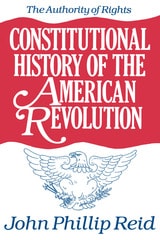
Constitutional History of the American Revolution, Volume I
The Authority Of RightsJohn Phillip Reid
University of Wisconsin Press, 1987
Constitutional History of the American Revolution
Volume I: The Authority of Rights
Volume II: The Authority to Tax
Volume III: The Authority to Legislate
Volume IV: The Authority of Law
John Phillip Reid addresses the central constitutional issues that divided the American colonists from their English legislators: the authority to tax, the authority to legislate, the security of rights, the nature of law, the foundation of constitutional government in custom and contractarian theory, and the search for a constitutional settlement.
Constitutional History of the American Revolution, Volume II
The Authority To TaxJohn Phillip Reid
University of Wisconsin Press, 1987
John Phillip Reid addresses the central constitutional issues that divided the American colonists from their English legislators: the authority to tax, the authority to legislate, the security of rights, the nature of law, the foundation of constitutional government in custom and contractarian theory, and the search for a constitutional settlement.
Constitutional History of the American Revolution, Volume III
The Authority to LegislateJohn Phillip Reid
University of Wisconsin Press, 1992
This is the first comprehensive study of the constitutionality of the Parliamentary legislation cited by the American Continental Congress as a justification for its rebellion against Great Britain in 1776. The content and purpose of that legislation is well known to historians, but here Reid places it in the context of eighteenth-century constitutional doctrine and discusses its legality in terms of the intellectual premises of eighteenth-century Anglo-American legal values.
The third installment in a planned four-volume work, The Authority to Legislate follows The Authority to Tax and The Authority of Rights. In this volume, Reid shows that the inflexibility of British constitutional principle left no room for settlement or change; Parliament became entrapped by the imperatives of the constitution it was struggling to preserve. He analyzes the legal theories put forward in support of Parliament’s authority to legislate and the specific precedents cited as evidence of that authority.
Reid’s examination of both the debate over the authority to legislate and the constitutional theory underlying the debate shows the extent to which the American Revolution and the Declaration of Independence were actions taken in defense of the rule of law. Considered as a whole, Reid’s Constitutional History of the American Revolution contributes to an understanding of the central role of legal and constitutional standards, especially concern for rule by law, in the development of the American nation.
Constitutional History of the American Revolution, Volume IV
The Authority of LawJohn Phillip Reid
University of Wisconsin Press, 1993
This is the first comprehensive study of the constitutionality of the Parliamentary legislation cited by the American Continental Congress as a justification for its rebellion against Great Britain in 1776. The content and purpose of that legislation is well known to historians, but here John Phillip Reid places it in the context of eighteenth-century constitutional doctrine and discusses its legality in terms of the intellectual premises of eighteenth-century Anglo-American legal values.
The Authority of Law is the last of a four-volume work, preceded by The Authority to Tax, The Authority of Rights, and The Authority to Legislate. In these previous volumes, Reid argued that there would have been no rebellion had taxation been the only constitutional topic of controversy, that issues of rights actually played a larger role in the drafting of state and federal constitutions than they did in instigating a rebellion, and that the American colonists finally took to the battlefield against the British because of statutes that forced Americans to either concede the authority to legislate or leave the empire.
Expanding on the evidence presented in the first three volumes, The Authority of Law determines the constitutional issues dividing American whigs from British imperialists. Reid summarizes these issues as “the supremacy issue,” “the Glorious Revolution issue,” “the liberty issue,” and the “representation issue.” He then raises a compelling question: why, with so many outstanding lawyers participating in the debate, did no one devise a constitutionally legal way out of the standoff? Reid makes an original suggestion. No constitutional solution was found because the British were more threatened by American legal theory than the Americans were by British theory. British lawyers saw the future of liberty in Great Britain endangered by the American version of constitutional law.
Considered as a whole, Reid’s Constitutional History of the American Revolution contributes to an understanding of the central role of legal and constitutional standards, especially concern for rule by law, in the development of the American nation.
Constitutions and the Dialectics of Human Rights in Malawi and Kenya
Eunice N. Sahle
University of Wisconsin Press, 2026
As in many other countries, the protection of human rights and other practices of constitutionalism remains uneven in Malawi and Kenya. In this book, Eunice N. Sahle argues that the adoption in 1994 and 2010 in Malawi and Kenya, respectively, of new constitutional frameworks, which have the markings of “critical constitutional events,” provided significant openings for the promotion of human rights. Nonetheless, the emergence of such opportunities does not mean that the protection of human rights is automatic. Sahle zeroes in on the tension between the possibilities of human rights promotion on one hand, and the historical and contemporary factors influencing that process on the other. In that regard, her analysis shows the importance and limits of transformative constitutional frameworks as tools for social change. Further, by focusing on the promotion of human rights by a diverse range of social actors—individuals, civil society, organizations, and public institutions—she demonstrates the need to broaden who “counts” as an agent of human rights and to go beyond a strictly state-centric approach.
Constitutions, Courts, and History
Historical Narratives in Constitutional AdjudicationRenata Uitz
Central European University Press, 2005
Crafting Equality
America's Anglo-African WordCeleste Michelle Condit and John Louis Lucaites
University of Chicago Press, 1993
Drawing upon little studied speeches, newspapers, magazines, and other public discourse, Condit and Lucaites survey the shifting meaning of equality from 1760 to the present as a process of interaction and negotiation among different social groups in American politics and culture. They make a powerful case for the critical role of black Americans in actively shaping what equality has come to mean in our political conversation by chronicling the development of an African-American rhetorical community. The story they tell supports a vision of equality that embraces both heterogeneity and homogeneity as necessary for maintaining the balance between liberty and property.
A compelling revision of an important aspect of America's history, Crafting Equality will interest anyone wanting to better understand the role public discourse plays in affecting the major social and political issues of our times. It will also interest readers concerned with the relationship between politics and culture in America's increasingly multi-cultural society.
Creating the Land of Lincoln
The History and Constitutions of Illinois, 1778-1870Frank Cicero Jr.
University of Illinois Press, 2018

Cyprus
The Post-Imperial ConstitutionVassilis K. Fouskas and Alex O. Tackie
Pluto Press, 2009
Czecho/Slovakia
Ethnic Conflict, Constitutional Fissure, Negotiated BreakupEric Stein
University of Michigan Press, 2000