Results by title
79 books match the query 'Constitutional law' and 13 start with c
Confident Pluralism
Surviving and Thriving through Deep DifferenceJohn D. Inazu
University of Chicago Press, 2016
In Confident Pluralism, John D. Inazu analyzes the current state of the country, orients the contemporary United States within its broader history, and explores the ways that Americans can—and must—strive to live together peaceably despite our deeply engrained differences. Pluralism is one of the founding creeds of the United States—yet America’s society and legal system continues to face deep, unsolved structural problems in dealing with differing cultural anxieties and differing viewpoints. Inazu not only argues that it is possible to cohabitate peacefully in this country, but also lays out realistic guidelines for our society and legal system to achieve the new American dream through civic practices that value toleration over protest, humility over defensiveness, and persuasion over coercion.
The paperback edition includes a new preface that addresses the election of Donald Trump, the decline in civic discourse after the election, the Nazi march in Charlottesville, and more, this new edition of Confident Pluralism is an essential clarion call during one of the most troubled times in US history. Inazu argues for institutions that can work to bring people together as well as political institutions that will defend the unprotected. Confident Pluralism offers a refreshing argument for how the legal system can protect peoples’ personal beliefs and differences and provides a path forward to a healthier future of tolerance, humility, and patience.
Confident Pluralism
Surviving and Thriving through Deep DifferenceJohn D. Inazu
University of Chicago Press, 2018
In Confident Pluralism, John D. Inazu analyzes the current state of the country, orients the contemporary United States within its broader history, and explores the ways that Americans can—and must—strive to live together peaceably despite our deeply engrained differences. Pluralism is one of the founding creeds of the United States—yet America’s society and legal system continues to face deep, unsolved structural problems in dealing with differing cultural anxieties and differing viewpoints. Inazu not only argues that it is possible to cohabitate peacefully in this country, but also lays out realistic guidelines for our society and legal system to achieve the new American dream through civic practices that value toleration over protest, humility over defensiveness, and persuasion over coercion.
With a new preface that addresses the election of Donald Trump, the decline in civic discourse after the election, the Nazi march in Charlottesville, and more, this new edition of Confident Pluralism is an essential clarion call during one of the most troubled times in US history. Inazu argues for institutions that can work to bring people together as well as political institutions that will defend the unprotected. Confident Pluralism offers a refreshing argument for how the legal system can protect peoples’ personal beliefs and differences and provides a path forward to a healthier future of tolerance, humility, and patience.
Congress and the Constitution
Neal Devins and Keith E. Whittington, eds.
Duke University Press, 2005
Several contributors offer wide-ranging accounts of the workings of Congress. They look at lawmakers’ attitudes toward Congress’s role as a constitutional interpreter, the offices within Congress that help lawmakers learn about constitutional issues, Congress’s willingness to use its confirmation power to shape constitutional decisions by both the executive and the courts, and the frequency with which congressional committees take constitutional questions into account. Other contributors address congressional deliberation, paying particular attention to whether Congress’s constitutional interpretations are sound. Still others examine how Congress and the courts should respond to one another’s decisions, suggesting how the courts should evaluate Congress’s work and considering how lawmakers respond to Court decisions that strike down federal legislation. While some essayists are inclined to evaluate Congress’s constitutional interpretation positively, others argue that it could be improved and suggest institutional and procedural reforms toward that end. Whatever their conclusions, all of the essays underscore the pervasive and crucial role that Congress plays in shaping the meaning of the Constitution.
Contributors. David P. Currie, Neal Devins, William N. Eskridge Jr.. John Ferejohn, Louis Fisher, Elizabeth Garrett, Michael J. Gerhardt, Michael J. Klarman, Bruce G. Peabody, J. Mitchell Pickerill, Barbara Sinclair, Mark Tushnet, Adrian Vermeule, Keith E. Whittington, John C. Yoo
Constitution for a Disunited Nation
On Hungary's 2011 Fundamental LawGábor Attila Tóth
Central European University Press, 2013
Constitution-Making in the Region of Former Soviet Dominance
Rett R. Ludwikowski
Duke University Press, 1996
Beginning with a review of the constitutional traditions of Eastern and Central Europe, Ludwikowski goes on to offer analysis of the recent process of political change in the region. A second section focuses specifically on the the new constitutions and such issues as the selection of the form of government, concepts of divisions of power, unicameralism vs. bicameralism, the flexibility or rigidity of constitutions as working documents, and the process of reviewing the constitutionality of laws. Individual states as framed in these documents are analyzed in economic, political, and cultural terms. Although it is too soon to fully consider the implementation of these constitutions, special attention is devoted to the effect of reform on human rights protection, a notorious problem of continuing concern in the region. A final section offers an insightful comparative study of constitutional law by reviewing the post-Soviet process of constitution-making against the backdrop of Western constitutional traditions.
Constitution-Making in the Region of Former Soviet Dominance is both a comprehensive study of constitutional developments in the former Soviet bloc and a primary reference tool for scholars of constitutional law, and Eastern European and post-Soviet studies.
Constitutional Conscience
The Moral Dimension of Judicial DecisionH. Jefferson Powell
University of Chicago Press, 2008
Powell argues that almost every controversial decision has more than one constitutionally defensible resolution. In such cases, he goes on to contend, the language and ideals of the Constitution require judges to decide in good faith, exercising what Powell calls the constitutional virtues: candor, intellectual honesty, humility about the limits of constitutional adjudication, and willingness to admit that they do not have all the answers. Constitutional Conscience concludes that the need for these qualities in judges—as well as lawyers and citizens—is implicit in our constitutional practices, and that without them judicial review would forfeit both its own integrity and the credibility of the courts themselves.
Constitutional Judiciary in a New Democracy
The Hungarian Constitutional CourtLaszlo Solyom and Georg Brunner, Editors
University of Michigan Press, 2000
How was it possible that a new Court established in 1990, in a country just released from forty years of Communist rule, was able to enforce a Constitution, maintain the rule of law, and protect the freedom of its citizens in a way comparable to the U.S. Supreme Court? This new Court has issued decisions on topics ranging from the establishment of democracy and a market economy--privatization, compensation for the nationalization of property, and retroactive criminal legislation--as well as such issues as the constitutionality of capital punishment, abortion, freedom of speech and the media, and the separation of powers.
U.S. Supreme Court Justice Stephen Breyer provides the foreword and introduces the two essays that begin the book. In the first essay, Georg Brunner explains how the Court was set up and what its procedures are. In the second, Lázszló Sólyom describes systematically the emergence of the case-law of the Court and its jurisprudence on constitutional rights and on the powers and procedures of the other branches of government. The models followed by the Court are outlined, and its contribution to global constitutionalism explored.
Lázszló Sólyom is President of the Constitutional Court of Hungary and Professor of Law, ELTE University of Budapest. Georg Brunner is Professor of Law, University of Cologne, Germany.
Constitutional Revolutions
Pragmatism and the Role of Judicial Review in American ConstitutionalismRobert Justin Lipkin
Duke University Press, 2000
Drawing on ethical theory, philosophy of science, and constitutional theory, Lipkin provides a progressive, postmodern, and pragmatic theory of constitutional law that justifies the critical role played by the judiciary in American democracy. Judicial review, he claims, operates as a mechanism to allow “second thought,” or principled reflection, on the values of the wider culture. Without this revolutionary function, American democracy would be left without an effective institutional means to formulate the community’s considered judgments about good government and individual rights. Although judicial review is not the only forum for protecting this dimension of constitutional democracy, Lipkin maintains that we would be wise not to abandon judicial review unless a viable alternative emerges.
Judges, lawyers, law professors, and constitutional scholars will find this book a valuable resource.
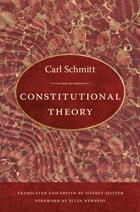
Constitutional Theory
Carl Schmitt
Duke University Press, 2008
Constitutional Theory is a significant departure from Schmitt’s more polemical Weimar-era works not just in terms of its moderate tone. Through a comparative history of constitutional government in Europe and the United States, Schmitt develops an understanding of liberal constitutionalism that makes room for a strong, independent state. This edition includes an introduction by Jeffrey Seitzer and Christopher Thornhill outlining the cultural, intellectual, and political contexts in which Schmitt wrote Constitutional Theory; they point out what is distinctive about the work, examine its reception in the postwar era, and consider its larger theoretical ramifications. This volume also contains extensive editorial notes and a translation of the Weimar Constitution.
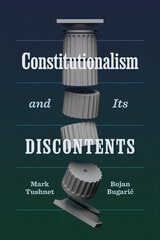
Constitutionalism and Its Discontents
Mark Tushnet and Bojan Bugaric
University of Chicago Press, 2026
A thoughtful and provocative meditation on both the potential and limits of constitutionalism.
In the early twenty-first century, constitutionalism confronts numerous pressures and critiques. Some prominent critics are concerned that constitutionalism’s modern form, in which high courts play a large role, limits popular self-governance. By committing their nations to detailed social and economic policies—from neoliberal requirements for balanced budgets to constitutionalized social welfare and environmental rights—many modern constitutions might make promises they cannot keep and be unduly rigid in the face of changing social, economic, and environmental conditions. Meanwhile, the rise of proto-authoritarian elected leaders around the world shows that constitutions are vulnerable to, and may even enable, democratic backsliding.
Mark Tushnet and Bojan Bugarič argue that addressing each of these serious concerns through constitutional design and innovation is potentially valuable, but paradoxically, every remedy also carries with it the possibility that it will intensify the very conditions it seeks to ameliorate. Instead, Tushnet and Bugarič propose a “thin” idea of constitutionalism and suggest that we should scale back our expectations for what constitutionalism can achieve. Political mobilization, led by people attuned to the economic and cultural causes of democratic backsliding, is a better bet.
Constitutionalism, Identity, Difference, and Legitimacy
Theoretical PerspectivesMichel Rosenfeld
Duke University Press, 1994
Sharing a common focus on the interplay between constitutional identity and individual or group diversity, these essays offer challenging new insights on subjects ranging from universal constitutional norms and whether constitutional norms can be successfully transplanted between cultures to a consideration of whether constitutionalism affords the means to reconcile a diverse society’s quest for identity with its need to properly account for its differences; from the relation between constitution-making and revolution to that between collective interests and constitutional liberty and equality.
This collection’s broad scope and nontechnical style will engage scholars from the fields of political theory, social theory, international studies, and law.
Contributors. Andrew Arato, Aharon Barak, Jon Elster, George P. Fletcher, Louis Henkin, Arthur J. Jacobson, Carlos Santiago Nino, Ulrich K. Preuss, David A. J. Richards, Michel Rosenfeld, Dominique Rousseau, András Sajó, Frederick Schauer, Bernhard Schlink, M. M. Slaughter, Cass R. Sunstein, Ruti G. Teitel, Robin West
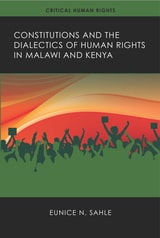
Constitutions and the Dialectics of Human Rights in Malawi and Kenya
Eunice N. Sahle
University of Wisconsin Press, 2026
As in many other countries, the protection of human rights and other practices of constitutionalism remains uneven in Malawi and Kenya. In this book, Eunice N. Sahle argues that the adoption in 1994 and 2010 in Malawi and Kenya, respectively, of new constitutional frameworks, which have the markings of “critical constitutional events,” provided significant openings for the promotion of human rights. Nonetheless, the emergence of such opportunities does not mean that the protection of human rights is automatic. Sahle zeroes in on the tension between the possibilities of human rights promotion on one hand, and the historical and contemporary factors influencing that process on the other. In that regard, her analysis shows the importance and limits of transformative constitutional frameworks as tools for social change. Further, by focusing on the promotion of human rights by a diverse range of social actors—individuals, civil society, organizations, and public institutions—she demonstrates the need to broaden who “counts” as an agent of human rights and to go beyond a strictly state-centric approach.
Constitutions, Courts, and History
Historical Narratives in Constitutional AdjudicationRenata Uitz
Central European University Press, 2005