Results by title
66 books match the query 'Constitutions' and 11 start with c
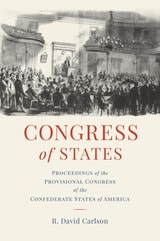
Congress of States
Proceedings of the Provisional Congress of the Confederate States of AmericaR. David Carlson
University of Alabama Press, 2023
A landmark publication of public reports that reveal the founding of the Confederate government
Past publications of the proceedings of the Confederate Congress have focused on the public sessions of the Regular Confederate States Congress that met in Richmond, Virginia from February 1862 to March 1865. Omitted were the formative early sessions of the Montgomery, Alabama and Richmond, Virginia Provisional Congresses of 1861 and 1862. In Congress of States, David Carlson reveals these critical early meetings.
To illuminate this pivot point in American and Southern history, Carlson has drawn on detailed and often verbatim minutes reported in Richmond, Montgomery, Charleston, New Orleans, Savannah, and Augusta newspapers, assembling here a unique set of transcriptions that reveal the birth of the Confederate government.
Congress of States provides an introduction to the Provisional Confederate Congress and the purpose of this work relative to the Southern Historical Society’s landmark 1923 publication “Proceedings of the Confederate Congress,” which detailed the 1862–1865 Regular Confederate Congress. He also includes a chronology outlining the major events of the secession crisis, annotated minutes for the Provisional Confederate Congress’s five sessions, appendices featuring the leadership and committees of the Provisional Congress, and fascinating examples of the proposed Confederate emblem and flags debated by the delegates.
A key set of primary sources that scholars, historians, librarians, and political scientists will value for years to come, Congress of States will also be essential reading for the general reader interested in American and Southern history, the Antebellum South, and the Civil War.
Constitution for a Disunited Nation
On Hungary's 2011 Fundamental LawGábor Attila Tóth
Central European University Press, 2013
Constitution-Making in the Region of Former Soviet Dominance
Rett R. Ludwikowski
Duke University Press, 1996
Beginning with a review of the constitutional traditions of Eastern and Central Europe, Ludwikowski goes on to offer analysis of the recent process of political change in the region. A second section focuses specifically on the the new constitutions and such issues as the selection of the form of government, concepts of divisions of power, unicameralism vs. bicameralism, the flexibility or rigidity of constitutions as working documents, and the process of reviewing the constitutionality of laws. Individual states as framed in these documents are analyzed in economic, political, and cultural terms. Although it is too soon to fully consider the implementation of these constitutions, special attention is devoted to the effect of reform on human rights protection, a notorious problem of continuing concern in the region. A final section offers an insightful comparative study of constitutional law by reviewing the post-Soviet process of constitution-making against the backdrop of Western constitutional traditions.
Constitution-Making in the Region of Former Soviet Dominance is both a comprehensive study of constitutional developments in the former Soviet bloc and a primary reference tool for scholars of constitutional law, and Eastern European and post-Soviet studies.
Constitutional Revolutions
Pragmatism and the Role of Judicial Review in American ConstitutionalismRobert Justin Lipkin
Duke University Press, 2000
Drawing on ethical theory, philosophy of science, and constitutional theory, Lipkin provides a progressive, postmodern, and pragmatic theory of constitutional law that justifies the critical role played by the judiciary in American democracy. Judicial review, he claims, operates as a mechanism to allow “second thought,” or principled reflection, on the values of the wider culture. Without this revolutionary function, American democracy would be left without an effective institutional means to formulate the community’s considered judgments about good government and individual rights. Although judicial review is not the only forum for protecting this dimension of constitutional democracy, Lipkin maintains that we would be wise not to abandon judicial review unless a viable alternative emerges.
Judges, lawyers, law professors, and constitutional scholars will find this book a valuable resource.
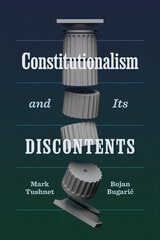
Constitutionalism and Its Discontents
Mark Tushnet and Bojan Bugaric
University of Chicago Press, 2026
A thoughtful and provocative meditation on both the potential and limits of constitutionalism.
In the early twenty-first century, constitutionalism confronts numerous pressures and critiques. Some prominent critics are concerned that constitutionalism’s modern form, in which high courts play a large role, limits popular self-governance. By committing their nations to detailed social and economic policies—from neoliberal requirements for balanced budgets to constitutionalized social welfare and environmental rights—many modern constitutions might make promises they cannot keep and be unduly rigid in the face of changing social, economic, and environmental conditions. Meanwhile, the rise of proto-authoritarian elected leaders around the world shows that constitutions are vulnerable to, and may even enable, democratic backsliding.
Mark Tushnet and Bojan Bugarič argue that addressing each of these serious concerns through constitutional design and innovation is potentially valuable, but paradoxically, every remedy also carries with it the possibility that it will intensify the very conditions it seeks to ameliorate. Instead, Tushnet and Bugarič propose a “thin” idea of constitutionalism and suggest that we should scale back our expectations for what constitutionalism can achieve. Political mobilization, led by people attuned to the economic and cultural causes of democratic backsliding, is a better bet.
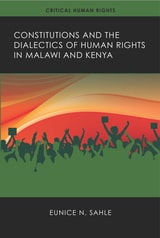
Constitutions and the Dialectics of Human Rights in Malawi and Kenya
Eunice N. Sahle
University of Wisconsin Press, 2026
As in many other countries, the protection of human rights and other practices of constitutionalism remains uneven in Malawi and Kenya. In this book, Eunice N. Sahle argues that the adoption in 1994 and 2010 in Malawi and Kenya, respectively, of new constitutional frameworks, which have the markings of “critical constitutional events,” provided significant openings for the promotion of human rights. Nonetheless, the emergence of such opportunities does not mean that the protection of human rights is automatic. Sahle zeroes in on the tension between the possibilities of human rights promotion on one hand, and the historical and contemporary factors influencing that process on the other. In that regard, her analysis shows the importance and limits of transformative constitutional frameworks as tools for social change. Further, by focusing on the promotion of human rights by a diverse range of social actors—individuals, civil society, organizations, and public institutions—she demonstrates the need to broaden who “counts” as an agent of human rights and to go beyond a strictly state-centric approach.
Constitutions of Matter
Mathematically Modeling the Most Everyday of Physical PhenomenaMartin H. Krieger
University of Chicago Press, 1996
Krieger's lucid discussions will help readers to appreciate the larger physical issues behind the mathematical detail of modern physics and gain deeper insights into how theoretical physicists work. Constitutions of Matter is a rare, behind-the-scenes glimpse into the world of modern physics.
"[Krieger] provides students of physics and applied mathematics with a view of the physical forest behind the mathematical trees, historians and philosophers of science with insights into how theoretical physicists go about their work, and technically advanced general readers with a glimpse into the discipline."—Scitech Book News
Constitutions, Courts, and History
Historical Narratives in Constitutional AdjudicationRenata Uitz
Central European University Press, 2005
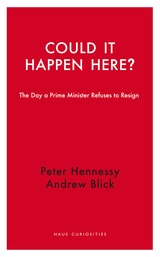
Could it Happen Here?
The Day a Prime Minister Refuses to ResignPeter Hennessy
Haus Publishing, 2025
In light of the resurgence of the far Right across Europe and some of the rhetoric of the 2024 General Election, which carried whiffs of political authoritarianism, Could It Happen Here? explores the possible consequences of a British prime minister refusing to leave office. Mapping out the processes that might occur after such an eventuality, the responsibilities of key players in the United Kingdom’s democratic system, and the integrity of that system after years of stress, Peter Hennessy and Andrew Blick analyze the United Kingdom’s “unwritten” constitution and provide a crucial recommendation for protecting and strengthening the resilience of its parliamentary democracy.
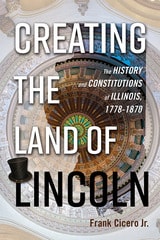
Creating the Land of Lincoln
The History and Constitutions of Illinois, 1778-1870Frank Cicero Jr.
University of Illinois Press, 2018

Cyprus
The Post-Imperial ConstitutionVassilis K. Fouskas and Alex O. Tackie
Pluto Press, 2009