Results by title
67 books match the query 'Consumer Behavior' and 4 start with c
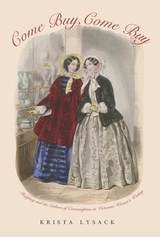
Come Buy, Come Buy
Shopping and the Culture of Consumption in Victorian Women’s WritingKrista Lysack
Ohio University Press, 2008
From the 1860s through the early twentieth century, Great Britain saw the rise of the department store and the institutionalization of a gendered sphere of consumption. Come Buy, Come Buy considers representations of the female shopper in British women’s writing and demonstrates how women’s shopping practices are materialized as forms of narrative, poetic, and cultural inscription, showing how women writers emphasize consumerism as productive of pleasure rather than the condition of seduction or loss. Krista Lysack examines works by Christina Rossetti, Mary Elizabeth Braddon, George Eliot, and Michael Field, as well as the suffragette newspaper Votes for Women, in order to challenge the dominant construction of Victorian femininity as characterized by self-renunciation and the regulation of appetite.
Come Buy, Come Buy considers not only literary works, but also a variety of archival sources (shopping guides, women’s fashion magazines, household management guides, newspapers, and advertisements) and cultural practices (department store shopping, shoplifting and kleptomania, domestic economy, and suffragette shopkeeping). With this wealth of sources, Lysack traces a genealogy of the woman shopper from dissident domestic spender to aesthetic connoisseur, from curious shop-gazer to political radical.

Consumer Culture
Lury, Celia
Rutgers University Press, 1996
This book is written as a survey for students who are interested in the nature and role of consumer culture in modern societies. Drawing on a wide range of studies and disciplines, Celia Lury examines the rise of consumer culture and the changing relations between the production and consumption of cultural goods. Rejecting the Marxist principle of production as the lone economic determinant in capitalist society, Lury presents consumerism as an equally active player in the free market. Rather than existing as opposites, production and consumerism are seen as complements, feeding off each other in an endless cycle. As the author writes, “the use or appropriation of an object is more often than not both a moment of consumption and production, of undoing and doing, of destruction and construction.”
Lury weaves unique arguments over the expansive nature of consumption, including explanations as to how poorer segments of society do in fact contribute to consumer culture and how a commodity moves beyond its function and assumes a cultural and symbolic meaning. Not only does the author explore the way an individual’s position in social groups structured by class, gender, race and age affects the nature of his or her participation in consumer culture, but also how this culture itself is instrumental in the defining of social and political groups and the forming of an individual’s self-identity.
Clearly written and well illustrated, Consumer Culture is a lively and engaging introduction to a topic which is of growing importance in media and cultural studies and in the sociology of culture. It will enable readers to understand and ultimately to have better control over the means of consumption.
Consuming Youth
Vampires, Cyborgs, and the Culture of ConsumptionRobert Latham
University of Chicago Press, 2002
Inspired by Marx's use of the cyborg vampire as a metaphor for the objectification of physical labor in the factory, Latham shows how contemporary images of vampires and cyborgs illuminate the contradictory processes of empowerment and exploitation that characterize the youth-consumer system. While the vampire is a voracious consumer driven by a hunger for perpetual youth, the cyborg has incorporated the machineries of consumption into its own flesh. Powerful fusions of technology and desire, these paired images symbolize the forms of labor and leisure that American society has staked out for contemporary youth.
A startling look at youth in our time, Consuming Youth will interest anyone concerned with film, television, and popular culture.
Crap
A History of Cheap Stuff in AmericaWendy A. Woloson
University of Chicago Press, 2020
In Crap: A History of Cheap Stuff in America, Wendy A. Woloson takes seriously the history of objects that are often cynically-made and easy to dismiss: things not made to last; things we don't really need; things we often don't even really want. Woloson does not mock these ordinary, everyday possessions but seeks to understand them as a way to understand aspects of ourselves, socially, culturally, and economically: Why do we—as individuals and as a culture—possess these things? Where do they come from? Why do we want them? And what is the true cost of owning them?
Woloson tells the history of crap from the late eighteenth century up through today, exploring its many categories: gadgets, knickknacks, novelty goods, mass-produced collectibles, giftware, variety store merchandise. As Woloson shows, not all crap is crappy in the same way—bric-a-brac is crappy in a different way from, say, advertising giveaways, which are differently crappy from commemorative plates. Taking on the full brilliant and depressing array of crappy material goods, the book explores the overlooked corners of the American market and mindset, revealing the complexity of our relationship with commodity culture over time.
By studying crap rather than finely made material objects, Woloson shows us a new way to truly understand ourselves, our national character, and our collective psyche. For all its problems, and despite its disposability, our crap is us.