Results by title
244 books match the query 'Crime' and 82 start with c
CRIME, JUSTICE, HISTORY
ERIC MONKKONEN
The Ohio State University Press, 2002
Crime in the U.S. and the institutions for its control are deeply embedded in and shaped by history. The historical origins have often become invisible, and their recovery difficult, but any understanding of the contemporary situation requires historical context. For over twenty-five years Eric H. Monkkonen has worked on some of the puzzles and problems in recovering the history of crime and police.
Much of his work has appeared in articles, often in specialized journals or not in English, which this book collects for the first time. In addition to Monkkonen’s major published articles, this volume includes several new ones. The topics embrace violence, public disorder, policing, popular culture, and contrasts between the U.S. and Europe. Some articles illuminate special methodological and source issues that challenge historians of criminal justice. As well as dealing with serious crime, this book includes several articles on specifically urban problems and solutions associated with disorder, crime, and poverty.
In contrast to the more technical articles, several chapters, which originally appeared as op-ed pieces, show how historical understanding can help address current policy issues in crime and crime control. All too often, current policy debates occur without proper historical background. As a result, old ideas that have been tried and rejected are re-introduced, or new and sometimes simple ideas are ignored.

CRIMINAL CONVERSATIONS
Victorian Crimes, Social Panic, and Moral OutrageEdited by Judith Rowbotham and Kim Stevenson
The Ohio State University Press, 2005
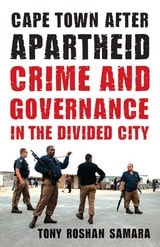
Cape Town after Apartheid
Crime and Governance in the Divided CityTony Roshan Samara
University of Minnesota Press, 2010
Cape Town after Apartheid focuses on urban renewal and urban security policies and practices in the city center and townships as this aspiring world-class city actively pursues a neoliberal approach to development. The city’s attempt to escape its past is, however, constrained by crippling inequalities, racial and ethnic tensions, political turmoil, and persistent insecurity. Samara shows how governance in Cape Town remains rooted in the perceived need to control dangerous populations and protect a somewhat fragile and unpopular economic system. In urban areas around the world, where the affluent minority and poor majority live in relative proximity to each other, aggressive security practices and strict governance reflect and reproduce the divided city.
A critical case for understanding a transnational view of urban governance, especially in highly unequal, majority-poor cities, this closely observed study of postapartheid Cape Town affords valuable insight into how security and governance technologies from the global North combine with local forms to create new approaches to social control in cities across the global South.
Challenged Sovereignty
The Impact of Drugs, Crime, Terrorism, and Cyber Threats in the CaribbeanIvelaw Lloyd Griffith
University of Illinois Press, 2024
Informed and up to date, Challenged Sovereignty explains the effects of today’s globalized problems on the contemporary Caribbean.
Chicago Studies in Political Economy
Edited by George J. Stigler
University of Chicago Press, 1988
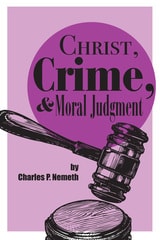
Christ, Crime, and Moral Judgment
Nemeth
St. Augustine's Press, 2025
Nemeth traces the modern shift in considering God as judge to the God who just wants to wipe away tears. If we look in Scripture, there are harsh words for the person who dismisses moral action as less than a continual call to evaluation and conversion. One also sees the detrimental effect of granting political underpinnings to all interpretations of the Bible and its indications of what righteous action is. Nemeth asserts that not only is the measure of law worthless without a kind of hardness toward offenders, but charity itself has no backbone without justice. Restoration requires judgment, but the Judge who speaks harshly is the one who cultivates the desire for his softness. Post-modern scholars don't worry about receiving God's mercy, but they really ought to define the parameters of human responsibility. Any human attempt to define mercy and compassion on the part of God will always fall short, we ought to save our energies to live up to the moral life and take Christ as a perfect example and proof of the possibility.
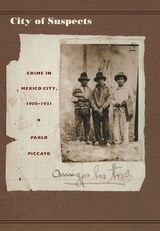
City of Suspects
Crime in Mexico City, 1900–1931Pablo Piccato
Duke University Press, 2001
By investigating postrevolutionary examples of corruption and organized crime, Piccato shines light on the historical foundations of a social problem that remains the main concern of Mexico City today. Emphasizing the social construction of crime and the way it was interpreted within the moral economy of the urban poor, he describes the capital city during the early twentieth century as a contested territory in which a growing population of urban poor had to negotiate the use of public spaces with more powerful citizens and the police. Probing official discourse on deviance, Piccato reveals how the nineteenth-century rise of positivist criminology—which asserted that criminals could be readily distinguished from the normal population based on psychological and physical traits—was used to lend scientific legitimacy to class stratifications and to criminalize working-class culture. Furthermore, he argues, the authorities’ emphasis on punishment, isolation, and stigmatization effectively created cadres of professional criminals, reshaping crime into a more dangerous problem for all inhabitants of the capital.
This unique investigation into crime in Mexico City will interest Latin Americanists, sociologists, and historians of twentieth-century Mexican history.
Cold Deck
A NovelH. Lee Barnes
University of Nevada Press, 2013
Cold Deck is the exciting story of an ordinary man who finds himself in extraordinary circumstances. Moving from Las Vegas’s mean streets to the insider’s world of casino workers, this is a story of survival set against the greed, fears, and glitz of Sin City.
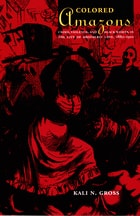
Colored Amazons
Crime, Violence, and Black Women in the City of Brotherly Love, 1880–1910Kali N. Gross
Duke University Press, 2006
Gross draws on prison records, trial transcripts, news accounts, and rare mug shot photographs. Providing an overview of Philadelphia’s black women criminals, she describes the women’s work, housing, and leisure activities and their social position in relation to the city’s native-born whites, European immigrants, and elite and middle-class African Americans. She relates how news accounts exaggerated black female crime, trading in sensationalistic portraits of threatening “colored Amazons,” and she considers criminologists’ interpretations of the women’s criminal acts, interpretations largely based on notions of hereditary criminality. Ultimately, Gross contends that the history of black female criminals is in many ways a history of the rift between the political rhetoric of democracy and the legal and social realities of those marginalized by its shortcomings.

Columbo
A Rhetoric of Inquiry with Resistant RespondersChristyne Berzsenyi
Intellect Books, 2019
An analysis of the hit television series Columbo and the investigative methods of its eponymous main character.
In the iconic detective show, which aired from 1968 to 2003, Lieutenant Columbo was known for his Socratic method of rhetorical inquiry. Feigning ignorance and employing a barrage of questions about minute details, the detective enacts a persona of “antipotency,” or counter authoritativeness, to affect the villains' underestimation of his attention to inconsistencies, abductive reasoning, and rhetorical efficacy. In his predominantly dialogue-based investigations, Columbo exhausts his suspects by asking a battery of questions concerning all minor details of the case—an aggravating, tedious provocation for the killer trying to maintain innocence.
In this engaging interdisciplinary study, Christyne Berzsenyi explores the character and his influences, dissects his methods of investigation, and assesses the show’s enduring legacy in academia and popular culture. While critical and theoretical, the text is also accessible to interdisciplinary readers, practical in application, and amusing for Columbo buffs.
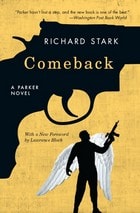
Comeback
A Parker NovelRichard Stark
University of Chicago Press, 2011
Parker returned to action after 23 years away, and he did so with a bang in this classic entry in the long-running hard-boiled crime series
Richard Stark's Parker novels are the hardest of hard-boiled, classic crime novels where the heists are huge, the body counts are high, and the bad guys usually win.
The Parker novels have been a huge influence on countless writers and filmmakers, including Quentin Tarantino, Stephen King, George Pelecanos, Colson Whitehead, Lucy Sante, John Banville, and many more. Their stripped-down language and hard-as-nails amorality create an unforgettable world where the next score could be the big one, but your next mistake could also be your last. There's nothing else like them.
After the bloodbath of Butcher’s Moon, the action-filled blowout Parker adventure, Donald Westlake said, "Richard Stark proved to me that he had a life of his own by simply disappearing. He was gone." And for nearly twenty-five years, he stayed away, while readers waited.
But nothing bad is truly gone forever, and Parker’s as bad as they come. According to Westlake, one day in 1997, “suddenly, he came back from the dead, with a chalky prison pallor”—and the resulting novel, Comeback, showed that neither Stark nor Parker had lost a single step. Knocking over a highly lucrative religious revival show, Parker reminds us that not all criminals don ski masks—some prefer to hide behind the wings of fallen angels.
Communities and Crime
An Enduring American ChallengePamela Wilcox
Temple University Press, 2017
Social scientists have long argued over the links between crime and place. The authors of Communities and Crime provide an intellectual history that traces how varying images of community have evolved over time and influenced criminological thinking and criminal justice policy.
The authors outline the major ideas that have shaped the development of theory, research, and policy in the area of communities and crime. Each chapter examines the problem of the community through a defining critical or theoretical lens: the community as social disorganization; as a system of associations; as a symptom of larger structural forces; as a result of criminal subcultures; as a broken window; as crime opportunity; and as a site of resilience.
Focusing on these changing images of community, the empirical adequacy of these images, and how they have resulted in concrete programs to reduce crime, Communities and Crime theorizes about and reflects upon why some neighborhoods produce so much crime. The result is a tour of the dominant theories of place in social science today.
Couch People
A NovelWill Burns
University of Alabama Press, 2026
A darkly comic descent into Arkansas’s surreal criminal underworld through the eyes of a hapless, debt‑ridden hypochondriac
Couch People is a feverish, darkly comic novel that captures the anxious intensity of a world obsessed with wellness and control even as life keeps spinning into chaos. Prince, a debt-ridden drug dealer on probation, clings to vitamins and homeopathic rituals while stumbling through a surreal Arkansas underworld filled with criminal volatility and sudden violence.
As Prince fights to stay out of prison, recover his stolen money, and hold onto a fragile hope for love, he moves through a landscape populated by unforgettable misfits and bizarre dangers, including a system where snitches are cremated, turned into diamonds, and set into convicts’ teeth. Will Burns blends his satirical bite with unexpected tenderness, creating a narrative that prizes raw interiority and absurd humor over neat redemption. Couch People becomes a propulsive fever dream about love, loss, and the impossible effort to impose order on a world that refuses to make sense, inviting readers to embrace the beautiful mess of being alive without a manual, a map, or mercy.

Country Cop
True Tales from a Texas Deputy SheriffBarry Goodson
University of North Texas Press, 2020
Crime And Capitalism
Readings in Marxist Crimonologyedited by David F. Greenberg
Temple University Press, 1993
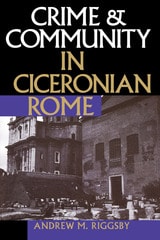
Crime and Community in Ciceronian Rome
By Andrew M. Riggsby
University of Texas Press, 1999
In the late Roman Republic, acts of wrongdoing against individuals were prosecuted in private courts, while the iudicia publica (literally "public courts") tried cases that involved harm to the community as a whole. In this book, Andrew M. Riggsby thoroughly investigates the types of cases heard by the public courts to offer a provocative new understanding of what has been described as "crime" in the Roman Republic and to illuminate the inherently political nature of the Roman public courts.
Through the lens of Cicero's forensic oratory, Riggsby examines the four major public offenses: ambitus (bribery of the electorate), de sicariis et veneficiis (murder), vis (riot), and repetundae (extortion by provincial administrators). He persuasively argues that each of these offenses involves a violation of the proper relations between the state and the people, as interpreted by orators and juries. He concludes that in the late Roman Republic the only crimes were political crimes.
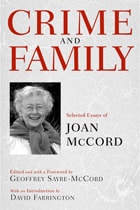
Crime and Family
Selected Essays of Joan McCordJoan McCord, introduction by David Farrington, foreword by Geoffrey Sayre-McCord
Temple University Press, 2007
Crime and Justice, Volume 10
An Annual Review of ResearchEdited by Michael Tonry and Norval Morris
University of Chicago Press Journals, 1988
Crime and Justice, Volume 11
Family ViolenceEdited by Lloyd Ohlin and Michael Tonry
University of Chicago Press Journals, 1990
Crime and Justice, Volume 12
An Annual Review of ResearchEdited by Michael Tonry and Norval Morris
University of Chicago Press Journals, 1989
Crime and Justice, Volume 13
Drugs and CrimeEdited by Michael Tonry and James Q. Wilson
University of Chicago Press Journals, 1991
Crime and Justice, Volume 14
An Annual Review of ResearchEdited by Michael Tonry
University of Chicago Press Journals, 1991

Crime and Justice, Volume 15
Modern PolicingEdited by Michael Tonry and Norval Morris
University of Chicago Press Journals, 1993
Crime and Justice, Volume 16
An Annual Review of ResearchEdited by Michael Tonry
University of Chicago Press Journals, 1992
Crime and Justice, Volume 17
An Annual Review of ResearchEdited by Michael Tonry
University of Chicago Press Journals, 1993
Crime and Justice, Volume 18
Beyond the Law: Crime in Complex OrganizationsEdited by Michael Tonry and Albert J. Reiss Jr.
University of Chicago Press Journals, 1993
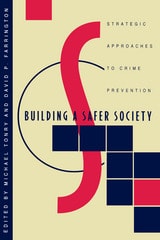
Crime and Justice, Volume 19
Strategic Approaches to Crime PreventionEdited by Michael Tonry and David Farrington
University of Chicago Press Journals, 1995
Crime and Justice, Volume 1
An Annual Review of ResearchEdited by Norval Morris and Michael Tonry
University of Chicago Press Journals, 1980
Crime and Justice, Volume 20
An Annual Review of ResearchEdited by Michael Tonry
University of Chicago Press Journals, 1996
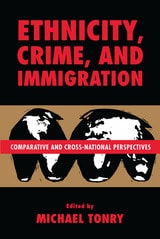
Crime and Justice, Volume 21
Comparative and Cross-National Perspectives on Ethnicity, Crime, and ImmigrationEdited by Michael Tonry
University of Chicago Press Journals, 1997
ethnic differences in criminal offending, victimization by crime, and
disparities and discrimination in justice systems. These nine essays
provide comrehensive up-to-date summaries of research and experience
concerning those subjects in Australia, Canada, England and Wales,
France, Germany, the Netherlands, Sweden, Switzerland, and the United
States. Population migration has reached an all time high in Europe and
with it, "immigration and crime" has become the single most volatile and
topical crime control issue in most of these countries.
The nine essays in this book are written by the leading specialists in
each country. Contributors include Roderic Broadhurst, Julian V. Roberts
and Anthony N. Doob, David J. Smith, Pierre Tournier, Hans-Jörg
Albrecht, Josine Junger-Tas, Peter L. Martens, Martin Killias, Robert J.
Sampson and Janet L. Lauritsen.
Michael Tonry is Sonosky Professor of Law and Public Policy at the
University of Minnesota.
Crime and Justice, Volume 22
An Annual Review of ResearchEdited by Michael Tonry
University of Chicago Press Journals, 1997
Crime and Justice, Volume 23
An Annual Review of ResearchEdited by Michael Tonry
University of Chicago Press Journals, 1998
Crime and Justice, Volume 24
Youth ViolenceEdited by Michael Tonry and Mark H. Moore
University of Chicago Press Journals, 1998
Featuring articles by leading American and European scholars from many fields, Youth Violence provides a reliable, up-to-date, authoritative and comprehensive overview of policy issues and research developments concerning crime and violence among the young.
Crime and Justice, Volume 25
An Annual Review of ResearchEdited by Michael Tonry
University of Chicago Press Journals, 1999
Crime and Justice, Volume 26
PrisonsEdited by Michael Tonry and Joan Petersilia
University of Chicago Press Journals, 1999
Featuring articles by Alfred Blumstein and Allen Beck, Joan Petersilia, Anthony Bottoms, Douglas McDonald and others, Prisons provides reliable, up-to-date, and comprehensive overviews of policy issues and research developments concerning prisons and imprisonment. This timely collection of essays will benefit scholars, administrators, and policy makers alike.
Crime and Justice, Volume 27
A Review of ResearchEdited by Michael Tonry
University of Chicago Press Journals, 2000
Crime and Justice, Volume 28
A Review of ResearchEdited by Michael Tonry
University of Chicago Press Journals, 2001
Volume 28 is a review of recent research on criminal justice issues, with a careful balance of research, theory, and practice.
Contributors:
John Laub and Robert J. Sampson on Desistance From Crime
Norval Morris and Leena Kurki on Supermax Prisons
Richard Harding on Private Prisons
David Boerner and Roxanne Lieb on Sentencing Reform In The Other Washington, 1975-2000
Michael A. Bellesiles on the History Of Firearms Regulation
Grant T. Harris, Tracey A. Skilling, and Marnie E. Rice on Psychopathy And Crime
Daniel Nagin on Costs And Benefits Of Crime Prevention.
Crime and Justice, Volume 29
A Review of ResearchEdited by Michael Tonry
University of Chicago Press Journals, 2002
Volume 29 is a review of recent research on criminal justice issues, with a careful balance of research, theory, and practice.
Crime and Justice, Volume 2
An Annual Review of ResearchEdited by Norval Morris and Michael Tonry
University of Chicago Press Journals, 1981
Crime and Justice, Volume 30
A Review of ResearchEdited by Michael Tonry
University of Chicago Press Journals, 2003
Volume 30 is a survey volume of recent research on criminal justice issues, with a careful balance of research, theory, and practice.
Contributors:
Alfred Blumstein
Rick Brown
Ronald V. Clarke
Anthony N. Doob
Manuel Eisner
David P. Farrington
Rosemary Gartner
James Jacobs
Candace Kruttschnitt
Ellen Peters
Alex R. Piquero
Tom R. Tyler
Cheryl Marie Webster
Crime and Justice, Volume 31
Youth Crime and Youth Justice: Comparative and Cross-national PerspectivesEdited by Michael Tonry and Anthony N. Doob
University of Chicago Press Journals, 2004
Contributors:
Hans-Jörg Albrecht
Anthony Bottoms
James Dignan
Anthony N. Doob
Carl-Gunnar Janson
Josine Junger-Tas
Britta Kyvsgaard
Allison Morris
Julian V. Roberts
Jane B. Sprott
Lode Walgrave
Crime and Justice, Volume 32
A Review of ResearchEdited by Michael Tonry
University of Chicago Press Journals, 2004
Volume 32 covers criminal justice issues, with a careful balance of research, theory, and practice. Topics in this volume include: environmental crime, the effects of wrongful imprisonment, the assessment of macro-level predictors and theories of crime, ethnic differences in intergenerational crime patterns, sentencing guidelines in Minnesota from 1978 to 2003, and the results of five decades of neutralization research.
Contributors:
Heith Copes
Francis T. Cullen
Richard S. Frase
Adrian Grounds
Shadd Maruna
Travis C. Pratt
Aaron S. Routhe
Neal Shover
David J. Smith
Crime and Justice, Volume 33
Crime and Punishment in Western Countries, 1980-1999Edited by Michael Tonry and David P. Farrington
University of Chicago Press Journals, 2006
Crime and Justice, Volume 34
A Review of ResearchEdited by Michael Tonry
University of Chicago Press Journals, 2006
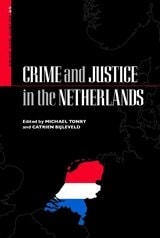
Crime and Justice, Volume 35
Crime and Justice in the NetherlandsEdited by Michael Tonry and Catrien Bijleveld
University of Chicago Press Journals, 2008
Crime and Justice, Volume 36
Crime, Punishment, and Politics in Comparative PerspectiveEdited by Michael Tonry
University of Chicago Press Journals, 2008
Crime and Justice, Volume 37
A Review of ResearchEdited by Michael Tonry
University of Chicago Press Journals, 2008
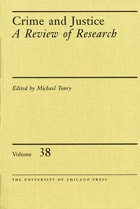
Crime and Justice, Volume 38
A Review of ResearchEdited by Michael Tonry
University of Chicago Press Journals, 2009
Since 1979, Crime and Justice has presented an annual review of the latest international research, providing expertise to enhance the work of sociologists, psychologists, criminal lawyers, justice scholars, and political scientists. The series explores a full range of issues concerning crime, its causes, and its cure. Volume 38 covers a range of criminal justice issues, from the effects of parental imprisonment on children to economists and crime.
Crime and Justice, Volume 39
A Review of ResearchEdited by Michael Tonry
University of Chicago Press Journals, 2010
Since 1979 the Crime and Justice series has presented a review of the latest international research, providing expertise to enhance the work of sociologists, psychologists, criminal lawyers, justice scholars, and political scientists. The series explores a full range of issues concerning crime, its causes, and its cure. Volume 39 covers a range of criminal justice issues, including how drug enforcement affects drug prices, the source of racial disparity in imprisonment, rape and attrition in the legal process, and sex offender recidivism. Contributors to this volume include: Brigitte Bouhours, Jonathan P. Caulkins , Aaron Chalfin, Philip J. Cook, , Kathleen Daly, Denise C. Gottfredson, David S. Kirk, John H. Laub, Stephen D. Mastrofski , Chongmin Na, Steven Raphael, Michael D. Reisig, Peter Reuter, Dirk van Zyl Smit, Keith Soothill, Michael Tonry, and James J. Willis.
Crime and Justice, Volume 3
An Annual Review of ResearchEdited by Michael Tonry and Norval Morris
University of Chicago Press Journals, 1982