Results by title
115 books match the query 'Criminal Law' and 28 start with c
Crime and Justice, Volume 23
An Annual Review of ResearchEdited by Michael Tonry
University of Chicago Press Journals, 1998
Crime and Justice, Volume 24
Youth ViolenceEdited by Michael Tonry and Mark H. Moore
University of Chicago Press Journals, 1998
Featuring articles by leading American and European scholars from many fields, Youth Violence provides a reliable, up-to-date, authoritative and comprehensive overview of policy issues and research developments concerning crime and violence among the young.
Crime and Justice, Volume 25
An Annual Review of ResearchEdited by Michael Tonry
University of Chicago Press Journals, 1999
Crime and Justice, Volume 27
A Review of ResearchEdited by Michael Tonry
University of Chicago Press Journals, 2000
Crime and Justice, Volume 28
A Review of ResearchEdited by Michael Tonry
University of Chicago Press Journals, 2001
Volume 28 is a review of recent research on criminal justice issues, with a careful balance of research, theory, and practice.
Contributors:
John Laub and Robert J. Sampson on Desistance From Crime
Norval Morris and Leena Kurki on Supermax Prisons
Richard Harding on Private Prisons
David Boerner and Roxanne Lieb on Sentencing Reform In The Other Washington, 1975-2000
Michael A. Bellesiles on the History Of Firearms Regulation
Grant T. Harris, Tracey A. Skilling, and Marnie E. Rice on Psychopathy And Crime
Daniel Nagin on Costs And Benefits Of Crime Prevention.
Crime and Justice, Volume 29
A Review of ResearchEdited by Michael Tonry
University of Chicago Press Journals, 2002
Volume 29 is a review of recent research on criminal justice issues, with a careful balance of research, theory, and practice.
Crime and Justice, Volume 34
A Review of ResearchEdited by Michael Tonry
University of Chicago Press Journals, 2006
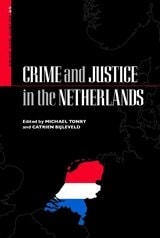
Crime and Justice, Volume 35
Crime and Justice in the NetherlandsEdited by Michael Tonry and Catrien Bijleveld
University of Chicago Press Journals, 2008
Crime and Justice, Volume 36
Crime, Punishment, and Politics in Comparative PerspectiveEdited by Michael Tonry
University of Chicago Press Journals, 2008
Crime and Justice, Volume 37
A Review of ResearchEdited by Michael Tonry
University of Chicago Press Journals, 2008
Crime and Justice, Volume 38
A Review of ResearchEdited by Michael Tonry
University of Chicago Press Journals, 2009
Since 1979, Crime and Justice has presented an annual review of the latest international research, providing expertise to enhance the work of sociologists, psychologists, criminal lawyers, justice scholars, and political scientists. The series explores a full range of issues concerning crime, its causes, and its cure. Volume 38 covers a range of criminal justice issues, from the effects of parental imprisonment on children to economists and crime.
Crime and Justice, Volume 39
A Review of ResearchEdited by Michael Tonry
University of Chicago Press Journals, 2010
Since 1979 the Crime and Justice series has presented a review of the latest international research, providing expertise to enhance the work of sociologists, psychologists, criminal lawyers, justice scholars, and political scientists. The series explores a full range of issues concerning crime, its causes, and its cure. Volume 39 covers a range of criminal justice issues, including how drug enforcement affects drug prices, the source of racial disparity in imprisonment, rape and attrition in the legal process, and sex offender recidivism. Contributors to this volume include: Brigitte Bouhours, Jonathan P. Caulkins , Aaron Chalfin, Philip J. Cook, , Kathleen Daly, Denise C. Gottfredson, David S. Kirk, John H. Laub, Stephen D. Mastrofski , Chongmin Na, Steven Raphael, Michael D. Reisig, Peter Reuter, Dirk van Zyl Smit, Keith Soothill, Michael Tonry, and James J. Willis.
Crime and Justice, Volume 40
Crime and Justice in ScandinaviaEdited by Michael Tonry and Tapio Lappi-Seppälä
University of Chicago Press Journals, 2012
Since 1979 the Crime and Justice series has presented a review of the latest international research, providing expertise to enhance the work of sociologists, psychologists, criminal lawyers, justice scholars, and political scientists. The series explores a full range of issues concerning crime, its causes, and its cure.
Volume 40, Crime and Justice in Scandinavia, offers the most comprehensive and authoritative look ever available at criminal justice policies, practices, and research in the Nordic countries. Topics range from the history of violence through juvenile delinquency, juvenile justice, and sentencing to controversial contemporary policies on prostitution, victims, and organized crime. Contributors to this volume include Jon-Gunnar Bernburg, Ville Hinkkanen, Cecilie Høigård, Hanns von Hofer, Charlotta Holmström, Janne Kivivuori, Lars Korsell, Tapio Lappi-Seppälä, Paul Larsson, Martti Lehti, Torkild Hovde Lyngstad, Sven-Axel Månsson, Anita Rönneling, Lise-Lotte Rytterbro, Torbjørn Skardhamar, May-Len Skilbrei, and Henrik Tham.
Crime and Justice, Volume 41
Prosecutors and Politics: A Comparative PerspectiveEdited by Michael Tonry
University of Chicago Press Journals, 2012
Prosecutors are powerful figures in any criminal justice system. They decide what crimes to prosecute, whom to pursue, what charges to file, whether to plea bargain, how aggressively to seek a conviction, and what sentence to demand. In the United States, citizens can challenge decisions by police, judges, and corrections officials, but courts keep their hands off the prosecutor. Curiously, in the United States and elsewhere, very little research is available that examines this powerful public role. And there is almost no work that critically compares how prosecutors function in different legal systems, from state to state or across countries. Prosecutors and Politics begins to fill that void.
Police, courts, and prisons are much the same in all developed countries, but prosecutors differ radically. The consequences of these differences are enormous: the United States suffers from low levels of public confidence in the criminal justice system and high levels of incarceration; in much of Western Europe, people report high confidence and support moderate crime control policies; in much of Eastern Europe, people’s perceptions of the law are marked by cynicism and despair. Prosecutors and Politics unpacks these national differences and provides insight into this key area of social control.
Since 1979 the Crime and Justice series has presented a review of the latest international research, providing expertise to enhance the work of sociologists, psychologists, criminal lawyers, justice scholars, and political scientists. The series explores a full range of issues concerning crime, its causes, and its cure.
Crime and Justice, Volume 42
Crime and Justice in America: 1975-2025Edited by Michael Tonry
University of Chicago Press Journals, 2012
For the American criminal justice system, 1975 was a watershed year. Offender rehabilitation and individualized sentencing fell from favor. The partisan politics of “law and order” took over. Among the results four decades later are the world’s harshest punishments and highest imprisonment rate. Policymakers’ interest in what science could tell them plummeted just when scientific work on crime, recidivism, and the justice system began to blossom. Some policy areas—sentencing, gun violence, drugs, youth violence—became evidence-free zones. In others—developmental crime prevention, policing, recidivism studies, evidence mattered. Crime and Justice in America: 1975-2025 tells how policy and knowledge did and did not interact over time and charts prospects for the future. What accounts for the timing of particular issues and research advances? What did science learn or reveal about crime and justice, and how did that knowledge influence policy? Where are we now, and, perhaps even more important, where are we going?
The contributors to this volume, the leading scholars in their fields, bring unsurpassed breadth and depth of knowledge to bear in answering these questions. They include Philip J. Cook, Francis T. Cullen, Jeffrey Fagan, David Farrington, Daniel S. Nagin, Peter Reuter, Lawrence W. Sherman, and Franklin E. Zimring.
For thirty-five years, the Crime and Justice series has provided a platform for the work of sociologists, psychologists, criminal lawyers, justice scholars, and political scientists as it explores the full range of issues concerning crime, its causes, and it remedies.
Crime and Justice, Volume 45
Sentencing Policies and Practices in Western Countries: Comparative and Cross-National PerspectivesEdited by Michael Tonry
University of Chicago Press Journals, 2016
Crime and Justice, Volume 46
Reinventing American Criminal JusticeEdited by Michael Tonry
University of Chicago Press Journals, 2017
Crime and Justice, Volume 47
A Review of ResearchEdited by Michael Tonry
University of Chicago Press Journals, 2018
Crime and Justice, Volume 48
American SentencingEdited by Michael Tonry
University of Chicago Press Journals, 2019
This volume covers what students, scholars, practitioners, and policy makers need to know about how sentencing really works, what a half century’s “reforms” have and have not accomplished, how sentencing processes can be made fairer, and how sentencing outcomes can be made more just. Its writers are among America’s leading scholarly specialists—often the leading specialist—in their fields.
Clearly and accessibly written, American Sentencing is ideal for teaching use in seminars and courses on sentencing, courts, and criminal justice. Its authors’ diverse perspectives shed light on these issues, making it likely the single, most authoritative source of information on the state of sentencing in America today.

Crime and Justice, Volume 49
Organizing Crime: Mafias, Markets, and NetworksEdited by Michael Tonry and Peter Reuter
University of Chicago Press Journals, 2021
For most Americans, The Godfather, The Sopranos, and the Cosa Nostra exemplify organized crime. In Asia the term conjures up images of Japanese yakuza and Chinese triads, in Italy the Cosa Nostra and ‘Ndrangheta, in Latin America Mexican narco-gangs and Colombian drug cartels, in the Netherlands transnational drug and human trafficking, and in Scandinavia outlaw motorcycle gangs. Some but not all those organizations are “mafias” with centuries-long histories, distinctive cultures, and complicated relationships with local communities and governments. Others are new, large but transitory and with no purpose other than maximizing profits from illegal markets.
Organized crime organizations have existed for centuries. Serious scholarly, as opposed to journalistic or law enforcement, efforts to understand them, however, date back only a few decades. Authoritative overviews were, until very recently, impossible. Rigorous, analytically acute, and methodologically sophisticated literatures did not exist. They have begun to emerge. They have developed in many countries, involve work in different languages and disciplines, and deploy a wide range of methods.
Organizing Crime: Mafias, Markets, and Networks provides the most exhaustive overview ever published of knowledge about organized crime. It provides intensive accounts of American, Italian, and Dutch developments, covers both national mafias and transnational criminality, and delves in depth into gender, human capital, and money laundering issues. The writers are based in seven countries. To a person they are, or are among, the world’s most distinguished specialists in their subjects. At last, credible explanations and testable hypotheses are available concerning when, why, and under what circumstances mafias and other organized crime organizations come into being, what makes them distinctive, what they do and with what effects, and how to contain them.
Crime and Justice, Volume 50
A Review of ResearchEdited by Michael Tonry
University of Chicago Press Journals, 2021
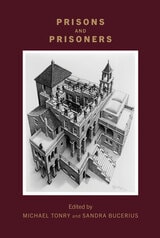
Crime and Justice, Volume 51
Prisons and PrisonersEdited by Michael Tonry and Sandra Bucerius
University of Chicago Press Journals, 2022
Since 1979, the Crime and Justice series has presented a review of the latest international research, providing expertise to enhance the work of sociologists, psychologists, criminal lawyers, justice scholars, and political scientists. The series explores a full range of issues concerning crime, its causes, and its cures. In both the review and the occasional thematic volumes, Crime and Justice offers an interdisciplinary approach to address core issues in criminology.
Volume 51 of Crime and Justice is the first to reprise a predecessor, Prisons (Volume 26, 1999), edited by series editor Michael Tonry and the late Joan Petersilia. In Prisons and Prisoners, editors Michael Tonry and Sandra Bucerius revisit the subject for several reasons.
In 1999, most scholarly research concerned developments in Britain and the United States and was published in English. Much of that was sociological, focused on inmate subcultures, or psychological, focused on how prisoners coped with and adapted to prison life. Some, principally by economists and statisticians, sought to measure the crime-preventive effects of imprisonment generally and the deterrent effects of punishments of greater and lesser severity. In 2022, serious scholarly research on prisoners, prisons, and the effects of imprisonment has been published and is underway in many countries. That greater cosmopolitanism is reflected in the pages of this volume. Several essays concern developments in places other than Britain and the United States. Several are primarily comparative and cover developments in many countries. Those primarily concerned with American research draw on work done elsewhere.
The subjects of prison research have also changed. Work on inmate subcultures and coping and adaptation has largely fallen by the wayside. Little is being done on imprisonment’s crime-preventive effects, largely because they are at best modest and often perverse. An essay in Volume 50 of Crime and Justice, examining the 116 studies then published on the effects of imprisonment on subsequent offending, concluded that serving a prison term makes ex-prisoners on average more, not less, likely to reoffend.
In 1999, little research had been done on the effects of imprisonment on prisoners’ families, children, or communities, or even—except for recidivism— on ex-prisoners’ later lives: family life, employment, housing, physical and mental health, or achievement of a conventional, law-abiding life. The first comprehensive survey of what was then known was published in the earlier Crime and Justice: Prisons volume. An enormous literature has since emerged, as essays in this volume demonstrate. Comparatively little work had been done by 1999 on the distinctive prison experiences of women and members of non-White minority groups. That too has changed, as several of the essays make clear.
What is not clear is the future of imprisonment. Through more contemporary and global lenses, the essays featured in this volume not only reframe where we are in 2022 but offer informed insights into where we might be heading.
Crime and Justice, Volume 52
A Review of ResearchEdited by Michael Tonry
University of Chicago Press Journals, 2024
Since 1979, Crime and Justice has presented a review of the latest international research, providing expertise to enhance the work of sociologists, psychologists, criminal lawyers, justice scholars, and political scientists. The series explores a full range of issues concerning crime, its causes, and its cures. In both the review and the thematic volumes, Crime and Justice offers an interdisciplinary approach to address core issues in criminology.
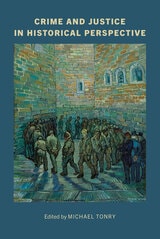
Crime and Justice, Volume 53
Crime and Justice in Historical PerspectiveEdited by Michael Tonry
University of Chicago Press Journals, 2024
Since 1979, Crime and Justice has presented a review of the latest international research, providing expertise to enhance the work of sociologists, psychologists, criminal lawyers, justice scholars, and political scientists. The series explores a full range of issues concerning crime, its causes, and its cures. In both the review and the thematic volumes, Crime and Justice offers an interdisciplinary approach to address core issues in criminology.
Crime and Justice, Volume 54
A Review of ResearchEdited by Michael Tonry
University of Chicago Press Journals, 2025
Since 1979, Crime and Justice: A Review of Research has presented reviews of the latest international research in criminology and criminal justice, providing expertise to enhance the work of sociologists, psychologists, criminal lawyers, criminologists, and political scientists. Volume 54 publishes first-rate review essays by leading scholars that summarize what is known about both cutting-edge and enduring subjects, what needs to be known, and how that might be accomplished. The wide-ranging, multidisciplinary topics covered include crime trends, immigration and crime, mass incarceration, money laundering, penal policy in Eastern and Central Europe, criminal frauds, the concept of lesser eligibility, and W. E. B. Du Bois’s unheralded contributions to criminology.
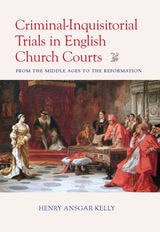
Criminal-Inquisitorial Trials in English Church Trials
From the Middle Ages to the ReformationHenry Ansgar Kelly
Catholic University of America Press, 2023

Criminals and Enemies
Austin Sarat
University of Massachusetts Press, 2019
The editors' introduction situates criminals and enemies in a theoretical context, focusing on the work of Thomas Hobbes and Carl Schmitt, while other essays consider topics ranging from Germany's denazification project to South Africa's pre- and post-apartheid legal regime to the complicating factors introduced by the war on terror. In addition to the editors, the contributors include Stephen Clingman, Jennifer Daskal, Sara Kendall, Devin Pendas, and Annette Weinke.
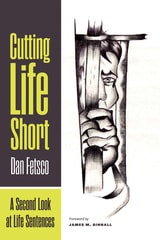
Cutting Life Short
A Second Look at Life SentencesDan Fetsco
University of Wyoming Press, 2026
Cutting Life Short challenges the idea that people who commit murder or other serious crimes are incapable of rehabilitation. The book tracks the growing population of people serving life in Wyoming and the US and explores research that indicates that much of the public, including victims of violent crime, support second chances for people who are serving excessive sentences.
Just over 200,000 Americans are now serving life sentences—more than the entire US prison population in 1970—in a cruel and fiscally irresponsible system, even though many inmates have demonstrated sustained rehabilitation over decades. Through individual case studies of Wyoming inmates, ranging from those who deserve release to rare cases like Matthew Shepard’s killer, who should remain imprisoned, the book explores themes of punishment, redemption, and justice reform while examining issues like prosecutorial misconduct, three-strike penalties, and restorative justice programs. Cases include the stories of Darla Rouse (one of Wyoming’s few commutation recipients), Russell Harrison (who claims he had an early release deal), and James Koester (whose investigating detective became his advocate). Drawing from a decade of experience on the Wyoming parole board, where he witnessed hundreds of rehabilitated inmates denied release despite widespread support from corrections officials and sometimes even victims, author Daniel Fetsco advocates creating systematic review processes for lengthy sentences that remove elected officials from clemency decisions, alongside broader reforms like restoring voting rights for former felons and promoting responsible crime reporting over fear-mongering sensationalism.
This forward-looking book argues that most of the people sentenced to life in prison can be, and should have been, safely released into the community and offers recommendations to help alleviate the problems associated with life sentences in Wyoming and across the US criminal justice system. It is of significance to students, scholars, professionals, and the general public invested in law, criminal justice and social justice.