60 books match the query 'Critique' and 12 start with c
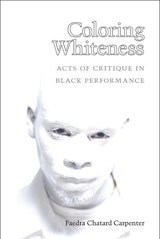
cover of Coloring Whiteness: Acts of Critique in Black Performance

Coloring Whiteness

Acts of Critique in Black Performance

Faedra Chatard Carpenter

University of Michigan Press, 2014

Coloring Whiteness pays homage to the ways that African American artists and performers have interrogated tropes and mythologies of whiteness to reveal racial inequalities, focusing on comedy sketches, street theater, visual art, video, TV journalism, and voice-over work since 1964. By investigating enactments of whiteness—from the use of white makeup and suggestive masks, to literary motifs and cultural narratives regarding “white” characteristics and qualities—Faedra Chatard Carpenter explores how artists have challenged commonly held notions of racial identity. Through its layered study of expressive culture, her book considers how artistic and performance strategies are used to “color” whiteness and complicate blackness in our contemporary moment.

Utilizing theories of performance and critical race studies, Coloring Whiteness is also propelled by Carpenter’s dramaturgical sensibilities. Her analysis of primary performance texts is informed not only by traditional print and visual materials, but also by her interviews with African American theater artists, visual artists, and cultural critics. The book is an invaluable contribution to the fields of theater and performance studies, African American studies, cultural studies, critical race studies, and American studies.
[more]
cover of Counter-Colonial Criminology: A Critique of Imperialist Reason

Counter-Colonial Criminology

A Critique of Imperialist Reason

Biko Agozino

Pluto Press, 2003

This book is about how the history of colonialism has shaped the definition of crime and justice systems not only in former colonies but also in colonialist countries. Biko Agozino argues that criminology in the West was originally tested in the colonies and then brought back to mother countries -- in this way, he claims, the colonial experience has been instrumental in shaping modern criminology in colonial powers.

He looks at how radical critiques of mainstream criminology by critical feminist and postmodernist thinkers contribute to an understanding of the relationship between colonial experience and criminology. But he also shows that even critical feminist and postmodernist assessments of conventional criminology do not go far enough as they remain virtually silent on colonial issues.

Biko Agozino considers African and other postcolonial literature and contributions to counter colonial criminology, their originality, relevance and limitations. Finally he advocates a “committed objectivity” approach to race-class-gender criminology investigations in order to come to terms with imperialistic and neo-colonialist criminology.
[more]
cover of Critique Of Applied Ethics: Reflections and Recommendations

Critique Of Applied Ethics

Reflections and Recommendations

Abraham Edel

Temple University Press, 1994
"Part One is historically rich and analytically sophisticated. It is unquestionably the best treatment of the applied ethics landscape. In Part Two, the authors have an uncanny sense of the issues and a remarkable ability to demythologize the jargon temple of doom, such that controversial philosophical positions are rendered clear.... I look forward to teaching from this book." --John J. McDermott, Distinguished Professor of Philosophy and Humanities, Professor and Head of Humanities in Medicine, Texas A&M University Over the past two decades, applied ethics has turned increasingly toward theories that explore ethical questions faced by a variety of professions and away from classic moral concerns. Abraham Edel, Elizabeth Flower, and Finbarr O'Connor utilize examples of professional, public policy, and personal decision making to illustrate the strengths and limitations of the application of ethics in a rapidly changing world. They first discuss the emergence of applied ethics and how it functions within a philosophical tradition. They are not concerned, however, with solving the problems they expose, but with employing them as a means to critique applied ethics. Using human rights and health and welfare issues, the authors examine the subsequent ethical stumbling blocks that surround the "moral order" of these social concerns. Through a historical discussion of the abundant ethical theories posited since the Enlightenment, they suggest ways to decide which can serve as intellectual tools for applied ethics and consider how knowledge and experience enter into any moral decision. Turning to the factors pertinent in the analysis and solution of moral problems, they dissect the underlying influences on the practice of ethics, the way in which a moral problem is diagnosed and its relevant contexts established, the ensuing conflicts between the concerns of the individual and of society, and the degree of inventiveness in issues of morality. The authors suggest that, instead of viewing theory as a set consequence derived from prior applications, relating theory to practice will engage a process of mutual aid, from which each element will learn, refining and improving the other.
[more]
cover of Critique Of Cynical Reason

Critique Of Cynical Reason

Peter Sloterdijk

University of Minnesota Press, 1988

In 1983, two centuries after the publication of Kant's Critique of Pure Reason, another philosophical treatise-polemical in nature, with a title that conscious and disrespectfully alludes to the earlier work —appeared in West Germany. Pete Sloterdijk's Critique of Cynical Reason stirred both critical acclaim and consternation and attracted a wide readership, especially among those who had come of age in the 1960s. Sloterdijk finds cynicism the dominant mode in contemporary culture in personal and institutional settings; his book is less a history of the impulse than. an investigation of its role in the postmodern 1970s and 1980s, among those whose earlier hopes for social change had crumbled and faded away. Sloterdijk thus brings into cultural and political discourse an issue which, though central to the mood of a generation, has remained submerged throughout the current debate about modernity and postmodernity.

With Adorno and Horkeimer's Dialectic of Enlightenment as his primary jumping-off point, Sloterdijk also draws upon, and contends with, the poststructuralist concepts of Deleuze and Guattari. He defines cynicism as enlightened false consciousness—a sensibility "well off and miserable at the same time," able to function in the workaday world yet assailed by doubt and paralysis; and, as counterstrategy, proposes the kynicism of antiquity—the sensuality and loud, satiric laughter of Diogenes. Above all, Sloterdijk is determined to resist the amnesia inherent in cynicism. The twentieth-century German historical experience lies behind his work, which closes with a brilliant essay on the Weimar Republic —the fourteen years between a lost war and Hitler's ascent to power, and a time when the cynical mode first achieved cultural dominance.
[more]
cover of Critique and Cosmos: After Misao Miyoshi

Critique and Cosmos

After Misao Miyoshi

Rob Wilson and Paul A. Bové, special issue editors

Duke University Press, 0

This special issue aims to channel the energies, tactics, critical forces, and comparative poetics Masao Miyoshi (1928–2009) carried out in his work from the 1970s on: coming to terms with his concept of aftering (the act of prolonging and transforming impacts across cultural, political, and disciplinary borders) and its temporal, border-crossing, translational, field-reframing, and revisionary effects. Contributors do not assess his scholarship and photography in any memorial, critical, or honorific sense. Instead, they seek to renew the critical visions that he distributed across various fields, from Asian to Asian American studies and beyond. Each takes seriously the mandate inside Miyoshi's work that cultural criticism envision its work broadly and courageously. Essays address the state of Japan studies; China's role in twentieth-century geopolitics, particularly involving Tibet; the critical ethos of "the planetary" in the Anthropocene; and the Korean film Snowpiercer, whose plot represents an embodiment of killer capitalism.

Contributors. Tsering Wangmo Dhompa, Arif Dirlik, Harry Harootunian, Reginald Jackson, Mary Layoun, Christine L. Marran, George Solt, Keijiro Suga, Stefan Tanaka, Chih-ming Wang, Rob Wilson
[more]
cover of Critique and Postcritique

Critique and Postcritique

Elizabeth S. Anker and Rita Felski, editors

Duke University Press, 2017

Now that literary critique's intellectual and political pay-off is no longer quite so self-evident, critics are vigorously debating the functions and futures of critique. The contributors to Critique and Postcritique join this conversation, evaluating critique's structural, methodological, and political potentials and limitations. Following the interventions made by Bruno Latour, Eve Kosofsky Sedgwick, Sharon Marcus and Stephen Best, and others, the contributors assess the merits of the postcritical turn while exploring a range of alternate methods and critical orientations. Among other topics, the contributors challenge the distinction between surface and deep reading; outline how critique-based theory has shaped the development of the novel; examine Donna Haraway's feminist epistemology and objectivity; advocate for a "hopeful" critical disposition; highlight the difference between reading as method and critique as genre; and question critique's efficacy at attending to the affective dimensions of experience. In these and other essays this volume outlines the state of contemporary literary criticism while pointing to new ways of conducting scholarship that are better suited to the intellectual and political challenges of the present. 

Contributors: Elizabeth S. Anker, Christopher Castiglia, Russ Castronovo, Simon During, Rita Felski, Jennifer L. Fleissner, Eric Hayot, Heather Love, John Michael, Toril Moi, Ellen Rooney, C. Namwali Serpell
[more]
cover of Critique and the Digital

Critique and the Digital

Edited by Erich Hörl, Nelly Y. Pinkrah, and Lotte Warnsholdt

Diaphanes, 2020
Erich Hörl, Nelly Y. Pinkrah, and Lotte Warnsholdt gather diverse perspectives on one agreed-upon condition: that the computational power of today’s world has fundamentally transformed all aspects of it. The contributors investigate and question not only the possible sites of critique but also of the concept of critique. If there used to be a critical subject constituted in the cultural techniques of modernity, and if digitality indicates itself as a product of modernity while at the same time somehow being its very ending, what are the ramifications? Digitality severely alters the critical subject and its spatio-temporal relations, and it therefore interferes with its potential to be a critical subject. The contributors of this volume ask what critique in the digital age might look like and offer specific examples of critique and critical practices.
[more]
cover of Critique of Black Reason

Critique of Black Reason

Achille Mbembe

Duke University Press, 2017

In Critique of Black Reason eminent critic Achille Mbembe offers a capacious genealogy of the category of Blackness—from the Atlantic slave trade to the present—to critically reevaluate history, racism, and the future of humanity. Mbembe teases out the intellectual consequences of the reality that Europe is no longer the world's center of gravity while mapping the relations among colonialism, slavery, and contemporary financial and extractive capital. Tracing the conjunction of Blackness with the biological fiction of race, he theorizes Black reason as the collection of discourses and practices that equated Blackness with the nonhuman in order to uphold forms of oppression. Mbembe powerfully argues that this equation of Blackness with the nonhuman will serve as the template for all new forms of exclusion. With Critique of Black Reason, Mbembe offers nothing less than a map of the world as it has been constituted through colonialism and racial thinking while providing the first glimpses of a more just future. 
[more]
cover of Critique of Exotica: Music, Politics and the Culture Industry

Critique of Exotica

Music, Politics and the Culture Industry

John Hutnyk

Pluto Press, 2000

[more]
cover of Critique of Freedom: The Central Problem of Modernity

Critique of Freedom

The Central Problem of Modernity

Otfried Höffe

University of Chicago Press, 2020

In this ambitious book, philosopher Otfried Höffe provides a sophisticated account of the principle of freedom and its role in the project of modernity. Höffe addresses a set of complex questions concerning the possibility of political justice and equity in the modern world, the destruction of nature, the dissolving of social cohesion, and the deregulation of uncontrollable markets. Through these considerations, he shows how the idea of freedom is central to modernity, and he assesses freedom’s influence in a number of cultural dimensions, including the natural, economic and social, artistic and scientific, political, ethical, and personal-metaphysical.

Neither rejecting nor defending freedom and modernity, he instead explores both from a Kantian point of view, looking closely at the facets of freedom’s role and the fundamental position it has taken at the heart of modern life. Expanding beyond traditional philosophy, Critique of Freedom develops the building blocks of a critical theory of technology, environmental protection, economics, politics, medicine, and education. With a sophisticated yet straightforward style, Höffe draws on a range of disciplines in order to clearly distinguish and appreciate the many meanings of freedom and the indispensable role they play in liberal society.
[more]
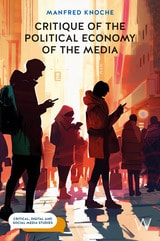
cover of Critique of the Political Economy of the Media: Foundations and Applications

Critique of the Political Economy of the Media

Foundations and Applications

Manfred Knoche

University of Westminster Press, 2025

Critique of the Political Economy of the Media is an approach to the critical analysis of the media’s role in contemporary society. It is based on Karl Marx’s theory of capitalism, using a combination of critical social theory and empirical social research for studying what role the media has in capitalism.

It introduces a theoretical framework that engages with important themes including the crisis-ridden structural transformation of the media industry, media economics in the age of digital communications, media concentration, science communication and open access publishing, media technologies, the role of advertising in capitalism, and the contradictions of alternative media in capitalism.
[more]
cover of Critique: The Stakes of Form

Critique

The Stakes of Form

Edited by Sami Khatib, Holger Kuhn, Oona Lochner, Isabel Mehl, and Beate Söntgen

Diaphanes, 2020

Critique is a form of thinking and acting. Since the end of the 18th century, there has been a dynamization and fluidization of the understanding of form, as concepts such as the break, marginalization, tearing, and opening indicate. As a philosophical problem, the question of form arises in critical theory from Marx to Adorno. Since the 1960s, literary practices have proliferated that generate critical statements less through traditional argument and more through the programmatic use of formal means. At the same time, the writing self, along with its attitudes, reflections, affects, and instruments, visibly enters the critical scene. This volume examines how the interdependence of critique, object, and form translates into critical stances, understood as learnable, reproducible gestures, which bear witness to changing conditions and media of critical practice.
[more]