Results by title
87 books match the query 'Developing & Emerging Countries' and 7 start with c
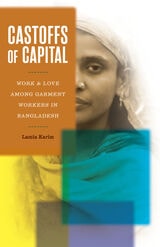
Castoffs of Capital
Work and Love among Garment Workers in BangladeshLamia Karim
University of Minnesota Press, 2022
FINALIST FOR THE GREGORY BATESON PRIZE FROM THE AMERICAN ANTHROPOLOGICAL ASSOCIATION
Dispelling stereotypes about garment workers in the global apparel industry
Castoffs of Capital examines how female garment workers experience their work and personal lives within the stranglehold of global capital. Drawing on fieldwork in Bangladesh, anthropologist Lamia Karim focuses attention onto the lives of older women aged out of factory work, heretofore largely ignored, thereby introducing a new dimension to the understanding of a female-headed workforce that today numbers around four million in Bangladesh.
Bringing a feminist labor studies lens, Castoffs of Capital foregrounds these women not only as workers but as mothers, wives, sisters, lovers, friends, and political agents. Focusing on relations among work, gender, and global capital’s targeting of poor women to advance its market penetration, Karim shows how women navigate these spaces by adopting new subject formations. She locates these women’s aspirations for the “good life” not only in material comforts but also in their longings for love and sexual fulfillment that help them momentarily forget the precarity of their existence under the shadow of capital.
Through richly detailed ethnographic studies, this innovative and beautifully written book examines the making and unmaking of these women’s wants and desires, loves and tribulations, hopes and despairs, and triumphs and struggles.
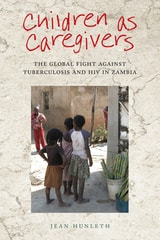
Children as Caregivers
The Global Fight against Tuberculosis and HIV in ZambiaHunleth, Jean
Rutgers University Press, 2017
In Zambia, due to the rise of tuberculosis and the closely connected HIV epidemic, a large number of children have experienced the illness or death of at least one parent. Children as Caregivers examines how well intentioned practitioners fail to realize that children take on active caregiving roles when their guardians become seriously ill and demonstrates why understanding children’s care is crucial for global health policy.
Using ethnographic methods, and listening to the voices of the young as well as adults, Jean Hunleth makes the caregiving work of children visible. She shows how children actively seek to “get closer” to ill guardians by providing good care. Both children and ill adults define good care as attentiveness of the young to adults’ physical needs, the ability to carry out treatment and medication programs in the home, and above all, the need to maintain physical closeness and proximity. Children understand that losing their guardians will not only be emotionally devastating, but that such loss is likely to set them adrift in Zambian society, where education and advancement depend on maintaining familial, reciprocal relationships.
View a gallery of images from the book (https://www.flickr.com/photos/childrenascaregivers)
Download the open access ebook.
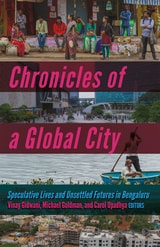
Chronicles of a Global City
Speculative Lives and Unsettled Futures in BengaluruVinay Gidwani
University of Minnesota Press, 2024
Tracking Bengaluru’s dramatic urban transformation through the entanglements of finance, land frenzy, real estate volatility, and livelihood upheavals
Over the past two decades, Bengaluru’s exploding real estate sector and massive infrastructure investments have led to land speculation targeting working-class neighborhoods and agricultural land for development. Chronicles of a Global City turns Bengaluru inside out to examine its “world-city” transformation that stimulated rapid urbanization and unbounded growth. Moving the spotlight away from the urban elites and “new middle class,” this book explores how people caught up in the whirlwinds of change in Bengaluru—from construction laborers, street vendors, domestic workers, and platform delivery workers to small-time property brokers, petty landlords, and local politicians—experience, struggle, aspire, invent, strive, and speculate to make a livable city for themselves.
Grounded in long-term ethnographic research and activist experiences, Chronicles of a Global City vividly illuminates the multifaceted entanglements of finance capital, real estate markets, livelihood struggles, and fraying ecologies in urban and peri-urban Bengaluru. Its anchoring concept, “speculative urbanism,” provides a powerful, innovative lens for understanding the risk-laden practices of leveraging land, labor, and resources for the promise of future profit.
Contributors: Hemangini Gupta, Pierre Hauser, Priyanka Krishna, Eesha Kunduri, Kaveri Medappa, Usha Rao, Shaheen Shasa, Swathi Shivanand, Vinay K. Sreenivasa.
Co-production of Knowledge in Action
Emancipatory Strategies for Urban EqualityEdited by Cassidy Johnson, Vanesa Castán Broto, Wilbard Kombe, Catalina Ortiz, Barbara Lipietz, Emmanuel Osuteye, and Caren Levy
University College London, 2025
In urban development, co-production refers to a strategy that prioritizes collaboration across multiple institutions and with citizens, aiming to enable conflict resolution and transformative change. However, critics contend that these theoretical ambitions often have limited practical impact. Co-production of Knowledge in Action examines how co-production is articulated and deployed in cities such as Lima, Freetown, Kampala, Dar es Salaam, and Delhi. It engages with ongoing experiences of co-production-inspired action, mapping the different aspirations that inform co-production practices and their impacts on urban communities. Critiquing co-production strategies for urban development in relation to practical experiences in these cities, this volume adopts a postcolonial approach to knowledge production as a means to transform urban planning practices.
Colonialism Is Crime
Marianne Nielsen
Rutgers University Press, 2019

Constellations of Inequality
Space, Race, and Utopia in BrazilSean T. Mitchell
University of Chicago Press, 2017
In 1982, the Brazilian Air Force arrived on the Alcântara peninsula to build a state-of-the-art satellite launch facility. They displaced some 1,500 Afro-Brazilians from coastal land to inadequate inland villages, leaving many more threatened with displacement. Completed in 1990, this vast undertaking in one of Brazil’s poorest regions has provoked decades of conflict and controversy.
Constellations of Inequality tells this story of technological aspiration and the stark dynamics of inequality it laid bare. Sean T. Mitchell analyzes conflicts over land, ethnoracial identity, mobilization among descendants of escaped slaves, military-civilian competition in the launch program, and international intrigue. Throughout, he illuminates Brazil’s changing politics of inequality and examines how such inequality is made, reproduced, and challenged. How people conceptualize and act on the unequal conditions in which they find themselves, he shows, is as much a cultural and historical matter as a material one. Deftly broadening our understanding of race, technology, development, and political consciousness on local, national, and global levels, Constellations of Inequality paints a portrait of contemporary Brazil that will interest a broad spectrum of readers.
Cookstove Chronicles
Social Life of a Women’s Technology in IndiaMeena R. Khandelwal
University of Arizona Press, 2024
Based on anthropological research in Rajasthan, Cookstove Chronicles argues that the supposedly obsolete chulha persists because it offers women control over the tools needed to feed their families. Their continued use of old stoves alongside the new is not a failure to embrace new technologies but instead a strategy to maximize flexibility and autonomy. The chulha is neither the villain nor hero of this story. It produces particulate matter that harms people’s bodies, leaves soot on utensils and walls, and accelerates glacial melting and atmospheric warming. Yet it also depends on renewable biomass fuel and supports women’s autonomy as a local, do-it-yourself technology.
Meena Khandelwal, a feminist anthropologist, describes her collaboration with engineers, archaeologists, and others. She employs critical social theory and reflections from fieldwork to bring together research from a range of fields, including history, geography, anthropology, energy and environmental studies, public health, and science and technology studies (STS). In so doing she not only demystifies multidisciplinary research but also highlights the messy reality of actual behavior.
Cookstove Chronicles critically examines why, despite extensive development efforts, use of the chulha persists. It offers an important new framework for looking at development, technology, environmental change, and human behavior.