Results by title
117 books match the query 'Digital media' and 8 start with c
Citizen Science in the Digital Age
Rhetoric, Science, and Public EngagementJames Wynn
University of Alabama Press, 2016
James Wynn’s timely investigation highlights scientific studies grounded in publicly gathered data and probes the rhetoric these studies employ. Many of these endeavors, such as the widely used SETI@home project, simply draw on the processing power of participants’ home computers; others, like the protein-folding game FoldIt, ask users to take a more active role in solving scientific problems. In Citizen Science in the Digital Age: Rhetoric, Science, and Public Engagement, Wynn analyzes the discourse that enables these scientific ventures, as well as the difficulties that arise in communication between scientists and lay people and the potential for misuse of publicly gathered data.
Wynn puzzles out the intricacies of these exciting new research developments by focusing on various case studies. He explores the Safecast project, which originated from crowd-sourced mapping for Fukushima radiation dispersal, arguing that evolving technologies enable public volunteers to make concrete, sound, science-based arguments. Additionally, he considers the potential use of citizen science as a method of increasing the public’s identification with the scientific community, and contemplates how more collaborative rhetoric might deepen these opportunities for interaction and alignment. Furthermore, he examines ways in which the lived experience of volunteers may be integrated with expert scientific knowledge, and also how this same personal involvement can be used to further policy agendas.
Precious few texts explore the intersection of rhetoric, science, and the Internet. Citizen Science in the Digital Age fills this gap, offering a clear, intelligent overview of the topic intended for rhetoric and communication scholars as well as practitioners and administrators in a number of science-based disciplines. With the expanded availability of once inaccessible technologies and computing power to laypeople, the practice of citizen science will only continue to grow. This study offers insight into how—given prudent application and the clear articulation of common goals—citizen science might strengthen the relationships between scientists and laypeople.
Climatic Media
Transpacific Experiments in Atmospheric ControlYuriko Furuhata
Duke University Press, 2022
Code
From Information Theory to French TheoryBernard Dionysius Geoghegan
Duke University Press, 2022
Communication
Paula Bialski
University of Minnesota Press, 2018
On contemporary communication in its various human and nonhuman forms
Contemporary communication puts us not only in conversation with one another but also with our machinery. Machine communication—to communicate not just via but also with machines—is therefore the focus of this volume. Diving into digital communications history, Finn Brunton brings to the fore the alienness of computational communication by looking at network timekeeping, automated trolling, and early attempts at communication with extraterrestrial life. Picking up this fascination with inhuman communication, Mercedes Bunz then performs a close reading of interaction design and interfaces to show how technology addresses humans (as very young children). Finally, Paula Bialski shares her findings from a field study of software development, analyzing the communicative forms that occur when code is written by separate people. Today, communication unfolds merely between two or more conscious entities but often includes an invisible third party. Inspired by this drastic shift, this volume uncovers new meanings of what it means “to communicate.”
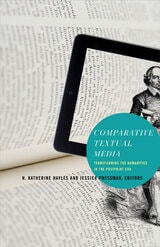
Comparative Textual Media
Transforming the Humanities in the Postprint EraN. Katherine Hayles
University of Minnesota Press, 2013
For the past few hundred years, Western cultures have relied on print. When writing was accomplished by a quill pen, inkpot, and paper, it was easy to imagine that writing was nothing more than a means by which writers could transfer their thoughts to readers. The proliferation of technical media in the latter half of the twentieth century has revealed that the relationship between writer and reader is not so simple. From telegraphs and typewriters to wire recorders and a sweeping array of digital computing devices, the complexities of communications technology have made mediality a central concern of the twenty-first century.
Despite the attention given to the development of the media landscape, relatively little is being done in our academic institutions to adjust. In Comparative Textual Media, editors N. Katherine Hayles and Jessica Pressman bring together an impressive range of essays from leading scholars to address the issue, among them Matthew Kirschenbaum on archiving in the digital era, Patricia Crain on the connection between a child’s formation of self and the possession of a book, and Mark Marino exploring how to read a digital text not for content but for traces of its underlying code.
Primarily arguing for seeing print as a medium along with the scroll, electronic literature, and computer games, this volume examines the potential transformations if academic departments embraced a media framework. Ultimately, Comparative Textual Media offers new insights that allow us to understand more deeply the implications of the choices we, and our institutions, are making.
Contributors: Stephanie Boluk, Vassar College; Jessica Brantley, Yale U; Patricia Crain, NYU; Adriana de Souza e Silva, North Carolina State U; Johanna Drucker, UCLA; Thomas Fulton, Rutgers U; Lisa Gitelman, New York U; William A. Johnson, Duke U; Matthew G. Kirschenbaum, U of Maryland; Patrick LeMieux; Mark C. Marino, U of Southern California; Rita Raley, U of California, Santa Barbara; John David Zuern, U of Hawai‘i at Mānoa.
Critical Terms for Media Studies
Edited by W. J. T. Mitchell and Mark B. N. Hansen
University of Chicago Press, 2010
Communications, philosophy, film and video, digital culture: media studies straddles an astounding array of fields and disciplines and produces a vocabulary that is in equal parts rigorous and intuitive. Critical Terms for Media Studies defines, and at times, redefines, what this new and hybrid area aims to do, illuminating the key concepts behind its liveliest debates and most dynamic topics.
Part of a larger conversation that engages culture, technology, and politics, this exciting collection of essays explores our most critical language for dealing with the qualities and modes of contemporary media. Edited by two outstanding scholars in the field, W. J. T. Mitchell and Mark B. N. Hansen, the volume features works by a team of distinguished contributors. These essays, commissioned expressly for this volume, are organized into three interrelated groups: “Aesthetics” engages with terms that describe sensory experiences and judgments, “Technology” offers entry into a broad array of technological concepts, and “Society” opens up language describing the systems that allow a medium to function.
A compelling reference work for our media landscape, Critical Terms for Media Studies will engage and deepen any reader’s knowledge of one of our most important new fields.
Critique and the Digital
Edited by Erich Hörl, Nelly Y. Pinkrah, and Lotte Warnsholdt
Diaphanes, 2020
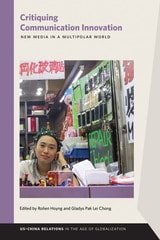
Critiquing Communication Innovation
New Media in a Multipolar WorldRolien Hoyng
Michigan State University Press, 2022