Results by title
81 books match the query 'Disasters & Disaster Relief' and 7 start with c
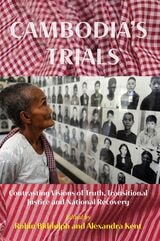
Cambodia's Trials
Contrasting Visions of Truth, Transitional Justice and National RecoveryEdited by Robin Biddulph and Alexandra Kent
National University of Singapore Press, 2023
More than four decades have passed since the end of Khmer Rouge rule in Cambodia in 1979. Even so, the country is still coming to terms with the destruction wrought by the Khmer Rouge during both the time they were in power and during the period of guerrilla resistance that lasted until 1998. The Khmer Rouge Tribunal, or the Extraordinary Chambers in the Court of Cambodia (ECCC), was established in 2006 to bring the Khmer Rouge leadership to justice. In many ways a product of the 1990s, when liberal democracy appeared to be on the rise both in Cambodia and internationally, the ECCC was imagined as a transitional justice initiative that would help ease the transition to liberal democracy.
The ECCC has long been the focus of scholarly attention in Cambodia’s recovery, but this compelling study argues that such an approach is dated, noting that the political circumstances in which the ECCC was born have since changed profoundly, both globally and locally. Cambodia’s current situation can no longer be analyzed solely in terms of transitional justice narratives or the work of the ECCC, and other ways in which Cambodians have come to terms with their past and built new lives must be considered. By decentering the ECCC in the scholarly narrative of Cambodia’s recovery, the volume’s authors offer fascinating new insights into the Khmer Rouge period and more recent years of social, cultural, and political change in Cambodia.
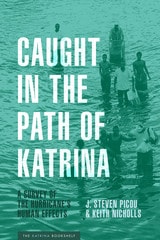
Caught in the Path of Katrina
A Survey of the Hurricane's Human EffectsBy J. Steven Picou and Keith Nicholls
University of Texas Press, 2019
In 2008, three years after Hurricane Katrina cut a deadly path along the northern coast of the Gulf of Mexico, researchers J. Steven Picou and Keith Nicholls conducted a survey of the survivors in Louisiana and Mississippi, receiving more than twenty-five hundred responses, and followed up two years later with their than five hundred of the initial respondents. Showcasing these landmark findings, Caught in the Path of Katrina: A Survey of the Hurricane's Human Effects yields a more complete understanding of the traumas endured as a result of the Storm of the Century.
The authors report on evacuation behaviors, separations from family, damage to homes, and physical and psychological conditions among residents of seven of the parishes and counties that bore the brunt of Katrina. The findings underscore the frequently disproportionate suffering of African Americans and the agonizingly slow pace of recovery. Highlighting the lessons learned, the book offers suggestions for improved governmental emergency management techniques to increase preparedness, better mitigate storm damage, and reduce the level of trauma in future disasters. Multiple major hurricanes have unleashed their destruction in the years since Katrina, making this a crucial study whose importance only continues to grow.
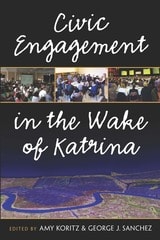
Civic Engagement in the Wake of Katrina
Amy Koritz and George J. Sanchez, editors
University of Michigan Press, 2009
"Civic engagement has been underrated and overlooked. Koritz and Sanchez illuminate the power of what community engagement through art and culture revitalization can do to give voice to the voiceless and a sense of being to those displaced."
---Sonia BasSheva Mañjon, Wesleyan University
"This profound and eloquent collection describes and assesses the new coalitions bringing a city back to life. It's a powerful call to expand our notions of culture, social justice, and engaged scholarship. I'd put this on my 'must read' list."
---Nancy Cantor, Syracuse University
"Civic Engagement in the Wake of Katrina is a rich and compelling text for thinking about universities and the arts amid social crisis. Americans need to hear the voices of colleagues who were caught in Katrina's wake and who responded with commitment, creativity, and skill."
---Peter Levine, CIRCLE (The Center for Information & Research on Civic Learning & Engagement)
This collection of essays documents the ways in which educational institutions and the arts community responded to the devastation wrought by Hurricane Katrina. While firmly rooted in concrete projects, Civic Engagement in the Wake of Katrina also addresses the larger issues raised by committed public scholarship. How can higher education institutions engage with their surrounding communities? What are the pros and cons of "asset-based" and "outreach" models of civic engagement? Is it appropriate for the private sector to play a direct role in promoting civic engagement? How does public scholarship impact traditional standards of academic evaluation? Throughout the volume, this diverse collection of essays paints a remarkably consistent and persuasive account of arts-based initiatives' ability to foster social and civic renewal.
Amy Koritz is Director of the Center for Civic Engagement and Professor of English at Drew University.
George J. Sanchez is Professor of American Studies and Ethnicity and History at the University of Southern California.
Front and rear cover designs, photographs, and satellite imagery processing by Richard Campanella.
digitalculturebooks is an imprint of the University of Michigan Press and the Scholarly Publishing Office of the University of Michigan Library dedicated to publishing innovative and accessible work exploring new media and their impact on society, culture, and scholarly communication. Visit the website at www.digitalculture.org.
Conrad's Shadow
Catastrophe, Mimesis, TheoryNidesh Lawtoo
Michigan State University Press, 2016
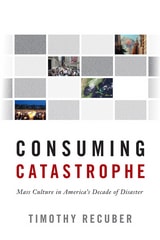
Consuming Catastrophe
Mass Culture in America's Decade of DisasterTimothy Recuber
Temple University Press, 2016
Horrified, saddened, and angered: That was the American people’s reaction to the 9/11 attacks, Hurricane Katrina, the Virginia Tech shootings, and the 2008 financial crisis. In Consuming Catastrophe, Timothy Recuber presents a unique and provocative look at how these four very different disasters took a similar path through public consciousness. He explores the myriad ways we engage with and negotiate our feelings about disasters and tragedies—from omnipresent media broadcasts to relief fund efforts and promises to “Never Forget.”
Recuber explains how a specific and “real” kind of emotional connection to the victims becomes a crucial element in the creation, use, and consumption of mass mediation of disasters. He links this to the concept of “empathetic hedonism,” or the desire to understand or feel the suffering of others.
The ineffability of disasters makes them a spectacular and emotional force in contemporary American culture. Consuming Catastrophe provides a lively analysis of the themes and meanings of tragedy and the emotions it engenders in the representation, mediation and consumption of disasters.
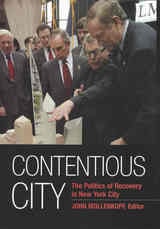
Contentious City
The Politics of Recovery in New York CityJohn Mollenkopf
Russell Sage Foundation, 2005
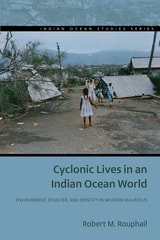
Cyclonic Lives in an Indian Ocean World
Environment, Disaster, and Identity in Modern MauritiusRobert M. Rouphail
Ohio University Press, 0
Disasters as historical processes shaping identity, governance, and diasporic memory in colonial and postcolonial Mauritius
In a world marked by increasingly destructive ecological and meteorological upheavals, Cyclonic Lives in an Indian Ocean World offers a historical analysis of how these catastrophes shape people’s understanding of themselves, their collective history, and their relationship to the institutions that govern them. An examination of cyclonic disasters in the multiethnic Indian Ocean island of Mauritius throws into stark relief how deep histories of diasporic identity formation, of imperial governance, and of the informal practices of racial difference making graft onto how everyday people interpret these moments of loss and the futures that emerge in their wake.
Cyclonic Lives shows that disasters are not only events; they are also processes through which people evaluate and rethink the most elemental social and cultural categories that give meaning to their lives. Beginning in the late nineteenth century and continuing until the early postcolonial era, this book tracks, for example, how Mauritians of African descent integrated these disasters into broader collective histories and memories of the Indian Ocean slave trade, how Hindu Indo-Mauritians understood cyclones’ ecological effects as material elements to be accounted for in a broader Hindu diasporic space, and how the late colonial and early postcolonial state built infrastructures—material, conceptual, and financial—to mitigate the threats posed by these storms and ensure their own long-term durability.
The increasing political, social, and economic instability that climate change has already triggered demands that humanists develop analytical geographies and methodologies that shed light on how power can modulate in asymmetrical ways at moments of crisis. If there is one central takeaway from this historical study of this small island in a big ocean, it is that catastrophic events are not things that merely happen to people; they are processes that remake them.