Results by title
138 books match the query 'Discovery and exploration' and 7 start with c
Came Men on Horses
The Conquistador Expeditions of Francisco Vázquez de Coronado and Don Juan de OñateStan Hoig
University Press of Colorado, 2013
Guided by myths of golden cities and worldly rewards, policy makers, conquistador leaders, and expeditionary aspirants alike came to the new world in the sixteenth century and left it a changed land. Came Men on Horses follows two conquistadors—Francisco Vázquez de Coronado and Don Juan de Oñate—on their journey across the southwest.
Driven by their search for gold and silver, both Coronado and Oñate committed atrocious acts of violence against the Native Americans, and fell out of favor with the Spanish monarchy. Examining the legacy of these two conquistadors Hoig attempts to balance their brutal acts and selfish motivations with the historical significance and personal sacrifice of their expeditions. Rich human details and superb story-telling make Came Men on Horses a captivating narrative scholars and general readers alike will appreciate.
Capturing the Landscape of New Spain
Baltasar Obregón and the 1564 Ibarra ExpeditionRebecca A. Carte
University of Arizona Press, 2015
Although Obregón’s role in the Ibarra expedition was that of soldier-explorer, and despite his lacking an advanced education, he would go on to compose Historia de los descubrimientos de Nueva España twenty years later, expanding his narrative to include the years before and after his own firsthand experiences with Ibarra. Obregón depicts the storied landscape of the northern borderlands with vivid imagery, fusing setting and situation, constructing a new reality of what was, is, and should be, and presenting it as truth.
In Capturing the Landscape of New Spain, Rebecca A. Carte explains how landscape performs a primary role in Obregón’s retelling, emerging at times as protagonist and others as antagonist. Carte argues that Obregón’s textualization offers one of the first renderings of the region through the Occidental cultural lens, offering insight into Spanish cultural perceptions of landscape during a period of important social and political shifts.
By examining mapping and landscape discourse, Carte shows how history and geography, past and present, people and land, come together to fashion the landscape of northern New Spain.

Cartographic Encounters
Perspectives on Native American Mapmaking and Map UseEdited by G. Malcolm Lewis
University of Chicago Press, 1998
G. Malcolm Lewis provides accessible and detailed overviews of the history of native North American maps, mapmaking, and scholarly interest in these topics. Other contributions include a study of colonial Aztec cartography that highlights the connections among maps, space, and history; an account of the importance of native maps as archaeological evidence; and an interpretation of an early-contact-period hide painting of an actual encounter involving whites and two groups of warring natives.
Although few original native maps have survived, contemporary copies and accounts of mapmaking form a rich resource for anyone interested in the history of Native American encounters or the history of cartography and geography.

Cities of Gold
Legendary Kingdoms, Quixotic Quests, and Fantastic New World WealthBill Yenne
Westholme Publishing, 2011
A History of Exploration for Real and Mythical Treasures in the Americas
For half a millennium, stories of vast treasures—El Dorado, Manoa, the Seven Cities of Cibola, the Lost Dutchman Mine—have been part of the lore of the Americas. Long before the Europeans set foot in the New World, myths and rumors of fabulous wealth in distant lands, such as the kingdom of Prester John, were told and retold so often that they were assumed to be true. When Spanish explorers first made contact with the Aztec and Inca civilizations, they found cultures that were literally dripping with gold. This evidence made it easy to believe the native stories of even greater wealth just beyond the horizon. In these uncharted lands, dreamers sought their fortunes: Francisco de Coronado ranged over the North American plains in search of the elusive Quivira; Gonzalo Pizarro, brother of the Incan conqueror, and Lope Aguirre, the “Wrath of God,” were both part of ill-fated expeditions in search of El Dorado; and Leonard Clark walked out of the Amazon after World War II with gold and claimed he had found that fabled kingdom.
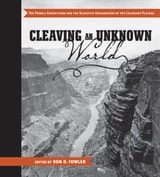
Cleaving an Unknown World
The Powell Expeditions and the Scientific Exploration of the Colorado PlateauDon D Fowler
University of Utah Press, 2011
In 2009 the University of Utah Press and the Utah State Historical Society co-published three volumes of long out-of-print journals, letters, and other documents from John Wesley Powell’s expeditions down the Colorado River. We are proud to announce the fourth and final volume. Cleaving an Unknown World collects Powell’s journal (Smithsonian Journal of History, 1968); Jack Hillers’s diary and photographs, previously published as Photographed All the Best Scenery, edited by Don D. Fowler (University of Utah Press, 1972); original maps from Francis Marion Bishop (Utah Historical Quarterly, 1969); Frederick S. Dellenbaugh’s letters (Utah Historical Quarterly, 1969); and John C. Sumner’s journal from the first Powell expedition (Utah Historical Quarterly, 1969). Roy Webb’s foreword provides the context for these disparate pieces.
This beautifully illustrated book features Hillers’s photographs—long regarded as a remarkable and unique record of the Colorado River and the Grand Canyon. Cleaving an Unknown World belongs in the library of any reader interested in the exploration of the American West.
Conquistador in Chains
Cabeza de Vaca and the Indians of the AmericasDavid A. Howard
University of Alabama Press, 1996
Unlike many Spanish conquistadores who brought to the Americas a wave of disease, destruction, and oppression, Cabeza de Vaca’s stated intention was to pursue a different kind of conquest—one that would be just and humane, true to Spanish religion and law, and one that safeguarded liberty and justice for the indigenous peoples of the New World.
Bringing to South America skills and experiences earned with native peoples in North America, however, Cabeza de Vaca both failed to understand the indigenous peoples in the south and alienated many Spanish settlers in the Rio de la Plata Province, whose economic interests he threatened. Eventually the Spanish colonists formed a conspiracy to remove him from power and return him to Spain in chains.
That Cabeza de Vaca was overthrown is not surprising. His ideas and policies opposed the self-interest of most of the first Spaniards who had come to America, although he inspired the support of many even after his humiliating return to Spain. In Conquistador in Spain, historian David Howard provides a fascinating account of the rise and fall of this colonial idealist.
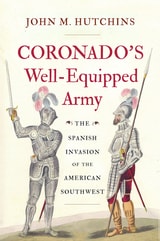
Coronado's Well-Equipped Army
The Spanish Invasion of the American SouthwestJohn M. Hutchins
Westholme Publishing, 2023
Winner of Two Colorado Book Awards
The historic 1540–1542 expedition of Captain-General Francisco Vasquez de Coronado is popularly remembered as a luckless party of exploration which wandered the American Southwest and then blundered onto the central Great Plains of Texas, Oklahoma, and Kansas. The expedition, as historian John M. Hutchins relates in Coronado’s Well-Equipped Army: The Spanish Invasion of the American Southwest, was a military force of about 1,500 individuals, made up of Spanish soldiers, Indian warrior allies, and camp followers. Despite the hopes for a peaceful conquest of new lands—including those of a legendary kingdom of Cibola—the expedition was obliged to fight a series of battles with the natives in present-day Sonora, California, Arizona, and New Mexico. The final phase of the invasion was less warlike, as the members of the expedition searched the Great Plains in vain for a wealthy civilization called Quivira.While much has been written about the march of Coronado and his men, this is the first book to address the endeavor as a military campaign of potential conquest like those conducted by other conquistadors. This helps to explain many of the previously misunderstood activities of the expedition. In addition, new light is cast on the non-Spanish participants, including Mexican Indian allies and African retainers, as well as the important roles of women.