Results by title
55 books match the query 'Documentary films' and 5 start with c
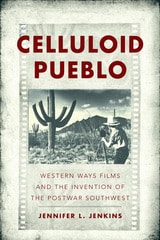
Celluloid Pueblo
Western Ways Films and the Invention of the Postwar SouthwestJennifer L. Jenkins
University of Arizona Press, 2016
Celluloid Pueblo tells the story of Western Ways Features and its role in the invention of the Southwest of the imagination. Active during a thirty-year period of profound growth and transformation, the Herberts created a dynamic visual record of the region, and their archival films now serve as a time capsule of the Sunbelt in the mid-twentieth century. Drawing upon a ten-year career with Fox, Western Ways owner-operator Charles Herbert brought a newshound’s sensibility and acute skill at in-camera editing to his southwestern subjects. The Western Ways films provided counternarratives to Hollywood representations of the West and established the regional identity of Tucson and the borderlands.
Jennifer L. Jenkins’s broad-sweeping book examines the Herberts’ work on some of the first sound films in the Arizona borderlands and their ongoing promotion of the Southwest. The book covers the filmic representation of Native and Mexican lifeways, Anglo ranching and leisure, Mexican missions and tourism, and postwar borderlands prosperity and progressivism. The story of Western Ways closely follows the boom-and-bust arc of the midcentury Southwest and the constantly evolving representations of an exotic—but safe and domesticated—frontier.
Collecting Visible Evidence
Jane Gaines
University of Minnesota Press, 1999
A redefinition of the nature of documentary film.
In documentary studies, the old distinctions between fiction and nonfiction no longer apply, as contemporary film and video artists produce works that defy classification. Coming together to make sense of these developments, the contributors to this book effectively redefine documentary studies. They trace the documentary impulse in the early detective camera, in the reenactment of battle scenes from World War I, and in the telecast of the Nevada A-bomb test in 1952. Other topics include experiments in virtual reality; the crisis of representation in anthropology; and video art and documentary work that challenge the asymmetry of the postcolonial us/them divide.
Contributors: Jenny Cool; Elizabeth Cowie, U of Kent; Faye Ginsburg, New York U; Tom Gunning, U of Chicago; Eithne Johnson; Alexandra Juhasz, Pitzer College; Neil Lerner, Davidson College; Akira Mizuta Lippit, San Francisco State U; Nancy Lutkehaus, USC; James M. Moran; Vivian Sobchack, UCLA; Linda Williams, U of California, Berkeley; Mark Williams, Dartmouth College; Mark J. P. Wolf, Concordia U, Wisconsin.
Communicating Ideas with Film, Video, and Multimedia
A Practical Guide to Information Motion-MediaS. Martin Shelton
Southern Illinois University Press, 2004
Forgoing discussions of technology, Shelton instead concentrates on the communication principles that can motivate an audience to achieve a particular goal—a goal that must be realistic, worthwhile, and appropriate. His inventive approach coalesces theory of the media with its philosophy, analysis, history, and application, as well as his own informed personal opinions. This valuable guide examines how to effectively encode information in motion-media by using in-depth communication analysis and pertinent filmic design. Throughout, Shelton emphasizes that kinetic visuals, rather than audio, are the defining elements of the best motion-media communication. Organized into five parts that can be used independently or in sequence, the volume frames key topics in the industry that collectively form a cohesive strategy for motion-media design and production. First, Shelton discusses the essence of the medium as a communication tool. In the second part, he addresses the forms and functions of motion-media. The third part details communication analysis and its application. Next, Shelton delves into script design, distribution, and career growth. Lastly, he offers advice on business aspects of the profession. Told from the vantage point of a seasoned expert, Communicating Ideas with Film, Video, and Multimedia is a “how to do it” book as well as a treatise on “why to do it.” Shelton’s narrative is complemented by twenty-six illustrations (including multimedia flowcharts, sample forms, and photographs of some of the great documentary filmmakers), a variety of script formats, and a listing of the all-time best documentary films.
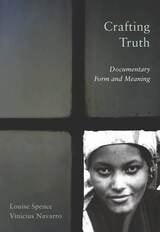
Crafting Truth
Documentary Form and MeaningSpence, Louise
Rutgers University Press, 2011
A documentary's sounds and images are always the product of selection and choice, and often underscore points the filmmaker wishes to make. Crafting Truth illuminates the ways these films tell their stories; how they use the camera, editing, sound, and performance; what rhetorical devices they employ; and what the theoretical, practical, and ethical implications of these choices are. Complex documentary concepts are presented through easily accessible language, images, and a discussion of a wide range of films and videos to encourage new ways of thinking about and seeing nonfiction film.
Creating the Witness
Documenting Genocide on Film, Video, and the InternetLeshu Torchin
University of Minnesota Press, 2012
Since the beginning of the conflict in 2003, more than 300,000 lives have been lost in Darfur. Players of the video game Darfur Is Dying learn this sobering fact and more as they work to ensure the survival of a virtual refugee camp. The video game not only puts players in the position of a struggling refugee, it shows them how they can take action in the real world.
Creating the Witness examines the role of film and the Internet in creating virtual witnesses to genocide over the last one hundred years. The book asks, how do visual media work to produce witnesses—audiences who are drawn into action? The argument is a detailed critique of the notion that there is a seamless trajectory from observing an atrocity to acting in order to intervene. According to Leshu Torchin, it is not enough to have a camera; images of genocide require an ideological framework to reinforce the messages the images are meant to convey. Torchin presents wide-ranging examples of witnessing and genocide, including the Armenian genocide, the Holocaust (engaging film as witness in the context of the Nuremburg trials), and the international human rights organization WITNESS and its sustained efforts to use video to publicize human rights advocacy and compel action.
From a historical and comparative approach, Torchin’s broad survey of media and the social practices around it investigates the development of popular understandings of genocide to achieve recognition and response—both political and judicial—ultimately calling on viewers to act on behalf of human rights.