Results by title
53 books match the query 'Dwellings' and 6 start with c
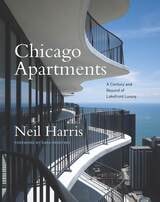
Chicago Apartments
A Century and Beyond of Lakefront LuxuryNeil Harris and Teri J. Edelstein
University of Chicago Press, 2020
The Chicago lakefront is one of America’s urban wonders. The ribbon of high-rise luxury apartment buildings along the Lake Michigan shore has few, if any, rivals nationwide for sustained architectural significance. This historic confluence of site, money, style, and development lies at the heart of the updated edition of Neil Harris's Chicago Apartments: A Century and Beyond of Lakefront Luxury. The book features more than one hundred buildings, stretching from south to north and across more than a century, each with its own special combination of design choice, floor plans, and background story. Harris, with the assistance of Teri J. Edelstein, proves to be an affable and knowledgeable tour guide, guiding us through dozens of buildings, detailing a host of inimitable development histories, design choices, floor plans, and more along the way. Of particular note are recent structures on the Chicago River and south of the Loop that are proposing new definitions of comfort and extravagance. Featuring nearly 350 stunning images and a foreword by renowned Chicago author Sara Paretsky, this new edition of Chicago Apartments offers a wide-ranging look inside some of the Windy City’s most magnificent abodes.
[more]
Chicago's Historic Hyde Park
Susan O'Connor Davis
University of Chicago Press, 2013
Stretching south from 47th Street to the Midway Plaisance and east from Washington Park to the lake’s shore, the historic neighborhood of Hyde Park—Kenwood covers nearly two square miles of Chicago’s south side. At one time a wealthy township outside of the city, this neighborhood has been home to Chicago’s elite for more than one hundred and fifty years, counting among its residents presidents and politicians, scholars, athletes, and fiery religious leaders. Known today for the grand mansions, stately row houses, and elegant apartments that these notables called home, Hyde Park—Kenwood is still one of Chicago’s most prominent locales.
Physically shaped by the Columbian Exposition of 1893 and by the efforts of some of the greatest architects of the nineteenth and twentieth centuries—including Daniel Burnham, Frank Lloyd Wright, Mies Van Der Rohe—this area hosts some of the city’s most spectacular architecture amid lush green space. Tree-lined streets give way to the impressive neogothic buildings that mark the campus of the University of Chicago, and some of the Jazz Age’s swankiest high-rises offer spectacular views of the water and distant downtown skyline.
In Chicago’s Historic Hyde Park, Susan O’Connor Davis offers readers a biography of this distinguished neighborhood, from house to home, and from architect to resident. Along the way, she weaves a fascinating tapestry, describing Hyde Park—Kenwood’s most celebrated structures from the time of Lincoln through the racial upheaval and destructive urban renewal of the 1940s, 50s, and 60s into the preservationist movement of the last thirty-five years. Coupled with hundreds of historical photographs, drawings, and current views, Davis recounts the life stories of these gorgeous buildings—and of the astounding talents that built them. This is architectural history at its best.
[more]
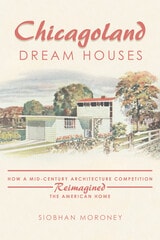
Chicagoland Dream Houses
How a Mid-Century Architecture Competition Reimagined the American HomeSiobhan Moroney
University of Illinois Press, 2024
“Chicagoland Dream Houses is an engaging addition to the growing body of scholarship concerning Chicago’s twentieth-century residential landscape characterized by a diverse group of architects and builders.”--Michelangelo Sabatino, coauthor of Modern in the Middle: Chicago Houses 1929–1975
[more]
Circular Villages of the Monongahela Tradition
Bernard K. Means
University of Alabama Press, 2007
Between A.D. 1000 and 1635, the inhabitants of southwestern Pennsylvania and portions of adjacent states—known to archaeologists as the Monongahela Culture or Tradition—began to reside regularly in ring-shaped village settlements. These circular settlements consisted of dwellings around a central plaza. A cross-cultural and cross-temporal review of archaeological, ethnohistorical, and ethnographic cases demonstrates that this settlement form appeared repeatedly and independently worldwide, including throughout portions of the Eastern Woodlands, among the Plains Indians, and in Central and South America.
Specific archaeological cases are drawn from Somerset County, Pennsylvania, that has the largest number of completely excavated Monongahela villages. Most of these villages, excavated in the 1930s as federal relief projects, were recently dated. Full analysis of the extensive excavations reveals not only the geometric architectural patterning of the villages, but enables an analysis of the social groupings, population estimates, and economic status of residents who inhabited the circular villages. Circular patterning can be revealed at less fully excavated archaeological sites. Focused test excavations can help confirm circular village plans without extensive and destructive excavations.
[more]
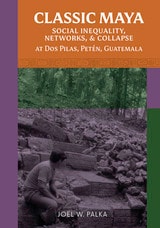
Classic Maya Social Inequality, Networks, and Collapse at Dos Pilas, Petén, Guatemala
Joel W. Palka
University of Utah Press, 2026
Household archaeology and the unraveling of Classic Maya power
The Classic Maya collapse (ca. CE 800) in Mesoamerica has been the focus of much scholarly debate over the last century. In Classic Maya Social Inequality, Networks, and Collapse at Dos Pilas, Petén, Guatemala, Joel W. Palka further explores possible causes of the collapse and breaks new ground by examining its differing effects on Maya elites and commoners.
Drawing on four years of extensive household excavations, Palka reveals how the unraveling of Maya society unfolded not through drought or economic decline alone, but through the disintegration of elite social networks and shifting strategies of survival among high-status commoners. Using data from monumental architecture, hieroglyphic inscriptions, and domestic archaeology, this study illuminates the lived experience of collapse from multiple social strata. By integrating political, environmental, and household perspectives, Palka provides one of the most comprehensive archaeological analyses of social change at an ancient Maya capital. This richly illustrated volume redefines our understanding of collapse, resilience, and transformation in ancient Mesoamerica, offering vital insights for archaeologists, anthropologists, and historians alike.
[more]
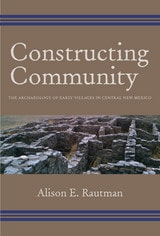
Constructing Community
The Archaeology of Early Villages in Central New MexicoAlison E. Rautman
University of Arizona Press, 2014
In central New Mexico, tourists admire the majestic ruins of old Spanish churches and historic pueblos at Abo, Quarai, and Gran Quivira in Salinas Pueblo Missions National Monument. The less-imposing remains of the earliest Indian farming settlements, however, have not attracted nearly as much notice from visitors or from professional archaeologists. In Constructing Community, Alison E. Rautman synthesizes over twenty years of research about this little-known period of early sedentary villages in the Salinas region.
Rautman tackles a very broad topic: how archaeologists use material evidence to infer and imagine how people lived in the past, how they coped with everyday decisions and tensions, and how they created a sense of themselves and their place in the world. Using several different lines of evidence, she reconstructs what life was like for the Ancestral Pueblo people of Salinas, and identifies some of the specific strategies that they used to develop and sustain their villages over time.
Examining evidence of each site’s construction and developing spatial layout, Rautman traces changes in community organization across the architectural transitions from pithouses to jacal structures to unit pueblos, and finally to plaza-oriented pueblos. She finds that, in contrast to some other areas of the American Southwest, early villagers in Salinas repeatedly managed their built environment to emphasize the coherence and unity of the village as a whole. In this way, she argues, people in early farming villages across the Salinas region actively constructed and sustained a sense of social community.
[more]