108 books match the query 'Effect of human beings on' and 9 start with c
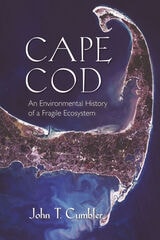
cover of Cape Cod: An Environmental History of a Fragile Ecosystem

Cape Cod

An Environmental History of a Fragile Ecosystem

John T. Cumbler

University of Massachusetts Press, 2014

To many, Cape Cod represents the classic setting for an American summer vacation. Attracting seasonal tourists with picturesque beaches and abundant seafood, the Cape has held a place in our national imagination for almost two hundred years. People have been drawn to its beauty and resources since Native Americans wandered up its long sandy peninsula some 12,000 years ago, while writers such as Henry David Thoreau and Norman Mailer have celebrated its mystery and allure. But, despite its idealized image, Cape Cod has a long history of scarcity and an increasingly evident fragility.

John T. Cumbler's book offers an environmental, social, and economic history of Cape Cod told through the experiences of residents as well as visitors. He notes that over the past four hundred years the Cape has experienced three regimes of resource utilization. The first regime of Native Americans who lived relatively lightly on the land was supplanted by European settlers who focused on production and extraction. This second regime began in the age of sail but declined through the age of steam as the soil and seas failed to yield the resources necessary to sustain continuing growth. Environmental and then economic crises during the second half of the nineteenth century eventually gave way to the third regime of tourism and recreation. But this regime has its own environmental costs, as residents have learned over the last half century.

Although the Cape remains a special place, its history of resource scarcity and its attempts to deal with that scarcity offer useful lessons for anyone addressing similar issues around the globe.
[more]
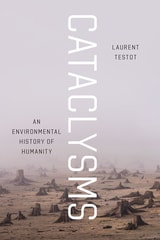
cover of Cataclysms: An Environmental History of Humanity

Cataclysms

An Environmental History of Humanity

Laurent Testot

University of Chicago Press, 2020

Humanity is by many measures the biggest success story in the animal kingdom; but what are the costs of this triumph? Over its three million years of existence, the human species has continuously modified nature and drained its resources. In Cataclysms, Laurent Testot provides the full tally, offering a comprehensive environmental history of humanity’s unmatched and perhaps irreversible influence on the world.

Testot explores the interconnected histories of human evolution and planetary deterioration, arguing that our development from naked apes to Homo sapiens has entailed wide-scale environmental harm. Testot makes the case that humans have usually been catastrophic for the planet, “hyperpredators” responsible for mass extinctions, deforestation, global warming, ocean acidification, and unchecked pollution, as well as the slaughter of our own species. Organized chronologically around seven technological revolutions, Cataclysms unspools the intertwined saga of humanity and our environment, from our shy beginnings in Africa to today’s domination of the planet, revealing how we have blown past any limits along the way—whether by exploding our own population numbers, domesticating countless other species, or harnessing energy from fossils. Testot’s book, while sweeping, is light and approachable, telling the stories—sometimes rambunctious, sometimes appalling—of how a glorified monkey transformed its own environment beyond all recognition.
 
In order to begin reversing our environmental disaster, we must have a better understanding of our own past and the incalculable environmental costs incurred at every stage of human innovation. Cataclysms offers that understanding and the hope that we can now begin to reform our relationship to the Earth.
 
[more]
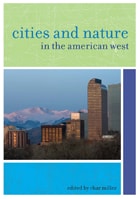
cover of Cities and Nature in the American West

Cities and Nature in the American West

Char Miller

University of Nevada Press, 2010
In less than a century, the American West has transformed from a predominantly rural region to one where most people live in metropolitan centers. Cities and Nature in the American West offers provocative analyses of this transformation. Each essay explores the intersection of environmental, urban, and western history, providing a deeper understanding of the com- plex processes by which the urban West has shaped and been shaped by its sustaining environment. The book also considers how the West’s urban development has altered the human experience and perception of nature, from the administration and marketing of national parks to the consumer roots of popular environ- mentalism; the politics of land and water use; and the challenges of environmental inequities. A number of essays address the cultural role of wilderness, nature, and such activities as camping. Others examine the increasingly per- vasive power of the West’s urban areas and urbanites to redefine the very foundations and future of the American West.
[more]
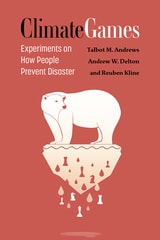
cover of Climate Games: Experiments on How People Prevent Disaster

Climate Games

Experiments on How People Prevent Disaster

Talbot M. Andrews, Andrew W. Delton, and Reuben Kline

University of Michigan Press, 2024

Can humanity work together to mitigate the effects of climate change? Climate Games argues we can. This book brings together a decade and a half of experimentation, conducted by researchers around the world, which shows that people can and will work together to prevent disasters like climate change. These experiments, called economic games, put money on the line to create laboratory disasters. Participants must work together by spending a bit of money now to prevent themselves from losing even more money in the future. Will people sacrifice their own money to prevent disaster? Can people make wise decisions? And can people decide wisely on behalf of others? The answer is a resounding yes. 

Yet real climate change is a complex social dilemma involving the world’s nearly eight billion inhabitants. In the real world, the worst effects of climate change are likely to be felt by developing countries, while most of the decisions will be made by rich, industrialized countries. And while the world as a whole would be better off if all nations reduced their greenhouse gas emissions, any given nation could decide it would be even better off if it continued emitting and let other nations take care of the problem. These disaster experiments test how real people respond to climate change’s unique constellation of challenges and deliver a positive message: People will prevent disaster.
[more]
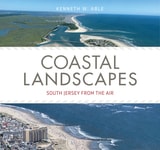
cover of Coastal Landscapes: South Jersey from the Air

Coastal Landscapes

South Jersey from the Air

Kenneth W. Able

Rutgers University Press, 2023

New Jersey has roughly one hundred and thirty miles of coastline, including a wide array of habitats from marshes to ocean beaches, each hosting a unique ecosystem. Yet these coastal landscapes are quite dynamic, changing rapidly as a result of commercial development, environmental protection movements, and of course climate change. Now more than ever, it is vital to document these landscapes before they disappear. 
 
Based on numerous aerial images from helicopter and drone flights between 2015 and 2021, this book provides extensive photographs and maps of the New Jersey coast, from the Pine Barrens to the ocean beaches. The text associated with each exceptional image describes it in detail, including its location, ecological setting, and relative position within the larger landscape. Author Kenneth Able, director of the Rutgers University Marine Field Station for over thirty years, has thoroughly ground-truthed each image by observations made through kayaks, boats, and wading through marshes. Calling upon his decades of expertise, Able paints a compelling portrait of coastal New Jersey’s stunning natural features, resources, history, and possible futures in an era of rising sea levels. 
 
[more]
cover of Count

Count

Valerie Martínez

University of Arizona Press, 2021

Count is a powerful book-length poem that reckons with the heartbreaking reality of climate change. Forty-three sections of myth-gathering, flora and fauna, accounts of climate devastation, personal narratives, witnessing, references to works of eco-art, and evocations of children unfold over the course of the book, creating a deeply nuanced image of the current climate crisis. Central to this vital work of ecopoetry is the idea of counting—counting down to the extinction of a species, counting the wonders of the natural world, counting our way back to the balance that is required to save ourselves from climate destruction. Filled with a sense of grief and sorrow for the current state of the planet, Count also offers a glimmering hope that future generations will restore our damaged environment.

With sections that vary between poetry, science, Indigenous storytelling, numerical measurement, and narration, Valerie Martínez’s new work results in an epic panorama infused with the timely urgency of facing an apocalyptic future. This beautiful, tragic, and unusual poem is a testimonial, a warning, and a call to action that will captivate lovers of contemporary poetry and ecopoetry, environmentalists, and climate activists alike. Count skillfully calls on our collective desire to leave a livable world, filled with the potential for healing, as a legacy to the generations of children that come after us.
[more]
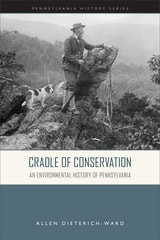
cover of Cradle of Conservation: An Environmental History of Pennsylvania

Cradle of Conservation

An Environmental History of Pennsylvania

Allen Dieterich-Ward

Temple University Press, 2024

From the origins of “Penn’s Woods” to the controversial practice of fracking, Cradle of Conservation provides the first comprehensive study of Pennsylvania’s environmental history. The story starts with forester Ralph Brock at the dawn of the conservation era and continues through the eras of energy production using coal, oil, natural gas, and other resources. Allen Dieterich-Ward also investigates how the non-human world shapes the history of the commonwealth and examines the impact of pollution.

Cradle of Conservation moves across time and place, from the Haudenosaunee people of the Susquehanna Valley, to the iron furnaces of nineteenth-century Pittsburgh, to the diesel trucks on the twentieth-century Pennsylvania Turnpike. In addition, Dieterich-Ward explores the histories of Philadelphia’s Schuylkill River and the state’s anthracite region and traces the environmental movements and crises that have led to public policy changes in the face of climate change.

Cradle of Conservation deepens our understanding of how Pennsylvanians have conserved and consumed.
[more]
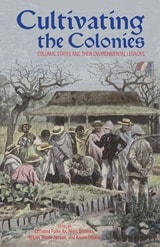
cover of Cultivating the Colonies: Colonial States and their Environmental Legacies

Cultivating the Colonies

Colonial States and their Environmental Legacies

Christina Folke Ax

Ohio University Press, 2011

The essays collected in Cultivating the Colonies demonstrate how the relationship between colonial power and nature revealsthe nature of power. Each essay explores how colonial governments translated ideas about the management of exoticnature and foreign people into practice, and how they literally “got their hands dirty” in the business of empire.

The eleven essays include studies of animal husbandry in the Philippines, farming in Indochina, and indigenous medicine in India. They are global in scope, ranging from the Russian North to Mozambique, examining the consequences of colonialismon nature, including its impact on animals, fisheries, farmlands, medical practices, and even the diets of indigenouspeople.

Cultivating the Colonies establishes beyond all possible doubt the importance of the environment as a locus for studyingthe power of the colonial state.
[more]
cover of Culture and Resource Conflict: Why Meanings Matter

Culture and Resource Conflict

Why Meanings Matter

Douglas L. Medin

Russell Sage Foundation, 2006

In a multi-cultural society, differing worldviews among groups can lead to conflict over competing values and behaviors. Nowhere is this tension more concrete than in the wilderness, where people of different cultures hunt and fish for the same animals. White Americans tend to see nature as something external which they have some responsibility to care for. In contrast, Native Americans are more likely to see themselves as one with nature. In Culture and Resource Conflict, authors Douglas Medin, Norbert Ross, and Douglas Cox investigate the discord between whites and Menominee American Indians over hunting and fishing, and in the process, contribute to our understanding of how and why cultures so often collide. Based on detailed ethnographic and experimental research, Culture and Resource Conflict finds that Native American and European American hunters and fishermen have differing approaches—or mental models—with respect to fish and game, and that these differences lead to misunderstanding, stereotyping, and conflict. Menominee look at the practice of hunting and fishing for sport as a sign of a lack of respect for nature. Whites, on the other hand, define respect for nature more on grounds of resource management and conservation. Some whites believe—contrary to fact—that Native Americans are depleting animal populations with excessive hunting and fishing, while the Menominee protest that they only hunt what they need and make extensive use of their catch. Yet the authors find that, despite these differences, the two groups share the fundamental underlying goal of preserving fish and game for future generations, and both groups see hunting and fishing as deeply meaningful activities. At its core, the conflict between these two groups is more about mistrust and stereotyping than actual disagreement over values. Combining the strengths of psychology and anthropology, Culture and Resource Conflict shows how misunderstandings about the motives of others can lead to hostility and conflict. As debates over natural resources rage worldwide, this unique book demonstrates the obstacles that must be overcome for different groups to reach consensus over environmental policy.
[more]