Results by title
78 books match the query 'Emergence' and 4 start with c
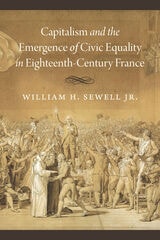
Capitalism and the Emergence of Civic Equality in Eighteenth-Century France
William H. Sewell Jr.
University of Chicago Press, 2021
William H. Sewell Jr. argues that the flourishing of commercial capitalism in eighteenth-century France introduced a new independence, flexibility, and anonymity to French social life. By entering the interstices of this otherwise rigidly hierarchical society, expanded commodity exchange colored everyday experience in ways that made civic equality thinkable, possible, even desirable, when the crisis of the French Revolution arrived. Sewell ties together masterful analyses of a multitude of interrelated topics: the rise of commerce, the emergence of urban publics, the careers of the philosophes, commercial publishing, patronage, political economy, trade, and state finance. Capitalism and the Emergence of Civic Equality in Eighteenth-Century France offers an original interpretation of one of history’s pivotal moments.

Communicating the Infinite
The Emergence of the Habad SchoolNaftali Loewenthal
University of Chicago Press, 1990
Beginning with the different levels of communication in the teachings of the Baal Shem Tov and the Maggid and his disciples, Naftali Loewenthal traces the unfolding of the dialectic between the urge to transmit esoteric ideas and a powerful inner restraint. Gradually R. Shneur Zalman came to the fore as the prime exponent of the communication ethos. Loewenthal follows the development of his discourses up to the time of his death, when R. Dov Ber and R. Aaron Halevi Horowitz formed their respective "Lubavitch" and "Staroselye" schools. The author continues with a detailed examination of the teachings of R. Dov Ber, an inspired mystic. Central in his thought was the esoteric concept of self-abnegation, bitul, yet this combined with the quest to communicate hasidic teachings to every level of society, including women.
From the late eighteenth century onwards, the main problem for the Jewish world was posed by the fall of the walls of the social and political ghetto. Generally, the response was either to secularize, or abandon altogether, traditional Judaism or to retreat from the threatening modern world into enclave religiosity; by stressing communication, the Habad school opened the way for a middle range response that was neither a retreat into elitism nor an abandonment of tradition. Based on years of research from Hebrew and Yiddish primary source materials, Communicating the Infinite is a work of importance not only to specialists of Judaic studies but also to historians and sociologists.
Congress and the Emergence of Sectionalism
From the Missouri Compromise to the Age of JacksonPaul Finkelman
Ohio University Press, 2008
Crossroads Modernism
Descent And Emergence In African-American Literary CultureEdward M. Pavlic
University of Minnesota Press, 2002
An essential reconsideration of black literature and culture and its response to modernity
In the African American encounter with modernism, all was not confrontation. Rather, as Edward M. Pavli´c demonstrates here, African American artists negotiated the intersection of high modernism in Europe and American discourse to fashion their own distinctive response to American modernity. A deft repositioning of black literature and culture, Pavli´c’s book re-envisions the potentials and dilemmas where the different traditions of modernism meet and firmly establishes African American modernism at this cultural crossroads.
Offering new insights into the work of a variety of African American artists—including Ralph Ellison, Richard Wright, Zora Neale Hurston, James Baldwin, Toni Morrison, Robert Hayden, David Bradley, Yusef Komunyakaa, Romare Bearden, and John Coltrane—Pavli´c explores the complex ways in which key modernist philosophical ideas and creative techniques have informed black culture. Crossroads Modernism also provides an in-depth look at how West African cultural legacies are brought to bear in the structure of a truly African American modernist creative process. The book brings to light two interrelated strains of black modernism: Afro-Modernism, which employs established modernist concerns and conceits to illuminate internal and psychological experience; and Diasporic Modernism, which places greater emphasis on shared cultural space and builds on traditions rooted in West African cultures.Whereas much has been said about the (generally racist) use of "blackness" in constituting modernism, Crossroads Modernism is the first book to expose the key role that modernism has played in the constitution of "blackness" in African-American aesthetics. In light of this work, canonical texts in African American literature can no longer be read as devoid of their own singular contribution to international modernism.