Results by title
72 books match the query 'English drama' and 6 start with c
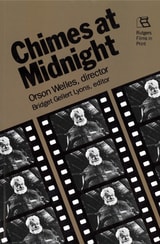
Chimes at Midnight
Orson Welles, DirectorLyons, Bridget G
Rutgers University Press, 1988
This volume offers a complete continuity script of Chimes at Midnight, including its famous battle sequence. Each shot is described in detail and is keyed to the original Shakesperian sources, thus making the volume an invaluable guide to Welles as an adaptor and creator of texts. The first complete transcription of the continuity script of Chimes is accompanied by the editor's critical introduction on Welles's transformation of Shakespeare; a special interview with Keith Baxter, one of the film's principal actors, which discusses its production history; reviews and articles; and a biographical sketch of Welles, a filmography, and a bibliography.
Christian Humanism in Shakespeare
A Study in Religion and LiteratureLee Oser
Catholic University of America Press, 2022
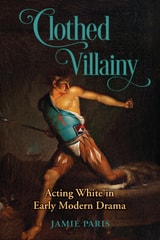
Clothed Villainy
Acting White in Early Modern DramaJamie Paris
University of Alabama Press, 2026
Examines how centuries-old stagecraft shaped modern racial politics—and why the performance of whiteness still commands the spotlight.
From Shakespearean blackface to the alt-right’s khaki-clad protests, Clothed Villainy: Acting White in in Early Modern Drama by Jamie Paris confronts the uncomfortable truths of racial performance across centuries. Paris argues that whiteness is not a fixed identity but a precarious and performative construct—shaped and sustained through actions, appearances, and cultural scripts.
Drawing on critical race theory, performance studies, and Indigenous scholarship, Clothed Villainy traces how racial scripts—whether “playing Black,” “playing Indian,” or especially “playing white”—have been used to uphold white supremacy and erase marginalized identities. By examining the costuming and characterization of white actors portraying Black villains on the early modern stage, Paris reveals how these theatrical traditions continue to echo in contemporary racial politics.
Written with bold clarity and personal insight, this book opens space for reimagining race, history, and identity through a more critical and inclusive lens. Clothed Villainy is essential reading for scholars, students, and anyone seeking to understand the deep-rooted performance of race in society and how we might reimagine it for a more equitable future.

Contemporary Irish Drama and Cultural Identity
Margaret Llewellyn-Jones
Intellect Books, 2013
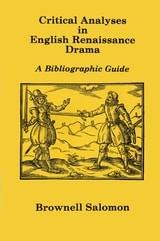
Critical Analyses in English Renaissance Drama
A Bibliographic GuideBrownell Salomon
University of Wisconsin Press, 1979
This bibliographic guide directs the reader to a prize selection of the best modern, analytical studies of every play, anonymous play, masque, pageant, and "entertainment" written by more than two dozen contemporaries of Shakespeare in the years between 1580 and 1642. Together with Shakespeare's plays, these works comprise the most illustrious body of drama in the English language.
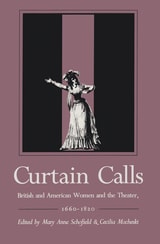
Curtain Calls
British and American Women and the Theater, 1660–1820Mary A. Schofield
Ohio University Press, 1991
“I here and there o’heard a Coxcomb cry,
Ah, rot—’tis a Woman’s Comedy.”
Thus Aphra Behn ushers in a new era for women in the British Theatre (Sir Patient Fancy, 1678). In the hundred years that were to follow—and exactly those years that Curtain Calls examines—women truly took the theater world by storm.
For each woman who chose a career in the theater world of the eighteenth century, there is a unique tale of struggle, insult, success, good or bad fortune, disaster, seduction, or fame. Whether acting, writing, reviewing, or stage managing, women played a major, if frequently unacknowledged, role in the history of the theater from the late seventeenth through the early nineteenth centuries. From Alpha Behn’s earliest plays through the glorious celebrity of Sara Siddons, women molded the taste of the age and carved out in the theater one of the few available opportunities for independence and renown.
Not all the women who tried succeeded, of course, and even the best faced opposition as they challenged the male stronghold of playwriting and theater managing. Curtain Calls maps the new territory as these pioneering women staked it for their own; it chronicles their lives, their triumphs, and their losses.
We begin with Aphra Behn, whose first play was staged in 1670, and conclude in the early decades of the nineteenth century with Inchbald and Siddons. The one hundred and fifty years encompassed by their lives contain the careers of dozens of lesser–known women, a network, as Dr. Johnson would have it, encompassing both talent and tribulation.
Contributors include: Edward Langhans, Linda R. Payne, Pat Rogers, Maureen e. Mulvihill, Deborah Payne, Betty Rizzo, Ellen Donkin, Frances M. Kavenik, Jessica Munns, nancy Cotton, Edna L. Steevs, Doreen Saar, Jean B. Kern, Katherine M. Rogers, Constance Clark, William J. Burling, Judith Phillips Stanton, Douglas Butler, Rose Zimbardo, and the editors.