Results by title
394 books match the query 'English literature' and 20 start with c

CONSUMING FANTASIES
LABOR, LEISURE, AND THE LONDON SHOPGIRL,LISE SHAPIRO SANDERS
The Ohio State University Press, 2006
Caribbeana
An Anthology of English Literature of the West Indies, 1657-1777Edited by Thomas W. Krise
University of Chicago Press, 1999
Caribbeana offers invaluable period commentaries on slavery, colonialism, gender relations, African and European history, natural history, agriculture, and medicine. Highlights include several of the earliest protests against slavery; a superb ode by the Cambridge-educated Afro-Jamaican poet Francis Williams; James Grainger's extended georgic poem, The Sugar Cane; Frances Seymour's poignant tale of the Englishman Inkle who sells his Indian savior-lover Yarico into slavery; and several descriptions of the West Indies during the early years of settlement.
Cato's Tears and the Making of Anglo-American Emotion
Julie Ellison
University of Chicago Press, 1999
Early popular dramas of this time, Ellison shows, linked male stoicism with sentimentality through portrayals of stoic figures whose civic sacrifices bring other men to tears. Later works develop a different model of sensibility, drawing their objects of sympathy from other races and classes—Native Americans, African slaves, servants. Only by examining these texts in light of the complex masculine tradition of stoic sentimentality, Ellison argues, can one interpret women's roles in the culture of sensibility.
In her conclusion, Ellison offers "a short history of liberal guilt," exploring the enduring link between male stoicism and male sensibility in political and cultural life from the late seventeenth century to today.
Challenging Communion
The Eucharist and Middle English LiteratureJennifer Garrison
The Ohio State University Press, 2017
Through new readings of texts such as Piers Plowman, A Revelation of Love, The Book of Margery Kempe, and John Lydgate’s religious poetry, Garrison shows how writers of Middle English often take advantage of the ways in which eucharistic theology itself contests the boundaries between the material and the spiritual, and how these writers challenge the eucharistic ideal of union between Christ and the community of believers. By troubling the definitions of literal and figurative, Middle English writers respond to and reformulate eucharistic theology in politically challenging and poetically complex ways. Garrison argues that Middle English texts often reject simple eucharistic promises in order to offer what they regard as a better version of the Eucharist, one that is intellectually and spiritually demanding and that invites readers to transform themselves and their communities.
Close Reading
The ReaderFrank Lentricchia and Andrew DuBois, eds.
Duke University Press, 2003
From a 1938 essay by John Crowe Ransom through the work of contemporary scholars, Close Reading highlights the interplay between critics—the ways they respond to and are influenced by others’ works. To facilitate comparisons of methodology, the collection includes discussions of the same primary texts by scholars using different critical approaches. The essays focus on Hamlet, “Lycidas,” “The Rape of the Lock,” Ulysses, Invisible Man, Beloved, Jane Austen, John Keats, and Wallace Stevens and reveal not only what the contributors are reading, but also how they are reading.
Frank Lentricchia and Andrew DuBois’s collection is an essential tool for teaching the history and practice of close reading.
Contributors. Houston A. Baker Jr., Roland Barthes, Homi Bhabha, R. P. Blackmur, Cleanth Brooks, Kenneth Burke, Paul de Man, Andrew DuBois, Stanley Fish, Catherine Gallagher, Sandra Gilbert, Stephen Greenblatt, Susan Gubar, Fredric Jameson, Murray Krieger, Frank Lentricchia, Franco Moretti, John Crowe Ransom, Eve Kosofsky Sedgwick, Helen Vendler
Closet Devotions
Richard Rambuss
Duke University Press, 1998
Through startling rereadings of works ranging from the devotional verse of the metaphysical poets (Donne, Herbert, Crashaw, and Traherne) to photographer Andres Serrano’s controversial “Piss Christ,” from Renaissance religious iconography to contemporary gay porn, Rambuss uncovers the highly charged erotic imagery that suffuses religious devotional art and literature. And he explores one of Christian culture’s most guarded (and literal) closets—the prayer closet itself, a privileged space where the vectors of same-sex desire can travel privately between the worshiper and his or her God.
Elegantly written and theoretically astute, Closet Devotions illuminates the ways in which sacred Christian devotion is homoeroticized, a phenomenon that until now has gone unexplored in current scholarship on religion, the body, and its passions. This book will attract readers across a wide array of disciplines, including gay and lesbian studies, literary theory and criticism, Renaissance studies, and religion.
Colonial Power, Colonial Texts
India in the Modern British NovelM. Keith Booker
University of Michigan Press, 1997
Come Buy, Come Buy
Shopping and the Culture of Consumption in Victorian Women’s WritingKrista Lysack
Ohio University Press, 2008
From the 1860s through the early twentieth century, Great Britain saw the rise of the department store and the institutionalization of a gendered sphere of consumption. Come Buy, Come Buy considers representations of the female shopper in British women’s writing and demonstrates how women’s shopping practices are materialized as forms of narrative, poetic, and cultural inscription, showing how women writers emphasize consumerism as productive of pleasure rather than the condition of seduction or loss. Krista Lysack examines works by Christina Rossetti, Mary Elizabeth Braddon, George Eliot, and Michael Field, as well as the suffragette newspaper Votes for Women, in order to challenge the dominant construction of Victorian femininity as characterized by self-renunciation and the regulation of appetite.
Come Buy, Come Buy considers not only literary works, but also a variety of archival sources (shopping guides, women’s fashion magazines, household management guides, newspapers, and advertisements) and cultural practices (department store shopping, shoplifting and kleptomania, domestic economy, and suffragette shopkeeping). With this wealth of sources, Lysack traces a genealogy of the woman shopper from dissident domestic spender to aesthetic connoisseur, from curious shop-gazer to political radical.
Common Prayer
The Language of Public Devotion in Early Modern EnglandRamie Targoff
University of Chicago Press, 2001
Through readings of William Shakespeare's Hamlet, Richard Hooker's Lawes of Ecclesiastical Politie, Philip Sidney's Apology for Poetry and his translations of the Psalms, John Donne's sermons and poems, and George Herbert's The Temple, Targoff uncovers the period's pervasive and often surprising interest in cultivating public and formalized models of worship. At the heart of this study lies an original and daring approach to understanding the origins of devotional poetry; Targoff shows how the projects of composing eloquent verse and improving liturgical worship come to be deeply intertwined. New literary practices, then, became a powerful means of forging common prayer, or controlling private and otherwise unmanageable expressions of faith.
Community and Solitude
New Essays on Johnson’s CircleLee, Anthony W
Bucknell University Press, 2019
Contributors: Christopher Catanese, James Caudle, Marilyn Francus, Christine Jackson-Holzberg, Claudia Thomas Kairoff, Elizabeth Lambert, Anthony W. Lee, James E. May, John Radner, and Lance Wilcox.
Published by Bucknell University Press. Distributed worldwide by Rutgers University Press.
Composition and Literature
Bridging the GapEdited by Winifred Bryan Horner
University of Chicago Press, 1983
Constituting Old Age in Early Modern English Literature, from Queen Elizabeth to King Lear
Christopher Martin
University of Massachusetts Press, 2012
How did Shakespeare and his contemporaries, whose works mark the last quarter century of Elizabeth I's reign as one of the richest moments in all of English literature, regard and represent old age? Was late life seen primarily as a time of withdrawal and preparation for death, as scholars and historians have traditionally maintained? In this book, Christopher Martin examines how, contrary to received impressions, writers and thinkers of the era—working in the shadow of the kinetic, long-lived queen herself—contested such prejudicial and dismissive social attitudes.
In late Tudor England, Martin argues, competing definitions of and regard for old age established a deeply conflicted frontier between external, socially “constituted” beliefs and a developing sense of an individual's “constitution” or physical makeup, a usage that entered the language in the mid-1500s. This space was further complicated by internal divisions within the opposing camps. On one side, reverence for the elder's authority, rooted in religious and social convention, was persistently challenged by the discontents of an ambitious younger underclass. Simultaneously, the aging subject grounded an enduring social presence and dignity on a bodily integrity that time inevitably threatened. In a historical setting that saw both the extended reign of an aging monarch and a resulting climate of acute generational strife, this network of competition and accommodation uniquely shaped late Elizabethan literary imagination. Through fresh readings of signature works, genres, and figures, Martin redirects critical attention to this neglected aspect of early modern studies.
Constructing Nineteenth-Century Religion
Literary, Historical, and Religious Studies in DialogueEdited by Joshua King and Winter Jade Werner
The Ohio State University Press, 2019
The participle in its title—Constructing—acknowledges that any articulation of nineteenth-century religion is never just a work of the past: scholars also actively construct religion as their disciplinary assumptions (and indeed personal and lived investments) shape their research and findings. Constructing NineteenthCentury Religion newly analyzes the diverse ways in which religion was debated and deployed in a wide range of nineteenthcentury texts and contexts. While focusing primarily on nineteenthcentury Britain, the collection also contributes to the increasingly transnational and transcultural outlook of postsecular studies, drawing connections between Britain and the United States, continental Europe, and colonial India.
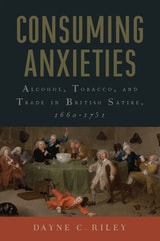
Consuming Anxieties
Alcohol, Tobacco, and Trade in British Satire, 1660-1751Dayne C. Riley
Bucknell University Press, 2024
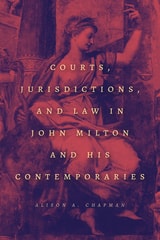
Courts, Jurisdictions, and Law in John Milton and His Contemporaries
Alison A. Chapman
University of Chicago Press, 2020
Surveying Milton’s early pamphlets, divorce tracts, late political tracts, and major prose works in comparison with the writings and cases of some of Milton’s contemporaries—including George Herbert, John Donne, Ben Jonson, and John Bunyan—Chapman reveals the variety and nuance in Milton’s juridical toolkit and his subtle use of competing legal traditions in pursuit of justice.
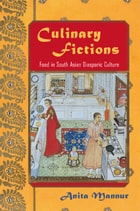
Culinary Fictions
Food in South Asian Diasporic CultureAnita Mannur
Temple University Press, 2009
For South Asians, food regularly plays a role in how issues of race, class, gender, ethnicity, and national identity are imagined as well as how notions of belonging are affirmed or resisted. Culinary Fictions provides food for thought as it considers the metaphors literature, film, and TV shows use to describe Indians abroad. When an immigrant mother in Jhumpa Lahiri’s The Namesake combines Rice Krispies, Planters peanuts, onions, salt, lemon juice, and green chili peppers to create a dish similar to one found on Calcutta sidewalks, it evokes not only the character’s Americanization, but also her nostalgia for India.
Food, Anita Mannur writes, is a central part of the cultural imagination of diasporic populations, and Culinary Fictions maps how it figures in various expressive forms. Mannur examines the cultural production from the Anglo-American reaches of the South Asian diaspora. Using texts from novels—Chitra Divakaruni’s Mistress of Spices and Shani Mootoo’s Cereus Blooms at Night—and cookbooks such as Madhur Jaffrey’s Invitation to Indian Cooking and Padma Lakshmi’s Easy Exotic, she illustrates how national identities are consolidated in culinary terms.
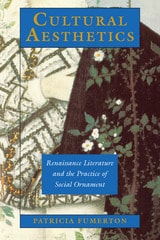
Cultural Aesthetics
Renaissance Literature and the Practice of Social OrnamentPatricia Fumerton
University of Chicago Press, 1991
Cultural Capital
The Problem of Literary Canon FormationJohn Guillory
University of Chicago Press, 1993
Cultural Capital
The Problem of Literary Canon FormationJohn Guillory
University of Chicago Press, 2023
Since its publication in 1993, John Guillory’s Cultural Capital has been a signal text for understanding the codification and uses of the literary canon. Cultural Capital reconsiders the social basis for aesthetic judgment and exposes the unequal distribution of symbolic and linguistic knowledge on which culture has long been based. Drawing from Pierre Bourdieu’s sociology, Guillory argues that canon formation must be understood less as a question of the representation of social groups and more as a question of the distribution of cultural capital in schools, which regulate access to literacy, to the practices of reading and writing.
Now, as the crisis of the canon has evolved into the so-called crisis of the humanities, Guillory’s groundbreaking, incisive work has never been more urgent. As scholar and critic Merve Emre writes in her introduction to this enlarged edition: “Exclusion, selection, reflection, representation—these are the terms on which the canon wars of the last century were fought, and the terms that continue to inform debates about, for instance, decolonizing the curriculum and the rhetoric of antiracist pedagogy.”
Curiosity
A Cultural History of Early Modern InquiryBarbara M. Benedict
University of Chicago Press, 2001
In this striking social history, Barbara M. Benedict draws on the texts of the early modern period to discover the era's attitudes toward curiosity, a trait we learn was often depicted as an unsavory form of transgression or cultural ambition.