Results by title
67 books match the query 'Environmental protection' and 5 start with c
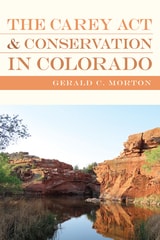
Carey Act and Conservation in Colorado
Gerald C. Morton
University Press of Colorado, 2024
Morton contextualizes the Carey Act’s significance in Colorado through a study of the Two Buttes and Muddy Creek projects in the state’s southeastern corner—tragic examples of the disconnect among developers seeking windfall profits in the face of financial rollercoasters, the challenge of reclaiming remote sagebrush country, and settlers seeking viable livelihoods that eventually led conservationists to reimagine the failures as public wildlife refuges. A collision of values between developers and settlers lay at the center of those wildlife habitat conservation efforts, forcing people to rethink their relationship with the land and ephemeral streams—an awareness that correlated with the advent of modern ecology.
The Carey Act and Conservation in Colorado is the untold story of the manipulation of nature and the reconceived use of land for public wildlife areas on the southern plains of the American West. Offering original research on arid lands policy, federal and state agency oversight, irrigation bond financing, heartbroken settlers’ grievances, individual developers’ motives, and the rise of wildlife conservation, this compelling tale of misfortune will appeal to scholars and general readers interested in conservationist and environmental history in the American West.

Chemical Alert!
A Community Action HandbookEdited by Marvin S. Legator and Sabrina F. Strawn
University of Texas Press, 1993
In the 1978 Love Canal toxic waste crisis, concerned citizens "did a far better job of evaluating the health of the community than did the professionals of the New York Health Department," asserts Marvin Legator. In Chemical Alert! A Community Action Handbook, he and coeditor Sabrina Strawn offer a step-by-step guide that can be used by any lay person or citizens' group to determine whether a health risk exists in their area.
Writing for the general reader with no scientific expertise, environmental, medical, and legal professionals instruct communities on the organizational and investigative techniques that will produce a valid, scientific case study. With these tools, citizens living near petrochemical plants or waste disposal areas—or who may have simply noticed a high incidence of certain health problems in their community—can determine for themselves whether a problem really exists and seek remediation. Given the reality that government agencies often lack the resources—or the will—to detect health hazards before they affect a community, an informed citizenry should be its own best environmental watchdog.

China's Environment and China's Environment Journalists
A StudyHugo de Burgh and Zeng Rong
Intellect Books, 2012
Crucible For Survival
Environmental Security and Justice in the Indian Ocean RegionDoyle, Timothy
Rutgers University Press, 2008
Custodians of the Land
Ecology and Culture in the History of TanzaniaGregory H. Maddox
Ohio University Press, 1995
Farming and pastoral societies inhabit ever-changing environments. This relationship between environment and rural culture, politics and economy in Tanzania is the subject of this volume which will be valuable in reopening debates on Tanzanian history.
In his conclusion, Isaria N. Kimambo, a founding father of Tanzanian history, reflects on the efforts of successive historians to strike a balance between external causes of change and local initiative in their interpretations of Tanzanian history.
He shows that nationalist and Marxist historians of Tanzanian history, understandably preoccupied through the first quarter-century of the country's post-colonial history with the impact of imperialism and capitalism on East Africa, tended to overlook the initiatives taken by rural societies to transform themselves.
Yet there is good reason for historians to think about the causes of change and innovation in the rural communities of Tanzania, because farming and pastoral people have constantly changed as they adjusted to shifting environmental conditions.