Results by title
101 books match the query 'Environmentalism' and 4 start with c

Capitalism, Democracy, and Ecology
Departing from MarxTimothy W. Luke
University of Illinois Press, 1999
Using Marx as a touchstone, Timothy W. Luke warns that if communities are not to be overwhelmed by new class economic and political agendas, then the practice of democracy must be reconstituted on a more populist basis. However, the galvanizing force for this new, more community-centered populism will not be the proletariat, as Marx predicted, nor contemporary militant patriotic groups. Rather, Luke argues that many groups unified by a concern for ecological justice present the strongest potential opposition to capitalism.
Wide-ranging and lucid, Capitalism, Democracy, and Ecology is essential reading in the age of information.

Cities and Nature in the American West
Char Miller
University of Nevada Press, 2010
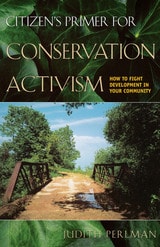
Citizen's Primer for Conservation Activism
How to Fight Development in Your CommunityBy Judith Perlman
University of Texas Press, 2004
Is there anything you can do when development threatens your local forest, beach, prairie, or wetland? Yes, there is. Across America, citizen activists are fighting and winning battles against unwanted development in their own communities. To help you resist the urban sprawl and absentee landowners that can wreck small towns and cities alike, this book is a practical, hands-on guide for building a grassroots campaign to defeat undesirable development.
Written by a successful activist, Citizen's Primer for Conservation Activism takes you through all the steps necessary to stop unplanned development in your community:
- Identifying the issues at stake
- Getting involved and developing leadership
- Devising a strategy
- Hiring and working with legal counsel
- Building coalitions and partnerships
- Influencing local government
- Conducting a media campaign
- Raising money
- Countering developer tactics
- Managing the whole process
With the proven strategies in this easy-to-access book, you can quickly gear up to challenge unwanted development and preserve the character of your local community.
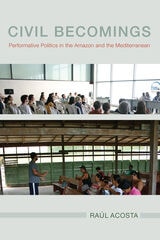
Civil Becomings
Performative Politics in the Amazon and the MediterraneanRaúl Acosta
University of Alabama Press, 2020
An anthropological approach to an emerging form of transnational political engagement by independent civil society organizations
Activism and advocacy have drawn academic interest as alternative ways of achieving collective ends outside established political institutions. However, there has been very little theoretical attention aimed at the interconnections between the two spheres. In Civil Becomings: Performative Politics in the Amazon and the Mediterranean, Raúl Acosta examines the manner in which progressive nongovernmental organizations (NGOs) and activists act in a more intermingled and processual way than scholars have previously acknowledged.
Acosta focuses on networks from the vantage point of two NGOs: one in Brazil that concentrated on environmental issues in the Amazon and another in Barcelona called the Mediterranean Social Forum. The focus of this research is not on organizational aspects of collaboration, but rather on the practices and contexts in which such cooperation occurs. Three major aspects of activist and advocacy networks are analyzed: their communicative characters, their collective performances of the political, and the negotiations they engage in between vernacular and cosmopolitan values.
This volume theorizes the cooperative actions of activist and advocacy networks as legitimating processes for the work of participating groups. In doing so, Acosta argues, they address the issues that justify a joint campaign or effort and also crucially underpin each participating collective as a worthy organization of civil society.