Results by title
118 books match the query 'Epistemology' and 6 start with c
Collective Memory and the Historical Past
Jeffrey Andrew Barash
University of Chicago Press, 2016
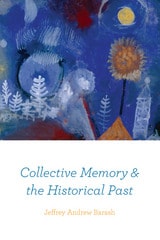
There is one critical way we honor great tragedies: by never forgetting. Collective remembrance is as old as human society itself, serving as an important source of social cohesion, yet as Jeffrey Andrew Barash shows in this book, it has served novel roles in a modern era otherwise characterized by discontinuity and dislocation. Drawing on recent theoretical explorations of collective memory, he elaborates an important new philosophical basis for it, one that unveils profound limitations to its scope in relation to the historical past.
Crucial to Barash’s analysis is a look at the radical transformations that symbolic configurations of collective memory have undergone with the rise of new technologies of mass communication. He provocatively demonstrates how such technologies’ capacity to simulate direct experience—especially via the image—actually makes more palpable collective memory’s limitations and the opacity of the historical past, which always lies beyond the reach of living memory. Thwarting skepticism, however, he eventually looks to literature—specifically writers such as Walter Scott, Marcel Proust, and W. G. Sebald—to uncover subtle nuances of temporality that might offer inconspicuous emblems of a past historical reality.
Crucial to Barash’s analysis is a look at the radical transformations that symbolic configurations of collective memory have undergone with the rise of new technologies of mass communication. He provocatively demonstrates how such technologies’ capacity to simulate direct experience—especially via the image—actually makes more palpable collective memory’s limitations and the opacity of the historical past, which always lies beyond the reach of living memory. Thwarting skepticism, however, he eventually looks to literature—specifically writers such as Walter Scott, Marcel Proust, and W. G. Sebald—to uncover subtle nuances of temporality that might offer inconspicuous emblems of a past historical reality.
[more]
Communities of Informed Judgment
Newman's Illative Sense and Accounts of RationalityFrederick D. Aquino
Catholic University of America Press, 2004
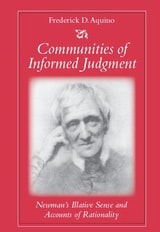
An original contribution to Newman studies, the book has an interdisciplinary focus, drawing from recent work in social epistemology, virtue epistemology, and cognitive science. It also takes up issues relevant to the philosophy of religion, epistemology of religious belief, systematic theology, ecumenical dialogue, and studies in John Henry Newman.
[more]

Companion Spirits
More-Than-Secular Journeys in More-Than-Human WorldsMayanthi L. Fernando
Duke University Press, 2027
In Companion Spirits, Mayanthi L. Fernando expands the concept of the more-than-human, offered as an antidote to anthropocentric worldmaking, beyond its secular foundations. Fernando argues that ways of thinking and being that underpin the Anthropocene—the idea that nature is inert, or that human mastery of the universe is possible—are effects of secularity. Drawing on autobiography, historiography, ethnography, theology, zoology, speculative fiction, and more, Fernando simultaneously examines the nexus of the Anthropocene and secularity and accounts for more-than-human worlds in more-than-secular ways. She also offers a counter-anthropology of the secular, tracking submerged sensibilities that do not adhere to dominant norms about science and religion, matter and spirit, reality and illusion. In so doing, she invites us, secular moderns included, to imagine the present, and the future, otherwise.
[more]
Complexities
Social Studies of Knowledge PracticesJohn Law and Annemarie Mol, eds.
Duke University Press, 2002
Although much recent social science and humanities work has been a revolt against simplification, this volume explores the contrast between simplicity and complexity to reveal that this dichotomy, itself, is too simplistic. John Law and Annemarie Mol have gathered a distinguished panel of contributors to offer—particularly within the field of science studies—approaches to a theory of complexity, and at the same time a theoretical introduction to the topic. Indeed, they examine not only ways of relating to complexity but complexity in practice.
Individual essays study complexity from a variety of perspectives, addressing market behavior, medical interventions, aeronautical design, the governing of supranational states, ecology, roadbuilding, meteorology, the science of complexity itself, and the psychology of childhood trauma. Other topics include complex wholes (holism) in the sciences, moral complexity in seemingly amoral endeavors, and issues relating to the protection of African elephants. With a focus on such concepts as multiplicity, partial connections, and ebbs and flows, the collection includes narratives from Kenya, Great Britain, Papua New Guinea, the Netherlands, France, and the meetings of the European Commission, written by anthropologists, economists, philosophers, psychologists, sociologists, and scholars of science, technology, and society.
Contributors. Andrew Barry, Steven D. Brown, Michel Callon, Chunglin Kwa, John Law, Nick Lee, Annemarie Mol, Marilyn Strathern, Laurent Thévenot, Charis Thompson
[more]

Conversations on Violence
An AnthologyBrad Evans
Pluto Press, 2021
'Brad Evans in one of the brightest critical minds of his generation' - Henry A. Giroux
Whether physical or metaphorical, institutional or interpersonal, violence is everywhere. A seemingly immutable fact of life, it is nonetheless rarely engaged with at the conceptual level. What does violence actually mean? And is it an inevitable part of the human condition?
Conversations on Violence brings together many of the world's leading critical scholars, artists, writers and cultural producers to provide a kaleidoscopic exploration of the concept of violence. Through in-depth interviews with thirty figures including Marina Abramovic, Kehinde Andrews and Simon Critchley, Brad Evans and Adrian Parr interrogate violence in all its manifestations, including its role in politics, art, gender discrimination and decolonisation.
Provocative, eye-opening and bracingly original, Conversations on Violence sheds light on a defining political and ethical concern of our age.
[more]
Creatively Undecided
Toward a History and Philosophy of Scientific AgencyMenachem Fisch
University of Chicago Press, 2017
Thomas Kuhn and Karl Popper are believed by many who study science to be the two key thinkers of the twentieth century. Each addressed the question of how scientific theories change, but they came to different conclusions.
By turning our attention to ambiguity and indecision in science, Menachem Fisch, in Creatively Undecided, offers a new way to look at how scientific understandings change. Following Kuhn, Fisch argues that scientific practice depends on the framework in which it is conducted, but he also shows that those frameworks can be understood as the possible outcomes of the rational deliberation that Popper viewed as central to theory change. How can a scientist subject her standards to rational appraisal if that very act requires the use of those standards? The way out, Fisch argues, is by looking at the incentives scientists have to create alternative frameworks in the first place. Fisch argues that while science can only be transformed from within, by people who have standing in the field, criticism from the outside is essential. We may not be able to be sufficiently self-critical on our own, but trusted criticism from outside, even if resisted, can begin to change our perspective—at which point transformative self-criticism becomes a real option.
By turning our attention to ambiguity and indecision in science, Menachem Fisch, in Creatively Undecided, offers a new way to look at how scientific understandings change. Following Kuhn, Fisch argues that scientific practice depends on the framework in which it is conducted, but he also shows that those frameworks can be understood as the possible outcomes of the rational deliberation that Popper viewed as central to theory change. How can a scientist subject her standards to rational appraisal if that very act requires the use of those standards? The way out, Fisch argues, is by looking at the incentives scientists have to create alternative frameworks in the first place. Fisch argues that while science can only be transformed from within, by people who have standing in the field, criticism from the outside is essential. We may not be able to be sufficiently self-critical on our own, but trusted criticism from outside, even if resisted, can begin to change our perspective—at which point transformative self-criticism becomes a real option.
[more]