Results by title
177 books match the query 'Equality' and 10 start with c
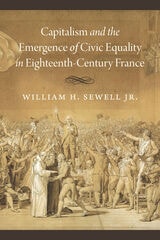
Capitalism and the Emergence of Civic Equality in Eighteenth-Century France
William H. Sewell Jr.
University of Chicago Press, 2021
William H. Sewell Jr. argues that the flourishing of commercial capitalism in eighteenth-century France introduced a new independence, flexibility, and anonymity to French social life. By entering the interstices of this otherwise rigidly hierarchical society, expanded commodity exchange colored everyday experience in ways that made civic equality thinkable, possible, even desirable, when the crisis of the French Revolution arrived. Sewell ties together masterful analyses of a multitude of interrelated topics: the rise of commerce, the emergence of urban publics, the careers of the philosophes, commercial publishing, patronage, political economy, trade, and state finance. Capitalism and the Emergence of Civic Equality in Eighteenth-Century France offers an original interpretation of one of history’s pivotal moments.

Carceral Liberalism
Feminist Voices against State ViolenceEdited by Shreerekha Pillai. Foreword by Demita Frazier
University of Illinois Press, 2023
One of Ms. Magazine's Most Anticipated Books of 2023
Carceral liberalism emerges from the confluence of neoliberalism, carcerality, and patriarchy to construct a powerful ruse disguised as freedom. It waves the feminist flag while keeping most women still at the margins. It speaks of a post-race society while one in three Black men remain incarcerated. It sings the praises of capital while the dispossessed remain mired in debt.
Shreerekha Pillai edits essays on carceral liberalism that continue the trajectory of the Combahee River Collective and the many people inspired by its vision of feminist solidarity and radical liberation. Academics, activists, writers, and a formerly incarcerated social worker look at feminist resurgence and resistance within, at the threshold of, and outside state violence; observe and record direct and indirect forms of carcerality sponsored by the state and shaped by state structures, traditions, and actors; and critique carcerality. Acclaimed poets like Honorée Fanonne Jeffers and Solmaz Sharif amplify the volume’s themes in works that bookend each section.
Cutting-edge yet historically grounded, Carceral Liberalism examines an American ideological creation that advances imperialism, anti-blackness, capitalism, and patriarchy.
Contributors: Maria F. Curtis, Joanna Eleftheriou, Autumn Elizabeth and Zarinah Agnew and D Coulombe, Jeremy Eugene, Demita Frazier, Honorée Fanonne Jeffers, Alka Kurian, Cassandra D. Little, Beth Matusoff Merfish, Francisco Argüelles Paz y Puente, Shreerekha Pillai, Marta Romero-Delgado, Ravi Shankar, Solmaz Sharif, Shailza Sharma, Tria Blu Wakpa and Jennifer Musial, Javier Zamora

Categorically Unequal
The American Stratification SystemDouglas S. Massey
Russell Sage Foundation, 2007
Challenging Inequality
Variation across Postindustrial SocietiesEvelyne Huber and John D. Stephens
University of Chicago Press, 2024
A wide-ranging examination of how policies, parties, and labor strength affect inequality in post-industrial societies.
Not all countries are unequal in the same ways or to the same degree. In Challenging Inequality, Evelyne Huber and John D. Stephens analyze different patterns of increasing income inequality in post-industrial societies since the 1980s, assessing the policies and social structures best able to mitigate against the worst effects of market inequality. Combining statistical data analysis from twenty-two countries with a comparative historical analysis of Germany, Spain, Sweden, and the United States, Huber and Stephens identify the factors that drive increases in inequality and shape persistent, marked differences between countries. Their statistical analysis confirms generalizable patterns and in-depth country studies help to further elucidate the processes at work.
Challenging Inequality shows how the combination of globalization and skill-biased technological change has led to both labor market dualization and rising unemployment levels, which in turn have had important effects on inequality and poverty. Labor strength—at both the society level and the enterprise level—has helped to counter rising market income inequality, as has a history of strong human capital spending. The generosity of the welfare state remains the most important factor shaping redistribution, while the consistent power of left parties is the common denominator behind both welfare state generosity and human capital investment.
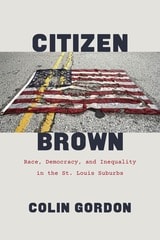
Citizen Brown
Race, Democracy, and Inequality in the St. Louis SuburbsColin Gordon
University of Chicago Press, 2019
Citizen Brown uncovers half a century of private practices and public policies that resulted in bitter inequality and sustained segregation in Ferguson and beyond. Gordon shows how municipal and school district boundaries were pointedly drawn to contain or exclude African Americans and how local policies and services—especially policing, education, and urban renewal—were weaponized to maintain civic separation. He also makes it clear that the outcry that arose in Ferguson was no impulsive outburst but rather an explosion of pent-up rage against long-standing systems of segregation and inequality—of which a police force that viewed citizens not as subjects to serve and protect but as sources of revenue was only the most immediate example. Worse, Citizen Brown illustrates the fact that though the greater St. Louis area provides some extraordinarily clear examples of fraught racial dynamics, in this it is hardly alone among American cities and regions.
Interactive maps and other companion resources to Citizen Brown are available at the book website.

Commager on Tocqueville
Henry Steele Commager
University of Missouri Press, 1993
Commager on Tocqueville is Henry Steele Commager's masterful interpretation of Alexis de Tocqueville's Democracy in America. Using Tocqueville's classic as a vehicle for discussing such contemporary issues as the environment, civil rights, and the military-industrial complex, Commager calls for a new vision of American leadership that trascends nationalism.
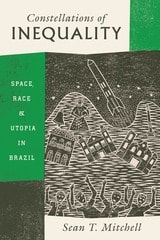
Constellations of Inequality
Space, Race, and Utopia in BrazilSean T. Mitchell
University of Chicago Press, 2017
In 1982, the Brazilian Air Force arrived on the Alcântara peninsula to build a state-of-the-art satellite launch facility. They displaced some 1,500 Afro-Brazilians from coastal land to inadequate inland villages, leaving many more threatened with displacement. Completed in 1990, this vast undertaking in one of Brazil’s poorest regions has provoked decades of conflict and controversy.
Constellations of Inequality tells this story of technological aspiration and the stark dynamics of inequality it laid bare. Sean T. Mitchell analyzes conflicts over land, ethnoracial identity, mobilization among descendants of escaped slaves, military-civilian competition in the launch program, and international intrigue. Throughout, he illuminates Brazil’s changing politics of inequality and examines how such inequality is made, reproduced, and challenged. How people conceptualize and act on the unequal conditions in which they find themselves, he shows, is as much a cultural and historical matter as a material one. Deftly broadening our understanding of race, technology, development, and political consciousness on local, national, and global levels, Constellations of Inequality paints a portrait of contemporary Brazil that will interest a broad spectrum of readers.

Cradle to Kindergarten
A New Plan to Combat InequalityAjay Chaudry
Russell Sage Foundation, 2017
The U.S. government invests less in children under the age of five than do most other developed nations. Most working families must seek private childcare, which means that children from low-income households, who would benefit most from high-quality early education, are the least likely to attend them. Existing policies, such as pre-kindergarten in some states are only partial solutions. To address these deficiencies, the authors propose to overhaul the early care system, beginning with a federal paid parental leave policy that provides both mothers and fathers with time and financial support after the birth of a child. They also advocate increased public benefits, including an expansion of the child care tax credit, and a new child care assurance program that subsidizes the cost of early care for low- and moderate-income families. They also propose that universal, high-quality early education in the states should start by age three, and a reform of the Head Start program that would include more intensive services for families living in areas of concentrated poverty and experiencing multiple adversities from the earliest point in these most disadvantaged children’s lives. They conclude with an implementation plan and contend that these reforms are attainable within a ten-year timeline.
Reducing educational and economic inequalities requires that all children have robust opportunities to learn, fully develop their capacities, and have a fair shot at success. Cradle to Kindergarten presents a blueprint for fulfilling this promise by expanding access to educational and financial resources at a critical stage of child development.
Crafting Equality
America's Anglo-African WordCeleste Michelle Condit and John Louis Lucaites
University of Chicago Press, 1993
Drawing upon little studied speeches, newspapers, magazines, and other public discourse, Condit and Lucaites survey the shifting meaning of equality from 1760 to the present as a process of interaction and negotiation among different social groups in American politics and culture. They make a powerful case for the critical role of black Americans in actively shaping what equality has come to mean in our political conversation by chronicling the development of an African-American rhetorical community. The story they tell supports a vision of equality that embraces both heterogeneity and homogeneity as necessary for maintaining the balance between liberty and property.
A compelling revision of an important aspect of America's history, Crafting Equality will interest anyone wanting to better understand the role public discourse plays in affecting the major social and political issues of our times. It will also interest readers concerned with the relationship between politics and culture in America's increasingly multi-cultural society.
Cultivating Differences
Symbolic Boundaries and the Making of InequalityEdited by Michèle Lamont and Marcel Fournier
University of Chicago Press, 1992
In this pioneering collection of original essays, a group of leading scholars helps set the agenda for the sociology of culture by exploring the factors that push us to segregate and integrate and the institutional arrangements that shape classification systems. Each examines the power of culture to shape our everyday lives as clearly as does economics, and studies the dimensions along which boundaries are frequently drawn.
The essays cover four topic areas: the institutionalization of cultural categories, from morality to popular culture; the exclusionary effects of high culture, from musical tastes to the role of art museums; the role of ethnicity and gender in shaping symbolic boundaries; and the role of democracy in creating inclusion and exclusion.
The contributors are Jeffrey Alexander, Nicola Beisel, Randall Collins, Diana Crane, Paul DiMaggio, Cynthia Fuchs Epstein, Joseph Gusfield, John R. Hall, David Halle, Richard A. Peterson, Albert Simkus, Alan Wolfe, and Vera Zolberg.