Results by title
57 books match the query 'Essays & Narratives' and 5 start with c
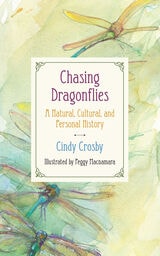
Chasing Dragonflies
A Natural, Cultural, and Personal HistoryCindy Crosby; Illustrations by Peggy Macnamara
Northwestern University Press, 2020
Chasing Dragonflies: A Natural, Cultural, and Personal History is an engaging, beautifully illustrated introduction to these remarkable insects. Drawing on her experiences as a natural history instructor, dragonfly monitor, cancer survivor, grandmother, and steward, Crosby tells the stories of dragonflies: their roles in poetry and art, their fascinating sex life—unique within the animal kingdom—and their evolution from dark-water dwellers to denizens of the air. We follow Crosby and other citizen-scientists into the prairies, wetlands, and woodlands of the Midwest, where they observe the environment and chronicle dragonfly populations and migration to decipher critical clues about our changing waterways and climate.
Woven throughout are personal stories: reflections on the author’s cancer diagnosis and recovery, change, loss, aging, family, joy, and discovering what it means to be at home in the natural world. Crosby draws an intimate portrait of a landscape teeming with variety and mystery, one that deserves our attention and conservation. As warm as it is informative, this book will interest gardeners, readers of literary nonfiction, and anyone intrigued by transformation, whether in nature or our personal lives.
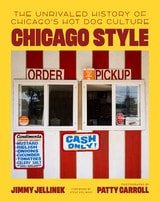
Chicago Style
The Unrivaled History of Chicago's Hot Dog CultureJimmy Jellinek, Patty Carroll, Steve Dolinsky
Northwestern University Press, 2027
The history of the iconic Chicago hot dog and the stands that built its legacy
Part culinary history, part street-corner anthropology, Chicago Style is a love letter to a city that built its identity on a bun. This book dives deep into the neon-lit, steam-fogged world of Chicago’s hot dog stands—those stubborn, glorious institutions where time seems to have stopped somewhere around 1963. Here, the steamed bun is sacred; the snap of the Vienna Beef frank is non-negotiable; and the famous warning—no ketchup—is less a rule than a social philosophy.
Chicago Style tells the story of the families, immigrants, hustlers, and neighborhood lifers who turned a humble Depression-era sandwich into one of the most recognizable foods in America. These stands are more than places to eat—they are tiny republics of flavor where politics, sports, gossip, and history are traded over paper boats loaded with mustard, relish, onions, tomatoes, sport peppers, celery salt, and a spear of pickle. With full-color art photography capturing the stands’ iconic visual culture and a reporter’s instinct for the characters who live behind the counter, Chicago Style reveals the Chicago hot dog stand for what it truly is: a form of civic architecture—democratic, delicious, and defiantly itself.
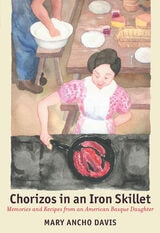
Chorizos in an Iron Skillet
Memories and Recipes from an American Basque DaughterMary Ancho Davis
University of Nevada Press, 2001
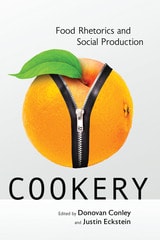
Cookery
Food Rhetorics and Social ProductionEdited by Donovan Conley and Justin Eckstein
University of Alabama Press, 2020
The rhetoric of contemporary food production and consumption with a focus on social boundaries
The rhetoric of food is more than just words about food, and food is more than just edible matter. Cookery: Food Rhetorics and Social Production explores how food mediates both rhetorical influence and material life through the overlapping concepts of invention and production. The classical canon of rhetorical invention entails the process of discovering one’s persuasive appeals, whereas the contemporary landscape of agricultural production touches virtually everyone on the planet. Together, rhetoric and food shape the boundaries of shared living.
The essays in this volume probe the many ways that food informs contemporary social life through its mediation of bodies—human and extra-human alike—in the forms of intoxication, addiction, estrangement, identification, repulsion, and eroticism. Our bodies, in turn, shape the boundaries of food through research, technology, cultural trends, and, of course, by talking about it.
Each chapter explores food’s persuasive nature through a unique prism that includes intoxication, dirt, “food porn,” strange foods, and political “invisibility.” Each case offers new insights about the relations between rhetorical influence and embodied practice through food. As a whole Cookery articulates new ways of viewing food’s powers of persuasion, as well as the inherent role of persuasion in agricultural production.
The purpose of Cookery, then, is to demonstrate the deep rhetoricity of our modern industrial food system through critical examinations of concepts, practices, and tendencies endemic to this system. Food has become an essential topic for discussions concerned with the larger social dynamics of production, distribution, access, reception, consumption, influence, and the fraught question of choice. These questions about food and rhetoric are equally questions about the assumptions, values, and practices of contemporary public life.
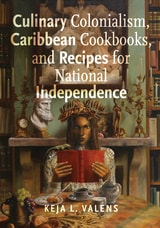
Culinary Colonialism, Caribbean Cookbooks, and Recipes for National Independence
Keja L. Valens
Rutgers University Press, 2024