59 books match the query 'Ethnoarchaeology' and 5 start with c
cover of Ceramic Ethnoarchaeology

Ceramic Ethnoarchaeology

Edited by William A. Longacre

University of Arizona Press, 1991

Ethnoarchaeology, the study of material culture in a living society by archaeologists, facilitates the extraction of information from prehistoric materials as well. Studies of contemporary pottery-making were initiated in the southwestern United States toward the end of the nineteenth century, then abandoned as a result of changes in archaeological theory. Now a resurgence in ethnoarchaeology over the past twenty-five years offers a new set of directions for the discipline. This volume presents the results of such work with pottery, a class of materials that occurs abundantly in many archaeological sites.

Drawing on projects undertaken around the world, in the Phillipines, East Africa, Mesoamerica, India, in both traditional and complex societies, the contributors focus on identifying social and behavioral sources of ceramic variation to show how analogical reasoning is fundamental to archaeological interpretation. As the number of pottery-making societies declines, opportunities for such research must be seized. By bringing together a variety of ceramic ethnoarchaeological analyses, this volume offers the profession a much-needed touchstone on method and theory for the study of pottery-making among living peoples.
[more]
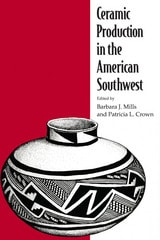
cover of Ceramic Production in the American Southwest

Ceramic Production in the American Southwest

Edited by Barbara J. Mills and Patricia L. Crown

University of Arizona Press, 1995
Southwestern ceramics have always been admired for their variety and aesthetic beauty. Although ceramics are most often used for placing the peoples who produced them in time, they can also provide important clues to past economic organization. This volume covers nearly 1000 years of southwestern prehistory and history, focusing on ceramic production in a number of environmental and economic contexts. It brings together the best of current research to illustrate the variation in the organization of production evident in this single geographic area. The contributors use diverse research methods in their studies of vessel form and decoration. All support the conclusion that the specialized production of ceramics for exchange beyond the household was widespread. The first seven chapters focus on ceramic production in specific regions, followed by three essays that re-examine basic concepts and offer new perspectives. Because previous studies of southwestern ceramics have focused more on distribution than production, Ceramic Production in the American Southwest fills a long-felt need for scholars in that region and offers a broad-based perspective unique in the literature. The Southwest lacked high levels of sociopolitical complexity and economic differentiation, making this volume of special interest to scholars working in similar contexts and to those interested in craft production.
[more]
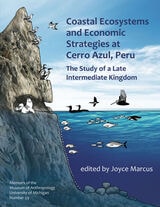
cover of Coastal Ecosystems and Economic Strategies at Cerro Azul, Peru: The Study of a Late Intermediate Kingdom

Coastal Ecosystems and Economic Strategies at Cerro Azul, Peru

The Study of a Late Intermediate Kingdom

Edited by Joyce Marcus

University of Michigan Press, 2016
Cerro Azul, a pre-Inca fishing community in the Kingdom of Huarco, Peru, stood at the interface between a rich marine ecosystem and an irrigated coastal plain. Under the direction of its noble families, Cerro Azul dried millions of fish for shipment to inland communities, from which it received agricultural products and dried llama meat.
[more]
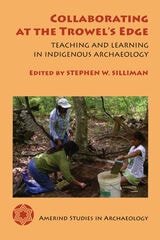
cover of Collaborating at the Trowel's Edge: Teaching and Learning in Indigenous Archaeology

Collaborating at the Trowel's Edge

Teaching and Learning in Indigenous Archaeology

Edited by Stephen W. Silliman

University of Arizona Press, 2008

A fundamental issue for twenty-first century archaeologists is the need to better direct their efforts toward supporting rather than harming indigenous peoples. Collaborative indigenous archaeology has already begun to stress the importance of cooperative, community-based research; this book now offers an up-to-date assessment of how Native American and non-native archaeologists have jointly undertaken research that is not only politically aware and historically minded but fundamentally better as well.

Eighteen contributors—many with tribal ties—cover the current state of collaborative indigenous archaeology in North America to show where the discipline is headed. Continent-wide cases, from the Northeast to the Southwest, demonstrate the situated nature of local practice alongside the global significance of further decolonizing archaeology. And by probing issues of indigenous participation with an eye toward method, theory, and pedagogy, many show how the archaeological field school can be retailored to address politics, ethics, and critical practice alongside traditional teaching and research methods.

These chapters reflect the strong link between politics and research, showing what can be achieved when indigenous values, perspectives, and knowledge are placed at the center of the research process. They not only draw on experiences at specific field schools but also examine advances in indigenous cultural resource management and in training Native American and non-native students.

Theoretically informed and practically grounded, Collaborating at the Trowel’s Edge is a virtual guide for rethinking field schools and is an essential volume for anyone involved in North American archaeology—professionals, students, tribal scholars, or avocationalists—as well as those working with indigenous peoples in other parts of the world. It both reflects the rapidly changing landscape of archaeology and charts new directions to ensure the ongoing vitality of the discipline.
[more]
cover of Contemporary Archaeologies of the Southwest

Contemporary Archaeologies of the Southwest

William Walker

University Press of Colorado, 2011

Organized by the theme of place and place-making in the Southwest, Contemporary Archaeologies of the Southwest emphasizes the method and theory for the study of radical changes in religion, settlement patterns, and material culture associated with population migration, colonialism, and climate change during the last 1,000 years.

Chapters address place-making in Chaco Canyon, recent trends in landscape archaeology, the formation of identities, landscape boundaries, and the movement associated with these aspects of place-making. They address how interaction of peoples with objects brings landscapes to life. Representing a diverse cross section of Southwestern archaeologists, the authors of this volume push the boundaries of archaeological method and theory, building a strong foundation for future Southwest studies.

This book will be of interest to professional and academic archaeologists, as well as students working in the American Southwest.

[more]