Results by title
60 books match the query 'Europe, Central' and 6 start with c
COMMITTEES IN POST-COMMUNIST DEMOCRATIC PARLIAMENTS
COMPARATIVE INSTITUTIONALIZATIONDAVID M. OLSON
The Ohio State University Press, 2002
The former Communist countries of Eastern Europe provide a treasure-trove of data on the development of democratic institutions. The contributors to this volume use the recent experiences of these countries to identify how the various committee systems are structured and tie the relative strength of the committee system in each country to the relative strength of its legislature. A uniform theoretical framework connects the work of each essay and ties the parts into an informative whole.
Comparative analysis based on seven indicators of institutionalization suggests that the committee systems of Hungary, Poland, and the Czech Republic are more institutionalized than those found elsewhere. Bulgaria is a middle case, while the parliaments of Moldova, Lithuania, and Estonia are the least. Of the indicators, stability in committee membership and extent of committee activity are among the most important for post-communist parliaments in their first decade.
This examination of legislative committees in their beginning stages suggests that the processes of institutionalization are sequenced: expertise in a policy sector is the basis of both the assertion of jurisdictional autonomy by committees and the motive for party control of their membership and officer positions. Basic to these developments, however, is the emergence of a stable and consistent structure of the committee system as a whole. More broadly, committee attributes are closely linked to the condition and functioning of both parliamentary party groups and the government.
Cinemas in Transition in Central and Eastern Europe after 1989
Catherine Portuges
Temple University Press, 2013
The contributors and editors of this exciting volume examine the interrelations between thematic, aesthetic, and infrastructural changes; the globalization of the international cinema marketplace; and the problems and promises arising from the privatization of national cinemas.
Cinemas in Transition in Central and Eastern Europe after 1989 also addresses the strategies employed for preserving national cinemas and cultures through an analysis of films from the Czech and Slovak republics, the former German Democratic Republic, Hungary, Poland, Romania, Ukraine, and the former Yugoslavia. The study provides a picture of Eastern European cinema at a critical juncture as well as its connections to the emergent world of transnational media.
Contributors include Barton Byg, Alexandra Foamente, Andrew Horton, Dina Iordanova, Ewa Mazierska, Bohdan Y. Nebesio, and Bogdan Stefanescu,
Contesting Copyright
A History of Intellectual Property in East Central Europe and the BalkansAugusta Dimou
Central European University Press, 2026
Corporate Governance in Central Europe and Russia
Banks, Funds, and Foreign InvestorsRoman Frydman
Central European University Press, 1996
Corporate Governance in Central Europe and Russia
Insiders and the StateAndrzej Rapaczynski
Central European University Press, 1996
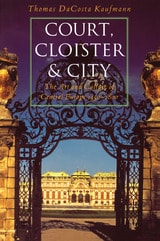
Court, Cloister, and City
The Art and Culture of Central Europe, 1450-1800Thomas DaCosta Kaufmann
University of Chicago Press, 1995
"Kaufmann throws considerable light on one of the more neglected and least understood periods in art history."—Philadelphia Inquirer
"A wonderful book which does justice both to a formal analysis of the art and to an explanation of broader political and economic forces at work."—Virginia Quarterly Review
"Important and stimulating, Kaufmann's study examines the cultural legacy of a region too little known and understood."—Choice
"Peaks of the creative heritage which [Kaufmann] describes reserve their message—and their surprises—for those who visit them in situ. But invest in Kaufmann's volume before you go."—R. J. W. Evans, New York Review of Books