Results by title
81 books match the query 'Executive Branch' and 4 start with c
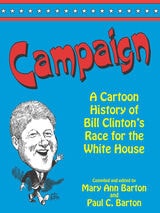
Campaign
A Cartoon History of Bill Clinton's Race for the White HouseMary Ann Barton
University of Arkansas Press, 1993
For many people, in the United States and abroad, the dramas of the campaign created the character of Clinton. From the Gennifer Flowers debacle to Clinton’s
resurrection at the Democratic National Convention and the triumph of the election win, the incisive cartoons in this collection capture Clinton’s emerging image in a way that no written word can. The forty-five contributing artists use these cartoons to depict the breathtaking and colorful events that only a presidential campaign can produce and offer hours of entertainment for any reader.
Changing Their Minds?
Donald Trump and Presidential LeadershipGeorge C. Edwards III
University of Chicago Press, 2021
Donald Trump has been a distinctive president, and his arrival in the Oval Office brought new questions. Could someone with his decades of experience as a self-promoter connect with the public and win its support? Could a president who is an experienced negotiator obtain the support in Congress needed to pass his legislative programs? Would we need to adjust the theory of presidential leadership to accommodate a president with unique persuasive skills?
Building on decades of research and employing extensive new data, George C. Edwards III addresses these questions. He finds that President Trump has been no different than other presidents in being constrained by his environment. He moved neither the public nor Congress. Even for an experienced salesman and dealmaker, presidential power is still not the power to persuade. Equally important was the fact that, as Edwards shows, Trump was not able to exploit the opportunities he had. In fact, we learn here that the patterns of the president’s rhetoric and communications and his approach to dealing with Congress ultimately lessened his chances of success. President Trump, it turns out, was often his own agenda’s undoing.
Coalition Politics and Cabinet Decision Making
A Comparative Analysis of Foreign Policy ChoicesJuliet Kaarbo
University of Michigan Press, 2013
Every day, coalition cabinets make policy decisions critical to international politics. Juliet Kaarbo examines the dynamics of these multiparty cabinets in parliamentary democracies in order to assess both the quality of coalition decision making and the degree to which coalitions tend to favor peaceful or military solutions. Are coalition cabinets so riddled by conflict that they cannot make foreign policy effectively, or do the multiple voices represented in the cabinet create more legitimate and imaginative responses to the international system? Do political and institutional constraints inherent to coalition cabinets lead to nonaggressive policies? Or do institutional and political forces precipitate more belligerent behavior?
Employing theory from security studies and political psychology as well as a combination of quantitative cross-national analyses and twelve qualitative comparative case studies of foreign policy made by coalition cabinets in Japan, the Netherlands, and Turkey, Kaarbo identifies the factors that generate highly aggressive policies, inconsistency, and other policy outcomes. Her findings have implications not merely for foreign policy but for all types of decision making and policy-making by coalition governments.
Czars in the White House
The Rise of Policy Czars as Presidential Management ToolsJustin S. Vaughn and José D. Villalobos
University of Michigan Press, 2015