Results by title
98 books match the query 'Existentialism' and 6 start with c
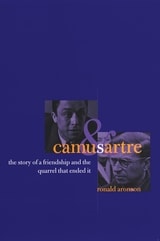
Camus and Sartre
The Story of a Friendship and the Quarrel that Ended ItRonald Aronson
University of Chicago Press, 2003
Albert Camus and Jean-Paul Sartre first met in 1943, during the German occupation of France. The two became fast friends. Intellectual as well as political allies, they grew famous overnight after Paris was liberated. As playwrights, novelists, philosophers, journalists, and editors, the two seemed to be everywhere and in command of every medium in post-war France. East-West tensions would put a strain on their friendship, however, as they evolved in opposing directions and began to disagree over philosophy, the responsibilities of intellectuals, and what sorts of political changes were necessary or possible.
As Camus, then Sartre adopted the mantle of public spokesperson for his side, a historic showdown seemed inevitable. Sartre embraced violence as a path to change and Camus sharply opposed it, leading to a bitter and very public falling out in 1952. They never spoke again, although they continued to disagree, in code, until Camus's death in 1960.
In a remarkably nuanced and balanced account, Aronson chronicles this riveting story while demonstrating how Camus and Sartre developed first in connection with and then against each other, each keeping the other in his sights long after their break. Combining biography and intellectual history, philosophical and political passion, Camus and Sartre will fascinate anyone interested in these great writers or the world-historical issues that tore them apart.
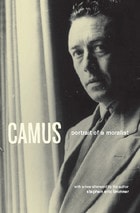
Camus
Portrait of a MoralistStephen Eric Bronner
University of Chicago Press, 2009
Decades after his death, Albert Camus (1913–1960) is still regarded as one of the most influential and fascinating intellectuals of the twentieth century. This biography by Stephen Eric Bronner explores the connections between his literary work, his philosophical writings, and his politics.
Camus illuminates his impoverished childhood, his existential concerns, his activities in the antifascist resistance, and the controversies in which he was engaged. Beautifully written and incisively argued, this study offers new insights—and above all—highlights the contemporary relevance of an extraordinary man.
“A model of a kind of intelligent writing that should be in greater supply. Bronner manages judiciously to combine an appreciation for the strengths of Camus and nonrancorous criticism of his weaknesses. . . . As a personal and opinionated book, it invites the reader into an engaging and informative dialogue.”—American Political Science Review
“This concise, lively, and remarkably evenhanded treatment of the life and work of Albert Camus weaves together biography, philosophical analysis, and political commentary.”—Science & Society

Cinephilia and the Adventure for Existential Health
Recomposing Subjectivity at the CinemaAdam Szymanski
Northwestern University Press, 2025
Exploring how art cinema cultivates existential health through the films of Olivier Assayas
This book proposes that cinephilia can facilitate existential health, which makes palpable the potential for subjectivity to be recomposed through meaningful encounters with cinema. Adam Szymanskidraws on the ethos of psychoanalyst Félix Guattari and thinks with select films from director Olivier Assayas—including Clouds of Sils Maria and Personal Shopper—to theorize how the cinema can be invested with therapeutic value. Cinephilia and the Adventure for Existential Health engages the history of psychoanalytic film theory, excavates its long-standing concern with the production of spectatorial subjectivity, and challenges pathologizing understandings of cinema spectatorship couched in identification, fetishism, and voyeurism. By embracing the indeterminacy of the cinematic experience and the adventurous disposition of cinephilia, the book allies itself to the pursuit of collective health and challenges the logic of medical power.

Cognition and Work
A Study concerning the Value and Limits of the Pragmatic Motifs in the Cognition of the WorldMax Scheler; Translated from the German by Zachary Davis
Northwestern University Press, 2021
Max Scheler’s Cognition and Work (Erkenntnis und Arbeit) first appeared in German in 1926, just two years before his death. The first part of the book offers one of the earliest critical analyses of American pragmatism, an analysis that would come to have a significant impact on the reception of pragmatism in Germany and western Europe. The second part of the work contains Scheler’s phenomenological account of perception and the experience of reality, an account that is as original as both Husserl’s and Merleau-Ponty’s phenomenologies of perception. Scheler aims to show that the modern mechanistic view of nature fails to account for the dynamic relation that not only the human being but all living beings have to the environment they inhabit.
Available in English translation for the first time, Cognition and Work pushes the boundaries of phenomenology as it is traditionally understood and offers insight into Scheler’s distinct metaphysics. This book is essential reading for those interested in phenomenology, pragmatism, perception, and living beings in their relation to the natural world.
Crisis of European Sciences and Transcendental Phenomenology
Edmund Husserl
Northwestern University Press, 1970
Husserl provides not only a history of philosophy but a philosophy of history. As he says in Part I, "The genuine spiritual struggles of European humanity as such take the form of struggles between the philosophies, that is, between the skeptical philosophies--or nonphilosophies, which retain the word but not the task—and the actual and still vital philosophies. But the vitality of the latter consists in the fact that they are struggling for their true and genuine meaning and thus for the meaning of a genuine humanity."

Critical Theory to Structuralism
Philosophy, Politics, and the Human SciencesEdited by David Ingram
University of Chicago Press, 2010
From Kant to Kierkegaard, from Hegel to Heidegger, continental philosophers have indelibly shaped the trajectory of Western thought since the eighteenth century. Although much has been written about these monumental thinkers, students and scholars lack a definitive guide to the entire scope of the continental tradition. The most comprehensive reference work to date, this eight-volume History of Continental Philosophy will both encapsulate the subject and reorient our understanding of it. Beginning with an overview of Kant’s philosophy and its initial reception, the History traces the evolution of continental philosophy through major figures as well as movements such as existentialism, phenomenology, hermeneutics, and poststructuralism. The final volume outlines the current state of the field, bringing the work of both historical and modern thinkers to bear on such contemporary topics as feminism, globalization, and the environment. Throughout, the volumes examine important philosophical figures and developments in their historical, political, and cultural contexts.
The first reference of its kind, A History of Continental Philosophy has been written and edited by internationally recognized experts with a commitment to explaining complex thinkers, texts, and movements in rigorous yet jargon-free essays suitable for both undergraduates and seasoned specialists. These volumes also elucidate ongoing debates about the nature of continental and analytic philosophy, surveying the distinctive, sometimes overlapping characteristics and approaches of each tradition. Featuring helpful overviews of major topics and plotting road maps to their underlying contexts, A History of Continental Philosophy is destined to be the resource of first and last resort for students and scholars alike.